
Spotted a bird? Identify it instantly with the Birdby app
Open the appAbout
The Lesser Black-backed Gull is a medium-sized gull, closely related to the Herring Gull, but distinguished by its darker mantle and yellow legs. It is a migratory species, breeding across Northern Europe and wintering along the coasts of Western Europe, Africa, and occasionally the Americas. Known for its opportunistic feeding habits, it thrives in various coastal and inland environments.
Size & lifespan
- Length
- 50-64 cm (20-25 in)
- Wingspan
- 125-150 cm (49-59 in)
- Weight
- 690-1300 g (1.5-2.9 lbs)
- Lifespan
- Up to 25 years in the wild
- Diet
- Omnivore (fish, invertebrates, carrion, refuse, eggs, chicks, small mammals, berries)
Physical characteristics
- Plumage
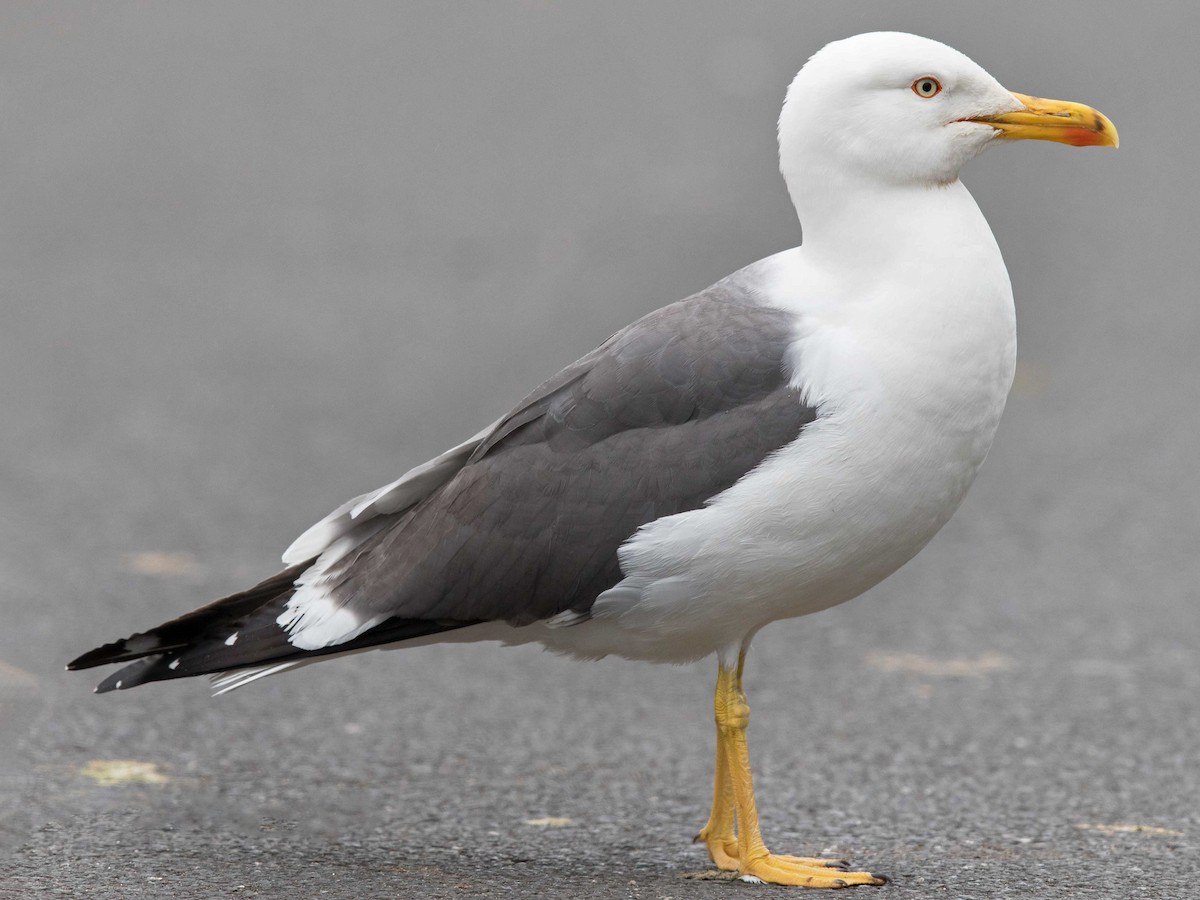
- Adults have a dark grey to black mantle and wings, contrasting with white underparts and tail. The wingtips are black with prominent white 'mirrors'. Head, neck, and underparts are pure white in breeding plumage, becoming streaked with grey-brown on the head and neck in non-breeding plumage.
- Beak shape
- Strong, slightly hooked yellow bill with a prominent red spot on the lower mandible.
- Eye color
- Yellow iris with a red orbital ring.
- Leg color
- Bright yellow.
- Distinguishing features
- Dark mantle (darker than Herring Gull, paler than Great Black-backed Gull), yellow legs, and a red spot on the bill. The extent of darkness on the mantle varies geographically among subspecies.
- Juvenile appearance
- First-winter birds are mottled brown with a dark bill and pinkish-grey legs. They gradually acquire adult plumage over 3-4 years, with the mantle darkening and legs turning yellow. Second-winter birds show a darker, more uniform brown mantle and often a paler bill base. Third-winter birds are largely adult-like but may retain some brown in the wings or tail.
- Seasonal changes
- Breeding adults have a clean white head and neck. Non-breeding adults develop fine grey-brown streaking on the head and nape, particularly around the eye and hindneck.
- Sexual dimorphism
- Males are typically slightly larger than females, but plumage is identical.
How to identify
- 1
Mantle Color
Observe the color of the back and upperwings. It should be a distinct dark grey to black, darker than Herring Gull but not as deep black as Great Black-backed Gull. Note that subspecies vary in mantle shade.
- 2
Leg Color
Look for bright yellow legs. This is a crucial field mark distinguishing it from pink-legged Herring and Great Black-backed Gulls.
- 3
Bill Color and Markings
Note the yellow bill with a prominent red spot on the lower mandible near the tip. The bill is typically less massive than that of a Great Black-backed Gull.
- 4
Size
Assess its size relative to other gulls. It's a medium-large gull, smaller than Great Black-backed Gull but larger than Common Gull.
- 5
Primary Pattern
In flight, observe the black wingtips with distinct white 'mirrors' (spots) on the outer primaries. The extent and shape of these mirrors can be useful for subspecies identification.
- 6
Juvenile Plumage
Young birds are mottled brown. Look for the gradual darkening of the mantle and the change from dark bill/pinkish legs to yellow bill/yellow legs over several years.
Habitat & range
- Biomes
- Coastal areas, estuaries, wetlands, agricultural land, urban environments, open sea.
- Geographic range
- Breeds in Northern Europe (from Iceland and the UK eastward to Russia) and winters along the coasts of Western Europe, the Mediterranean, Africa (especially West Africa), and occasionally the eastern seaboard of North America and South America.
- Elevation range
- Primarily sea level to low altitudes, rarely found at higher elevations.
- Preferred environments
- Coastal cliffs, islands, dunes, saltmarshes, estuaries, reservoirs, lakes, and increasingly urban rooftops and landfill sites for breeding and foraging.
Behavior
- Activity time
- Diurnal, though may forage at night under artificial light or moonlight, especially in urban areas or at landfills.
- Feeding habits
- Highly opportunistic and omnivorous. Feeds on fish, marine invertebrates (crabs, molluscs), insects, earthworms, carrion, refuse from landfills, eggs and chicks of other birds, small rodents, and berries. Often scavenges, follows fishing boats, and forages in agricultural fields.
- Social behavior
- Highly colonial, especially during breeding season, forming large colonies on coasts and islands. Outside breeding, often gathers in large flocks at roosts, feeding sites (e.g., landfills), and during migration.
- Flight pattern
- Strong, direct flight with powerful wingbeats. Glides on stiff wings. Often soars on thermals. Agile in the air, especially when foraging.
- Migration pattern
- A strong migratory species. Northern populations migrate south for the winter, with many individuals from Northern Europe traveling to the coasts of Western Europe and Africa. Some populations, particularly in the UK, are becoming increasingly resident or undertaking shorter migrations.
- Territoriality
- Highly territorial during the breeding season, defending nesting sites aggressively against conspecifics and predators.
Song & calls
- Song
- Does not have a true song. Vocalizations are primarily calls.
- Call
- A variety of loud, raucous calls. Common calls include a deep, guttural 'ga-ga-ga' or 'kyow-kyow-kyow' series, often given in alarm or territorial display. Also a long, drawn-out 'kyaaaaw' or 'yow-yow-yow' call, similar to Herring Gull but often deeper and more resonant. Alarm calls are sharp 'kek-kek-kek'.
- When they vocalize
- Most vocal during the breeding season, especially around colonies, and when competing for food or defending territory. Also vocal during migration and at roosts.
Breeding & reproduction
- Breeding season
- Typically April to July, with egg-laying peaking in May.
- Nesting habits
- Nests colonially, often in large numbers, on coastal cliffs, islands, dunes, saltmarshes, and increasingly on urban rooftops. The nest is a substantial scrape lined with vegetation (grass, seaweed, twigs) and sometimes refuse.
- Clutch size
- Usually 2-3 eggs, occasionally 1 or 4.
- Egg description
- Typically 2-3 eggs, olive-brown to greenish-blue, heavily blotched and spotted with dark brown or black. Average size is about 68 x 47 mm.
- Incubation period
- 27-32 days, primarily by the female, but both parents participate.
- Fledging period
- Chicks fledge (become capable of flight) at 35-42 days old. They remain dependent on parents for food for several weeks after fledging.
- Parental care
- Both parents share incubation duties and care for the chicks, providing food and protection until they are independent.
Where to find
Coastal Areas
Look along coastlines, estuaries, beaches, and rocky shores, especially during migration and winter.
Urban Environments
Increasingly found in cities, particularly on rooftops for nesting and around food sources like markets and refuse dumps.
Agricultural Land
Often seen foraging in ploughed fields, especially during migration and winter, following tractors for invertebrates.
Inland Water Bodies
Can be found around large lakes, reservoirs, and rivers, particularly during migration or in areas with abundant food.
Landfills/Refuse Dumps
A common and often dominant species at these sites, where they scavenge for food.
Field tips
- Focus on Leg Color. This is often the quickest and most reliable way to distinguish it from Herring Gulls and Great Black-backed Gulls at a distance.
- Compare Mantle Shade. If Herring Gulls are present, compare the mantle color directly. The Lesser Black-backed's mantle will be noticeably darker grey.
- Listen for Calls. Their calls are loud and distinctive, often a deeper, more resonant version of a Herring Gull's call. Learning the vocalizations can aid identification, especially in mixed flocks.
- Observe Behavior. Their opportunistic feeding habits mean they can be found in diverse locations. Look for them scavenging, following boats, or foraging in fields.
- Study Age Classes. Be aware of the different plumages of juvenile and immature birds, as they can look quite different from adults. Focus on the developing mantle color and leg/bill color changes.
Similar species
Herring Gull
Larus argentatus
The Herring Gull has a paler grey mantle (less dark than Lesser Black-backed Gull) and pink legs (Lesser Black-backed has yellow legs). The red spot on the bill is present in both, but the overall mantle color and leg color are key distinctions.
Great Black-backed Gull
Larus marinus
The Great Black-backed Gull is significantly larger and bulkier, with a much darker, almost black, mantle (darker than Lesser Black-backed Gull). It also has pink legs, not yellow. Its bill is heavier and more robust.
Yellow-legged Gull
Larus michahellis
The Yellow-legged Gull has a slightly paler grey mantle than most Lesser Black-backed Gulls (especially the nominate fuscus subspecies) and typically has brighter yellow legs. Its eye is often darker, and the red orbital ring is less prominent. The primary pattern can also differ subtly, with more extensive white on the wingtips.
Quick facts
- Key ID Feature:
- Dark grey/black mantle and yellow legs
- Diet:
- Highly opportunistic omnivore
- Migration:
- Strongly migratory, especially northern populations
- Nesting:
- Colonial, on coasts, islands, and urban rooftops
- Conservation:
- Least Concern (IUCN)
Fun facts
- The Lesser Black-backed Gull has several recognized subspecies, which vary in the darkness of their mantle. The nominate subspecies, Larus fuscus fuscus (Baltic Gull), has a very dark, almost black mantle, while Larus fuscus graellsii (British Lesser Black-backed Gull) has a paler, dark grey mantle.
- This species has shown a remarkable adaptability to urban environments, with many populations now nesting on city rooftops, a behavior that provides protection from ground predators and access to abundant food sources from human waste.
- Lesser Black-backed Gulls are known for their long-distance migrations, with some individuals traveling thousands of kilometers from their northern breeding grounds to wintering areas in Africa.
- They are often seen in mixed flocks with Herring Gulls, making direct comparison of mantle and leg color an excellent identification technique.
Scientific classification
- Kingdom
- Animalia
- Phylum
- Chordata
- Class
- Aves
- Order
- Charadriiformes
- Family
- Laridae
- Genus
- Larus
- Species
- Larus fuscus
Explore the Lesser Black-backed Gull
Identify birds anywhere
Free on iOS, Android, and Web. Photo & sound identification, full species database, and your personal life list.