
Spotted a bird? Identify it instantly with the Birdby app
Open the appAbout
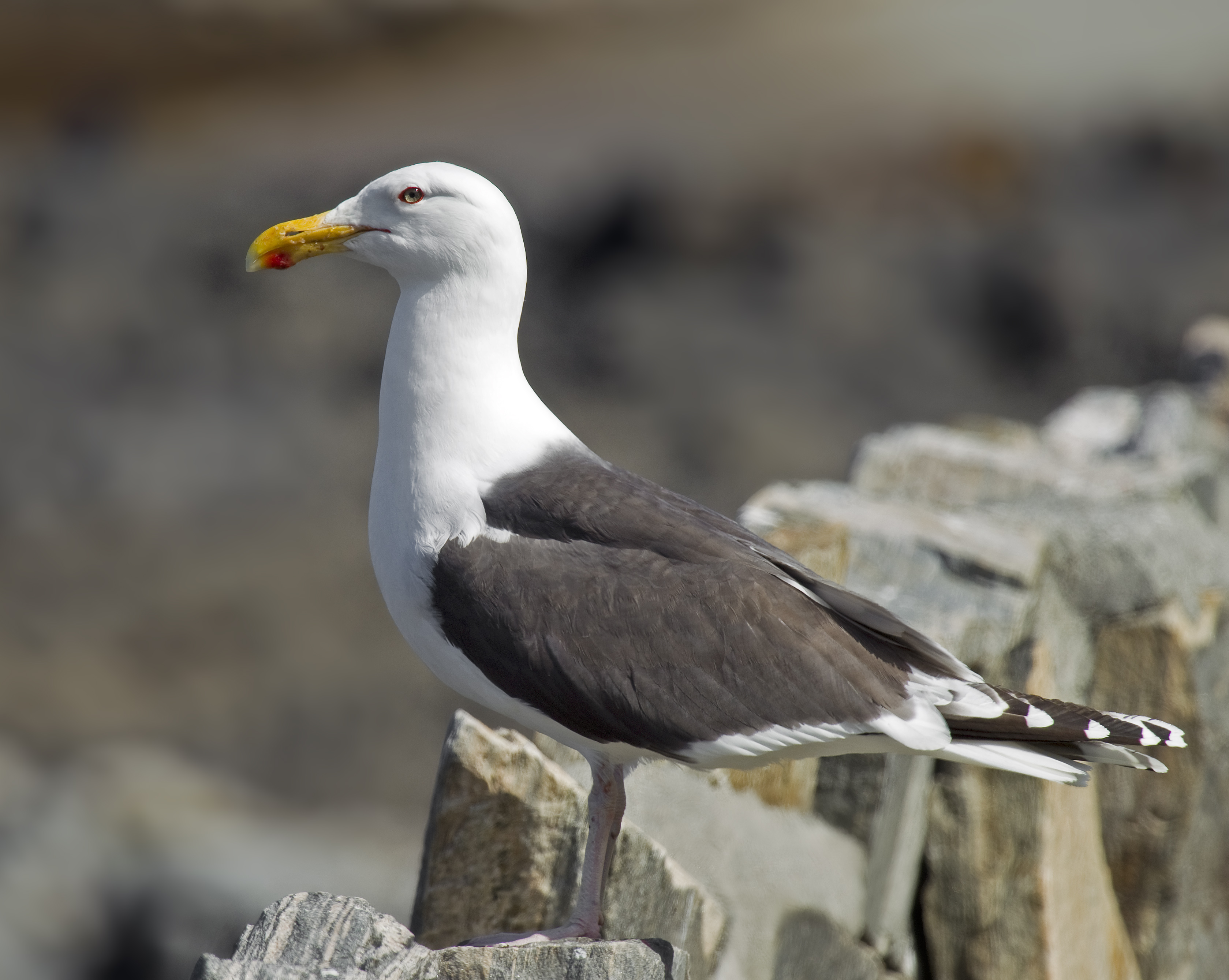
The Great Black-backed Gull is the largest gull species in the world, a formidable predator and opportunistic scavenger of coastal and marine environments. Known for its dark mantle, robust bill, and commanding presence, it is a dominant avian scavenger and predator across its range.
Size & lifespan
- Length
- 64-79 cm (25-31 in)
- Wingspan
- 150-170 cm (59-67 in)
- Weight
- 1.3-2.3 kg (2.9-5.1 lb), with some individuals reaching up to 2.5 kg (5.5 lb)
- Lifespan
- Typically 15-20 years in the wild, with maximum recorded age over 27 years.
- Diet
- Highly omnivorous and opportunistic. Includes fish, crustaceans, mollusks, eggs and chicks of other birds (including other gull species), small mammals (e.g., rats, rabbits), carrion, offal, insects, berries, and human refuse.
Physical characteristics
- Plumage
- Adults have a dark slate-grey to black mantle and back, contrasting sharply with pure white underparts. The head, neck, and tail are also white. The primary wing feathers are black with white tips. Juveniles are mottled brown and buff, gradually acquiring adult plumage over several years.
- Beak shape
- Large, heavy, and yellowish-orange bill with a prominent red spot on the gonys (lower mandible). Juveniles have a dark bill that lightens with age.
- Eye color
- Pale yellow, surrounded by a reddish orbital ring.
- Leg color
- Pinkish.
- Distinguishing features
- Its immense size, very dark mantle, and powerful bill are key distinguishing features. The dark back is significantly darker than that of Herring Gulls or Lesser Black-backed Gulls.
- Juvenile appearance
- First-year birds are mottled dark brown and grey-brown overall, with pale bases to the primaries forming a 'wing window' in flight. The bill is entirely dark. Over the next few years (second-winter, third-winter), plumage becomes progressively less mottled, with areas of white appearing, and the mantle starts to darken. Full adult plumage is typically attained in the fourth or fifth year.
- Seasonal changes
- Adult breeding plumage is pristine white on the head and underparts with a dark mantle. In non-breeding plumage (winter), faint streaking may appear on the head and neck, but it is much less pronounced than in many other gull species.
- Sexual dimorphism
- Males are generally slightly larger and heavier than females, but plumage is identical.
How to identify
- 1
Size
It is the largest gull species, noticeably larger and bulkier than any other gull in its range. This alone is often the best initial identification clue.
- 2
Mantle Color
The deep slate-grey to black color of its back and upperwings (the 'mantle') is distinctive and much darker than other large gulls, forming a strong contrast with its white head and underparts.
- 3
Bill
A very large, powerful, yellowish bill with a prominent red spot on the lower mandible is characteristic.
- 4
Leg Color
Adults have pinkish legs, which distinguish them from Lesser Black-backed Gulls (yellow legs).
- 5
Juvenile Plumage
Juveniles are heavily mottled brown but possess a very powerful bill and a large overall size. Look for the pale 'wing window' at the base of the primaries in flight.
- 6
Voice
Its deep, guttural calls and powerful 'laughing' vocalizations are lower pitched than those of smaller gulls.
Habitat & range
- Biomes
- Coastal marine, estuaries, large lakes, agricultural land, urban areas near coastlines.
- Geographic range
- Breeds across the North Atlantic coasts of Europe and North America, from northern France, the British Isles, and Scandinavia, eastward to northwest Russia, and westward to Greenland, Iceland, and northeastern North America (from Newfoundland south to North Carolina). Winters primarily within its breeding range, but some southern movements occur.
- Elevation range
- Primarily sea level to low elevations along coastlines; rarely observed far inland or at significant altitudes.
- Preferred environments
- Rocky coastlines, sandy beaches, estuaries, harbors, offshore islands, fish docks, refuse tips, and increasingly, agricultural fields and urban environments near the coast.
Behavior
- Activity time
- Diurnal, primarily active during daylight hours for foraging, though will feed at night if food is available (e.g., under artificial lights at harbors).
- Feeding habits
- Highly predatory. Hunts live prey including fish, crabs, seabird chicks (e.g., puffins, terns, eider ducklings), and small mammals. Also a significant scavenger, frequently feeding on carrion, offal from fishing vessels, and refuse. Known for kleptoparasitism (stealing food from other birds) and egg predation.
- Social behavior
- Usually solitary or in small groups when foraging, but can gather in large flocks at abundant food sources (e.g., refuse dumps, fishing boats, seabird colonies during breeding). Nests colonially or semi-colonially.
- Flight pattern
- Powerful, deliberate wing beats. Can soar effortlessly on air currents. Often flies relatively low over water when foraging, or high when commuting between feeding and nesting sites.
- Migration pattern
- Generally a partial migrant. Many northern populations move south for the winter, while southern populations remain resident year-round. Young birds disperse widely. Migration routes are typically coastal.
- Territoriality
- Highly territorial during the breeding season, defending nesting sites and immediate surroundings fiercely against conspecifics and other bird species. Outside the breeding season, territoriality reduces, especially at communal feeding sites.
Song & calls
- Song
- Generally not considered to have a 'song'. Vocalizations are primarily calls.
- Call
- A deep, powerful 'laughing' call, lower pitched than smaller gulls. Also emits a series of guttural 'ga-ga-ga' calls, a harsh 'kyow-kyow' alarm call, and various growls and mews. The 'long call' is a deep, resonant 'ow-ow-ow-OW-OW-OW-AH-AH-AH' that rises and falls in pitch.
- When they vocalize
- Most vocal during the breeding season to defend territories and communicate with mates and chicks. Also vocal when competing for food or during aggressive encounters.
Breeding & reproduction
- Breeding season
- Typically April to August, with egg-laying usually in May.
- Nesting habits
- Nests on coastal cliffs, offshore islands, rocky outcrops, dunes, and sometimes on buildings or flat roofs in urban areas. The nest is a bulky structure made of seaweed, grass, sticks, and other debris, often lined with finer materials. Built by both parents.
- Clutch size
- Usually 2-3 eggs, rarely 1 or 4.
- Egg description
- 2-3 eggs, olive to brownish-buff, heavily spotted and blotched with dark brown or black. Average size approximately 7.5 x 5.0 cm.
- Incubation period
- 27-29 days, primarily by the female, but male also assists.
- Fledging period
- Chicks fledge (become capable of flight) after approximately 49-56 days, but remain dependent on parents for several weeks thereafter.
- Parental care
- Both parents participate in incubation, brooding, and feeding of the young. Parents are highly protective of their nest and chicks.
Where to find
Coastal Areas
Look along rocky shores, beaches, cliffs, and estuaries. They are common in harbors, fishing ports, and fish processing plants where food is readily available.
Offshore Islands
Often found nesting on remote, undisturbed offshore islands, particularly those with seabird colonies, which provide a reliable food source.
Refuse Dumps
Known to frequent landfills and refuse sites, especially those near coastal regions, for scavenging opportunities.
Agricultural Fields
Increasingly observed inland in agricultural areas, particularly during plowing or harvesting, where they can feed on invertebrates and small rodents.
Field tips
- Scan for Large Size. When observing gulls, seek out the largest individual. Its sheer size often stands out immediately.
- Observe Mantle Coloration. Even from a distance, the deep, dark mantle against the white head and underparts is a strong indicator.
- Look at Bill Structure. Use binoculars to carefully examine the bill. Its robust nature and the red spot are key adult features.
- Listen for Calls. Become familiar with its deep, powerful calls, which differ from the higher-pitched calls of other gulls.
- Check Leg Color. If close enough, confirm the pinkish leg color to rule out Lesser Black-backed Gull.
Similar species
Lesser Black-backed Gull
Larus fuscus
The Great Black-backed Gull is significantly larger and heavier. Its mantle is darker (slate-black vs. dark grey/black in Lesser Black-backed), and its legs are pink (vs. yellow in Lesser Black-backed). The bill of the Great Black-backed is also proportionally heavier and more robust.
Herring Gull
Larus argentatus
The Great Black-backed Gull is much larger with a much darker mantle (slate-black vs. pale grey in Herring Gull). Its bill is also heavier and the eye is paler yellow. Juvenile Herring Gulls are browner overall, lacking the stark, almost black elements of juvenile Great Black-backed Gulls.
Quick facts
- Largest Gull:
- The Great Black-backed Gull holds the record as the largest gull species in the world.
- Predatory Nature:
- Known as a highly effective predator, capable of preying on a wide range of vertebrates, including other seabirds.
- Longevity:
- Can live for over two decades in the wild.
- Opportunistic Feeder:
- Adapts readily to various food sources, from live prey to carrion and human waste, showcasing its ecological flexibility.
Fun facts
- These gulls are often observed 'dunking' their prey in water to soften it or wash it before consumption.
- They are known to swallow large items whole, including substantial fish and even whole puffins.
- Their aggressive and dominant behavior often earns them the nickname 'tyrant of the coast'.
- During colonial nesting, individuals often position their nests at the periphery, providing a 'buffer' against predators for other species.
Scientific classification
- Kingdom
- Animalia
- Phylum
- Chordata
- Class
- Aves
- Order
- Charadriiformes
- Family
- Laridae
- Genus
- Larus
- Species
- Larus marinus
Explore the Great Black-backed Gull
Identify birds anywhere
Free on iOS, Android, and Web. Photo & sound identification, full species database, and your personal life list.