
Spotted a bird? Identify it instantly with the Birdby app
Open the appAbout
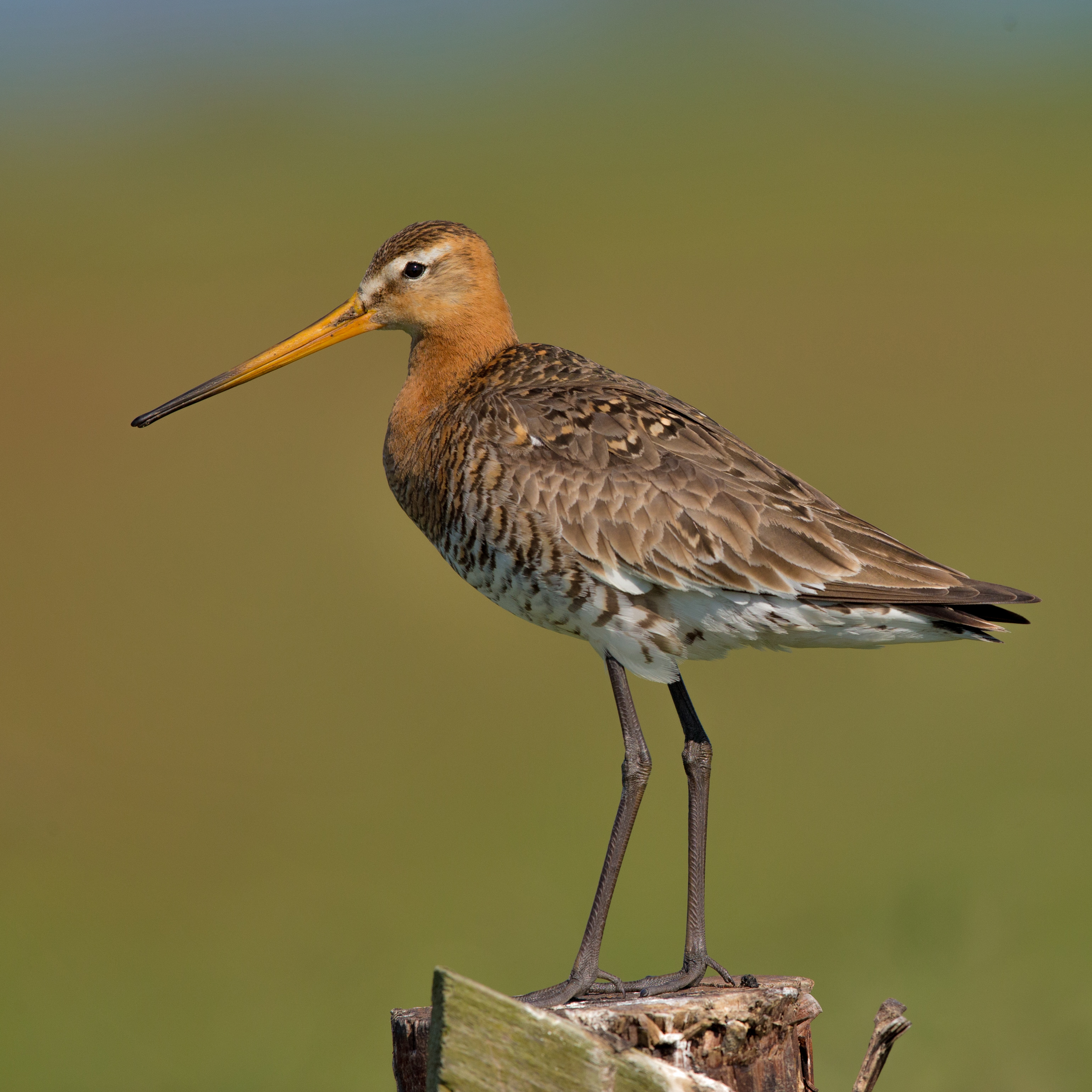
The Black-tailed Godwit is a large, long-legged, and long-billed wading bird, known for its striking breeding plumage and distinctive black tail with a white base in flight. It is a highly migratory species, breeding in temperate Eurasia and wintering in Africa, southern Asia, and Australia. It is a characteristic bird of wet grasslands and shallow wetlands.
Size & lifespan
- Length
- 36-44 cm (14-17 in)
- Wingspan
- 62-82 cm (24-32 in)
- Weight
- 160-500 g (5.6-17.6 oz)
- Lifespan
- Up to 15-20 years in the wild
- Diet
- Omnivore (primarily invertebrates)
Physical characteristics
- Plumage
- Breeding adults have a rich rufous-chestnut head, neck, and breast, fading to barred flanks and a white belly. The back is mottled brown. In flight, a broad white wing-bar and a distinctive black tail with a white base are prominent. Non-breeding plumage is duller, mostly grey-brown above and whitish below. Juveniles resemble non-breeding adults but have a buff wash on the breast and flanks.
- Beak shape
- Long, straight, or slightly upturned bill, pinkish at the base and dark towards the tip.
- Eye color
- Dark brown
- Leg color
- Long, dark grey to blackish legs, trailing well beyond the tail in flight.
- Distinguishing features
- Long legs and bill, broad white wing-bar, and black tail with white base in flight. The rufous breeding plumage is also a key feature.
- Juvenile appearance
- Juveniles are similar to non-breeding adults but have a buffy wash on the head, neck, and breast, and often have more distinct scaling on the upperparts.
- Seasonal changes
- Dramatic change from dull grey-brown non-breeding plumage to vibrant rufous-chestnut breeding plumage. The white wing-bar and black tail are consistent in all plumages.
- Sexual dimorphism
- Males in breeding plumage are typically brighter and more extensively rufous than females, especially on the head and breast. Females are often slightly larger and heavier.
How to identify
- 1
Size and Shape
Look for a large, elegant wader with very long legs and a very long, straight or slightly upturned bill.
- 2
Flight Pattern
Observe its strong, direct flight. Crucially, look for the broad white wing-bar and the striking black tail with a white base, which are diagnostic in flight.
- 3
Breeding Plumage
In spring and summer, identify the rich rufous-chestnut on the head, neck, and breast, contrasting with the mottled brown back and barred flanks.
- 4
Non-breeding Plumage
In autumn and winter, look for a plainer grey-brown upperparts and whitish underparts, but still note the long bill and legs, and the flight pattern.
- 5
Vocalizations
Listen for its distinctive 'grutto' call or the bubbling display song during the breeding season.
- 6
Feeding Behavior
Watch for its characteristic deep probing in soft mud or shallow water with its long bill.
Habitat & range
- Biomes
- Wetlands, grasslands, marshes, estuaries, floodplains, agricultural fields (especially wet meadows and rice paddies).
- Geographic range
- Breeds across temperate Eurasia from Iceland and Western Europe to Central Asia and Siberia. Winters in Western and Southern Europe, Africa (especially sub-Saharan), the Middle East, India, Southeast Asia, and Australia.
- Elevation range
- Primarily lowlands, typically below 500 meters, but can be found at higher altitudes during migration.
- Preferred environments
- Shallow freshwater wetlands, wet grasslands, sedge meadows, floodplains for breeding. Estuaries, coastal lagoons, mudflats, and rice fields for wintering and migration.
Behavior
- Activity time
- Diurnal, but can feed at night during migration or on tidal flats.
- Feeding habits
- Probes soft mud and shallow water with its long bill to find invertebrates such as insect larvae, worms, molluscs, and crustaceans. Also consumes some plant material, especially seeds and roots, particularly in winter.
- Social behavior
- Highly gregarious, especially outside the breeding season, forming large flocks on migration and in wintering grounds. Breeds in loose colonies or scattered pairs.
- Flight pattern
- Strong, direct flight with powerful, shallow wingbeats. Often flies in V-formations or long lines during migration. In display flight, males perform aerial acrobatics with deep wingbeats and calls.
- Migration pattern
- Long-distance migrant. Northern populations migrate south to Africa and southern Asia, while western European populations may winter closer to their breeding grounds or move to southern Europe/North Africa. Migration occurs in broad fronts, often with stopovers at key wetland sites.
- Territoriality
- Males establish small breeding territories, which they defend with calls and display flights. Outside the breeding season, they are not territorial.
Song & calls
- Song
- During breeding season, males perform an aerial display song, a rhythmic, bubbling 'gra-ka-ka-ka-ka' or 'grutto-grutto-grutto', often given during undulating flight.
- Call
- Common calls include a sharp 'wicka-wicka-wicka' or 'kew-kew-kew' in alarm or during flight. A distinctive 'grutto' call is also frequently heard.
- When they vocalize
- Most vocal during the breeding season, both on the ground and in flight. Calls are also given during migration and on wintering grounds, especially when disturbed.
Breeding & reproduction
- Breeding season
- April to July, varying geographically.
- Nesting habits
- Nests are shallow scrapes on the ground, typically in dense vegetation in wet grasslands or meadows, often near water. Lined with grass, sedges, and other plant material.
- Clutch size
- Usually 4 eggs.
- Egg description
- Typically 4 eggs, olive-brown to dark olive-green, sometimes with darker spots or blotches. Pyriform (pear-shaped).
- Incubation period
- 22-24 days, primarily by the female, but both parents participate.
- Fledging period
- 25-30 days. Chicks are precocial and leave the nest shortly after hatching, feeding themselves under parental supervision.
- Parental care
- Both parents share incubation duties and care for the chicks. Chicks are led to feeding areas and protected from predators until fledging.
Where to find
Wet Grasslands
Prime breeding habitat in temperate Eurasia, especially traditional hay meadows and floodplains.
Estuaries and Mudflats
Key wintering and migratory stopover sites, particularly along coastlines and large river deltas.
Rice Paddies
Important wintering habitat in parts of Asia, where they feed in flooded fields.
Shallow Freshwater Wetlands
Used for both breeding and migration, including marshes, fens, and flooded fields.
Field tips
- Scan open wetlands. Black-tailed Godwits prefer open, shallow water or wet ground where they can easily probe for food. Use a scope or binoculars to scan large areas.
- Look for flocks. Outside the breeding season, they are highly gregarious. Look for large, often noisy, flocks feeding together or resting on mudflats.
- Observe flight. The flight pattern and especially the wing and tail markings are crucial for identification. Watch birds taking off or flying overhead.
- Listen for calls. Their distinctive calls, particularly the 'grutto' or 'wicka-wicka', can often alert you to their presence before you see them.
- Visit during migration. Spring and autumn migration periods offer excellent opportunities to see large numbers of godwits at stopover sites.
Similar species
Bar-tailed Godwit
Limosa lapponica
The Bar-tailed Godwit lacks the prominent white wing-bar and has a finely barred tail (not black with a white base). Its bill is typically more upturned. Breeding plumage is more uniformly rufous, extending further down the belly, and lacks the distinct barring on the flanks. In flight, the Bar-tailed Godwit shows a plain back and rump, contrasting with the Black-tailed Godwit's white rump and black tail.
Common Redshank
Tringa totanus
The Common Redshank is smaller, has bright red legs and a red-based bill. Its white wing-bar is narrower, and its tail is white with fine barring, not solid black. Its call is a distinctive 'teu-hu-hu'.
Greenshank
Tringa nebularia
The Greenshank is slightly smaller, has greenish-grey legs, and a distinctly upturned bill. It lacks the prominent white wing-bar and black tail of the Black-tailed Godwit. Its plumage is generally paler grey.
Quick facts
- Bill Length:
- 9-12 cm (3.5-4.7 in)
- Migration Distance:
- Up to 10,000 km (6,200 miles) annually
- Subspecies:
- 3 recognized: L. l. limosa (Western European), L. l. islandica (Icelandic), L. l. melanuroides (Eastern Asian)
- Ecological Role:
- Important consumer of invertebrates in wetland ecosystems, indicator species for wetland health.
Fun facts
- The Icelandic subspecies (L. l. islandica) is known for its particularly vibrant rufous breeding plumage.
- Black-tailed Godwits are capable of extremely long non-stop flights during migration, fueled by significant fat reserves.
- The Dutch name 'Grutto' is onomatopoeic, derived from its characteristic call.
- Conservation efforts for the Black-tailed Godwit often focus on protecting and restoring wet grassland habitats, which are under threat from agricultural intensification.
Scientific classification
- Kingdom
- Animalia
- Phylum
- Chordata
- Class
- Aves
- Order
- Charadriiformes
- Family
- Scolopacidae
- Genus
- Limosa
- Species
- Limosa limosa
Explore the Black-tailed Godwit
Identify birds anywhere
Free on iOS, Android, and Web. Photo & sound identification, full species database, and your personal life list.