
Spotted a bird? Identify it instantly with the Birdby app
Open the appAbout
The Society Finch, also known as the Bengalese Finch, is a domesticated species of estrildid finch, not found in the wild. Its exact wild ancestor is unknown, but it is widely believed to be a hybrid of several Lonchura species, most commonly cited as a cross between the Striated Finch (Lonchura striata) and the White-rumped Munia (Lonchura striata domestica, formerly considered a subspecies of L. striata). It is renowned for its docile nature, ease of breeding, and excellent parental skills, often used as a foster parent for other finch species.
Size & lifespan
- Length
- 10-12 cm
- Wingspan
- 15-17 cm
- Weight
- 12-18 g
- Lifespan
- 5-7 years (up to 10 years in captivity)
- Diet
- Granivore (primarily seeds, supplemented with greens and insects)
Physical characteristics
- Plumage
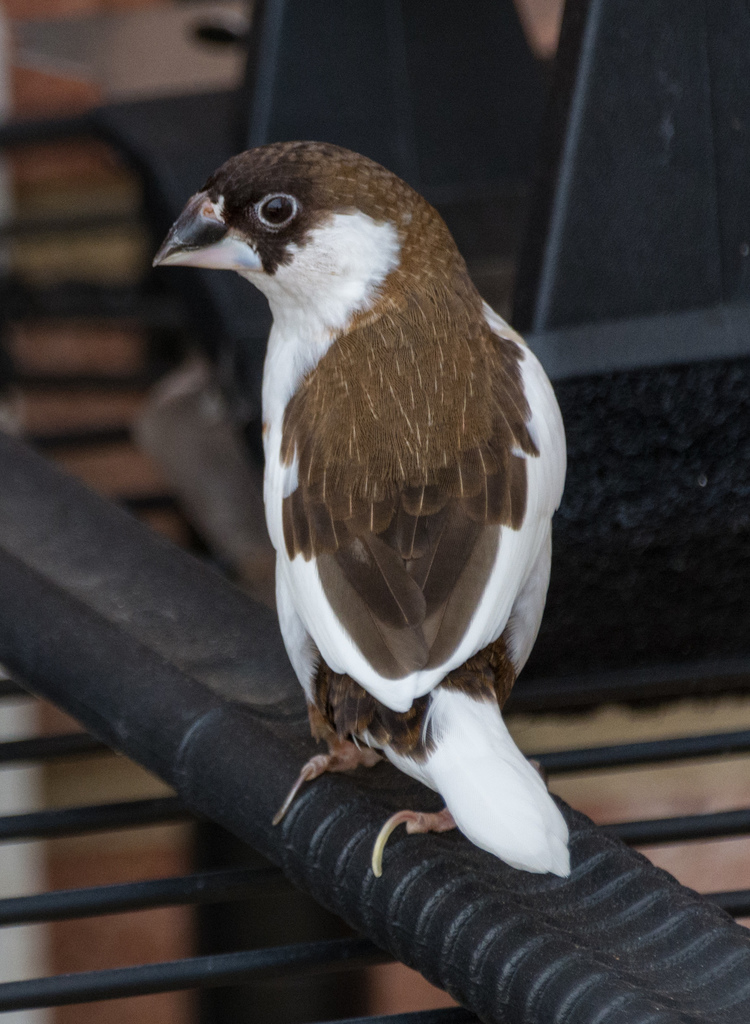
- Highly variable due to selective breeding. Common colorations include chocolate brown, fawn, white, pied (patches of brown/fawn and white), and cream. Patterns can include solid, self, clearwing, crested, and pearl. The underparts are typically lighter than the upperparts, often with fine barring or scaling on the flanks and breast, especially in brown varieties.
- Beak shape
- Conical, short, and stout, adapted for cracking seeds. Color ranges from light horn to dark grey.
- Eye color
- Dark brown to black
- Leg color
- Pinkish-grey to dark grey
- Distinguishing features
- Its domesticated origin means there is no single 'wild type' appearance. Key features include its small size, conical beak, and the wide array of color mutations. The overall impression is a neat, compact finch.
- Juvenile appearance
- Juveniles generally resemble adults but may have duller plumage, less distinct markings, and a slightly softer, less defined beak. Their calls are also softer and less developed.
- Seasonal changes
- None. As a domesticated species, plumage does not change seasonally for breeding or non-breeding purposes.
- Sexual dimorphism
- None. Males and females are virtually identical in plumage and size. Sexing typically requires observing breeding behavior (males sing more frequently and intensely) or DNA testing.
How to identify
- 1
Domesticated Appearance
Recognize the wide variety of color mutations (brown, white, pied, fawn, crested) not typically seen in wild finch species. This is the primary indicator of a Society Finch.
- 2
Size and Shape
Small, compact finch (approx. 10-12 cm) with a short, conical beak. They have a neat, well-proportioned body.
- 3
Behavior
Observe their highly social nature. They are almost always seen in groups, huddling together, and are generally very docile and non-aggressive, even with other species. Males sing a soft, warbling song.
- 4
Habitat
If encountered, they will always be in a captive setting (aviary, cage, pet store), as they do not exist in the wild.
Habitat & range
- Biomes
- Not applicable as it is a domesticated species. In captivity, they thrive in aviaries and cages.
- Geographic range
- Worldwide in captivity. No natural wild population.
- Elevation range
- Not applicable.
- Preferred environments
- Captive environments such as indoor cages, outdoor aviaries, and bird rooms. They require protection from extreme temperatures and predators.
Behavior
- Activity time
- Diurnal. Active during daylight hours, foraging, preening, and interacting with flock members.
- Feeding habits
- Primarily ground feeders, foraging for small seeds. In captivity, they readily consume commercial finch seed mixes, millet sprays, and small amounts of fresh greens and occasional protein supplements (e.g., egg food, mealworms).
- Social behavior
- Highly social and gregarious. They thrive in groups and are rarely aggressive towards other finches, making them excellent community aviary inhabitants. They often huddle together for warmth and security.
- Flight pattern
- Direct and swift, often in short bursts. Within an aviary, they exhibit agile, darting flights.
- Migration pattern
- Non-migratory. Resident in captive environments.
- Territoriality
- Generally non-territorial, especially within a flock. Males may establish small, temporary territories around a nest site during breeding, but this is usually mild and non-aggressive.
Song & calls
- Song
- The male's song is a soft, warbling, and somewhat rambling series of chirps, trills, and whistles. It is not particularly loud or complex but is pleasant and often delivered with a bobbing head and puffed-up throat feathers.
- Call
- Common calls include soft 'chip' or 'tsip' notes used for contact within the flock, alarm calls that are sharper and more urgent, and begging calls from juveniles.
- When they vocalize
- Males sing throughout the day, especially when courting a female or establishing a nest. Contact calls are constant within a flock.
Breeding & reproduction
- Breeding season
- Year-round in captivity, given suitable conditions (adequate food, warmth, and nesting sites).
- Nesting habits
- They are prolific breeders and will readily use various nesting receptacles, including wicker nests, nest boxes, and even open cups. They build a loose, cup-shaped nest from soft materials like dried grasses, coconut fiber, and shredded paper. Both parents participate in nest building.
- Clutch size
- 4-8 eggs, typically 5-6.
- Egg description
- Small, oval, pure white eggs. Approximately 1.4 cm x 1.1 cm.
- Incubation period
- 13-16 days, shared by both parents.
- Fledging period
- 18-21 days after hatching. Young birds leave the nest but are still fed by parents for another 1-2 weeks.
- Parental care
- Both parents are excellent caregivers, sharing incubation duties and feeding the young. They are well-known for their strong parental instincts, often successfully raising chicks of other finch species.
Where to find
Pet Stores
Widely available in pet stores specializing in birds.
Bird Breeders
Can be purchased directly from finch breeders.
Aviaries and Zoos
Often kept in public and private aviaries due to their social nature and ease of care.
Private Homes
A popular pet bird, found in many homes worldwide.
Field tips
- Observe Social Behavior. Look for groups of small finches huddling or interacting peacefully. Their gregarious nature is a key identifier.
- Listen for Song. Males have a soft, warbling song. While not loud, it's distinctive and often heard in a group setting.
- Note Plumage Variation. Be aware that their appearance can vary greatly. Don't expect a single 'type' of Society Finch. Look for the overall finch shape combined with domesticated color patterns.
Similar species
Striated Finch
Lonchura striata
The Striated Finch is considered a likely ancestor. Wild Striated Finches typically have a more uniform brown plumage with fine streaking on the underparts and a darker, more defined cap. Society Finches exhibit a much wider range of color mutations and patterns due to domestication.
White-rumped Munia
Lonchura striata domestica (formerly L. striata subs. domestica)
This is often considered the direct wild ancestor or a very close relative. Wild White-rumped Munias have a distinct white rump patch, which is often absent or obscured in many Society Finch color mutations. Society Finches are generally more robust and varied in appearance due to selective breeding.
Spice Finch
Lonchura punctulata
Spice Finches (Nutmeg Mannikins) have a distinct scaly pattern on their breast and flanks, and typically a darker brown head and back with a white belly. While some Society Finch mutations can have barring, the overall pattern and coloration are usually distinct. Spice Finches are also wild species with a more consistent appearance.
Quick facts
- Origin:
- Domesticated (hybrid origin, not found in wild)
- Temperament:
- Docile, social, non-aggressive
- Breeding:
- Prolific, excellent parents
- Diet:
- Seed-eater
- Sexual Dimorphism:
- None
Fun facts
- The Society Finch is unique among common pet birds as it has no known wild counterpart. Its origin is a mystery, though it's widely accepted to be a hybrid.
- They are often used as foster parents for other finch species, including more delicate or difficult-to-breed varieties, due to their exceptional parenting skills.
- Despite their name, they are not true 'societies' in the taxonomic sense, but rather a domesticated form of munia/mannikin.
- Their ability to breed year-round and their docile nature make them one of the most popular finches for beginners in aviculture.
Scientific classification
- Kingdom
- Animalia
- Phylum
- Chordata
- Class
- Aves
- Order
- Passeriformes
- Family
- Estrildidae
- Genus
- Lonchura
- Species
- Lonchura domestica
Explore the Society Finch
Identify birds anywhere
Free on iOS, Android, and Web. Photo & sound identification, full species database, and your personal life list.