
Spotted a bird? Identify it instantly with the Birdby app
Open the appAbout
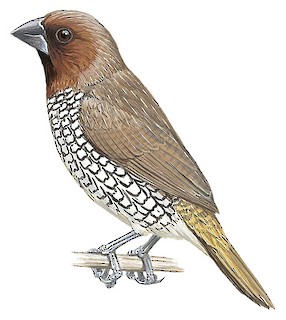
The Scaly-breasted Munia, also known as the Spotted Munia or Nutmeg Mannikin, is a small passerine bird native to tropical Asia. It is characterized by its distinctive scaly pattern on the breast and flanks, a conical bill, and a gregarious nature. This species is often found in open grasslands, agricultural areas, and gardens, feeding primarily on seeds. It has been introduced to many parts of the world and is considered an invasive species in some regions.
Size & lifespan
- Length
- 10-12 cm
- Wingspan
- 13-15 cm
- Weight
- 9-14 g
- Lifespan
- 3-7 years in the wild, up to 10 years in captivity
- Diet
- Granivore
Physical characteristics
- Plumage
- Adults have a chestnut-brown upperparts, a dark brown head, and a white underparts with prominent dark brown, scale-like markings on the breast and flanks. The rump and uppertail coverts are yellowish-brown. The tail is short and pointed, dark brown to blackish. The belly and undertail coverts are white.
- Beak shape
- Short, stout, conical bill, typically dark grey to blackish on the upper mandible and paler grey on the lower mandible.
- Eye color
- Dark brown
- Leg color
- Dark grey to blackish
- Distinguishing features
- The most distinctive feature is the scaly pattern on the breast and flanks. The dark brown head contrasts with the paler upperparts and scaly underparts. The conical bill is adapted for seed eating.
- Juvenile appearance
- Juveniles are duller overall, with plain buffy-brown upperparts and unscaled, plain buffy-white underparts. They lack the distinct scaly pattern of adults and have a paler bill. They gradually acquire adult plumage over several months.
- Seasonal changes
- No significant seasonal plumage changes. Plumage remains consistent throughout the year.
- Sexual dimorphism
- Males and females are monomorphic, meaning they look identical in plumage. Sexing typically requires behavioral observation during breeding or genetic testing.
How to identify
- 1
Plumage Pattern
Look for the distinctive dark brown, scale-like markings on the white breast and flanks. This is the most reliable field mark for adults.
- 2
Head Color
Note the solid dark brown head, which contrasts with the scaly underparts and chestnut-brown back.
- 3
Bill Shape and Color
Observe the short, stout, conical bill, typically dark grey to blackish on top and paler below, adapted for seed eating.
- 4
Social Behavior
Often seen in flocks, especially when foraging in open grassy areas or roosting communally.
- 5
Juvenile Identification
Young birds are plain buffy-brown above and buffy-white below, lacking scales. They are often seen accompanying adults.
Habitat & range
- Biomes
- Grasslands, savannas, shrublands, agricultural lands, urban and suburban gardens, open woodlands.
- Geographic range
- Native to the Indian subcontinent and Southeast Asia, extending from India and Sri Lanka east to Indonesia and the Philippines. Introduced populations exist in many parts of the world, including Hawaii, Florida, Australia, and various Caribbean islands.
- Elevation range
- Typically found from sea level up to 2,000 meters (6,500 feet), occasionally higher in some parts of its range.
- Preferred environments
- Prefers open habitats with tall grasses, reeds, and scattered bushes, especially near water sources. Commonly found in rice paddies, sugarcane fields, and cultivated areas, as well as parks and gardens in urban settings.
Behavior
- Activity time
- Diurnal, active during daylight hours.
- Feeding habits
- Primarily granivorous, feeding on a wide variety of grass seeds, including wild grasses and cultivated grains like rice. They forage on the ground, on seed heads, and sometimes glean insects. They often feed in large flocks.
- Social behavior
- Highly gregarious, usually found in flocks of varying sizes, from a few individuals to hundreds, especially outside the breeding season. They roost communally in dense vegetation.
- Flight pattern
- Flight is typically undulating and direct, with rapid wing beats. They often fly in tight flocks.
- Migration pattern
- Resident throughout its native range, with no significant migratory movements. Local movements may occur in response to food availability.
- Territoriality
- Generally not highly territorial, especially outside the breeding season. During breeding, pairs will defend a small area around their nest, but colony nesting is common.
Song & calls
- Song
- The song is a soft, high-pitched, rambling series of whistles, trills, and chattering notes, often described as a 'cheep-cheep-cheep-cheep-cheep-whistle-whistle-whistle' or a 'sweet-sweet-sweet-squeak'. It is not particularly loud or complex.
- Call
- Common calls include a soft, high-pitched 'chip' or 'tchip' contact call, often given in flight or while foraging. Also a short, sharp 'tsit' or 'psit' alarm call.
- When they vocalize
- Vocalizes throughout the day, especially when foraging in flocks or during breeding displays. Most vocal in the morning and late afternoon.
Breeding & reproduction
- Breeding season
- Varies geographically, often coinciding with the monsoon season or periods of abundant food. In India, typically June-October; in Southeast Asia, often year-round with peaks.
- Nesting habits
- Nests are typically globular or retort-shaped structures made of grass blades, leaves, and other plant material, often lined with finer grasses. They are usually placed in dense bushes, tall grasses, reeds, or sometimes in trees, often in colonies. Both sexes participate in nest building.
- Clutch size
- 4-10 eggs, commonly 5-7.
- Egg description
- Eggs are pure white, oval-shaped, and smooth. Typically measure about 15 x 11 mm.
- Incubation period
- 11-16 days, typically 12-14 days. Both parents incubate.
- Fledging period
- 18-21 days after hatching. Young are fed by both parents.
- Parental care
- Both male and female parents share incubation duties and feed the nestlings. Young are dependent on parents for a short period after fledging.
Where to find
Grasslands and Open Fields
Look in areas with tall grasses, especially near water, where they forage for seeds.
Agricultural Areas
Common in rice paddies, sugarcane fields, and other cultivated lands where grain seeds are abundant.
Gardens and Parks
In urban and suburban areas, they frequent gardens, parks, and scrubland with suitable vegetation.
Bird Feeders
In areas where they are introduced, they may visit bird feeders offering small seeds.
Field tips
- Listen for Calls. Their soft 'chip' calls are often the first indication of their presence, especially when a flock is foraging.
- Observe Flocks. They are rarely solitary. Look for small to large flocks moving through grassy areas or perched on wires and bushes.
- Check Seed Heads. They frequently cling to the stems of tall grasses to extract seeds directly from the seed heads.
- Look in Dense Cover. They often roost communally in dense bushes or reeds, especially at dusk.
Similar species
Black-headed Munia
Lonchura malacca
The Black-headed Munia has a solid black head, throat, and upper breast, contrasting sharply with white underparts and chestnut flanks. It lacks the scaly pattern of the Scaly-breasted Munia. Its bill is typically bicolored, grey and black.
White-rumped Munia
Lonchura striata
The White-rumped Munia has a dark brown head and upperparts, but its underparts are white with fine streaking on the flanks, not scales. Crucially, it has a prominent white rump, which the Scaly-breasted Munia lacks (its rump is yellowish-brown).
Chestnut Munia
Lonchura atricapilla
Similar to the Black-headed Munia, the Chestnut Munia has a black head and throat, but its entire underparts and flanks are rich chestnut, lacking any white or scaly pattern. Its bill is also bicolored.
Quick facts
- Diet:
- Seeds (granivorous)
- Sociality:
- Highly gregarious, forms flocks
- Nesting:
- Globular grass nests, often colonial
- Conservation Status:
- Least Concern
- Introduced Species:
- Yes, in many parts of the world
Fun facts
- The Scaly-breasted Munia is a popular cage bird, which has contributed to its widespread introduction outside its native range.
- In some regions, particularly where introduced, they are considered agricultural pests due to their consumption of cultivated grains.
- They are known to be quite acrobatic when feeding on seed heads, often hanging upside down to reach seeds.
- Despite their small size, they can form very large roosting flocks, sometimes numbering in the thousands.
Scientific classification
- Kingdom
- Animalia
- Phylum
- Chordata
- Class
- Aves
- Order
- Passeriformes
- Family
- Estrildidae
- Genus
- Lonchura
- Species
- Lonchura punctulata
Explore the Scaly-breasted Munia
Identify birds anywhere
Free on iOS, Android, and Web. Photo & sound identification, full species database, and your personal life list.