
How to identify the Scaly-breasted Munia
Lonchura punctulata
Spotted a bird? Identify it instantly with the Birdby app
Open the appTo correctly identify the Scaly-breasted Munia (Lonchura punctulata), check each of these features. Birds can be tricky: habit, habitat, and call often confirm a sighting that a single photo cannot.
Size at a glance
- Length
- 10-12 cm
- Wingspan
- 13-15 cm
- Weight
- 9-14 g
Physical features to check
- 1
Plumage
Overall feather coloration and pattern.
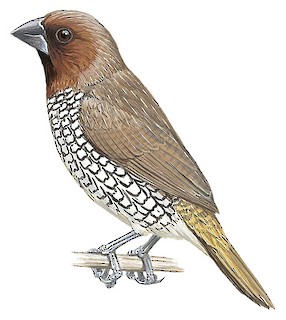
Adults have a chestnut-brown upperparts, a dark brown head, and a white underparts with prominent dark brown, scale-like markings on the breast and flanks. The rump and uppertail coverts are yellowish-brown. The tail is short and pointed, dark brown to blackish. The belly and undertail coverts are white.
- 2
Beak shape
Shape and color of the bill: a key field mark.
Short, stout, conical bill, typically dark grey to blackish on the upper mandible and paler grey on the lower mandible.
- 3
Eye color
Iris color and any distinctive eye markings.
Dark brown
- 4
Leg color
Leg and foot color.
Dark grey to blackish
- 5
Distinguishing features
Standout features that separate this species.
The most distinctive feature is the scaly pattern on the breast and flanks. The dark brown head contrasts with the paler upperparts and scaly underparts. The conical bill is adapted for seed eating.
- 6
Juvenile appearance
How young birds differ from adults.
Juveniles are duller overall, with plain buffy-brown upperparts and unscaled, plain buffy-white underparts. They lack the distinct scaly pattern of adults and have a paler bill. They gradually acquire adult plumage over several months.
- 7
Seasonal changes
Plumage variation between breeding and non-breeding seasons.
No significant seasonal plumage changes. Plumage remains consistent throughout the year.
- 8
Sexual dimorphism
How males and females differ.
Males and females are monomorphic, meaning they look identical in plumage. Sexing typically requires behavioral observation during breeding or genetic testing.
Key field marks
- Plumage Pattern. Look for the distinctive dark brown, scale-like markings on the white breast and flanks. This is the most reliable field mark for adults.
- Head Color. Note the solid dark brown head, which contrasts with the scaly underparts and chestnut-brown back.
- Bill Shape and Color. Observe the short, stout, conical bill, typically dark grey to blackish on top and paler below, adapted for seed eating.
- Social Behavior. Often seen in flocks, especially when foraging in open grassy areas or roosting communally.
- Juvenile Identification. Young birds are plain buffy-brown above and buffy-white below, lacking scales. They are often seen accompanying adults.
Explore the Scaly-breasted Munia
Identify birds anywhere
Free on iOS, Android, and Web. Photo & sound identification, full species database, and your personal life list.