
Spotted a bird? Identify it instantly with the Birdby app
Open the appAbout
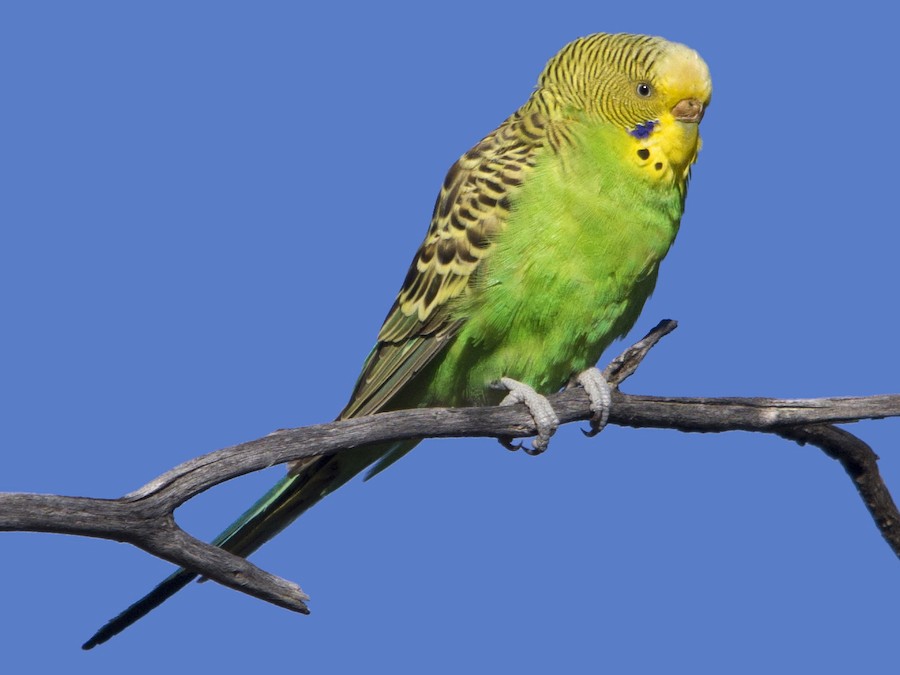
The Budgerigar, often simply called 'budgie', is a small, long-tailed, seed-eating parrot. Native to Australia, it is the only species in the genus Melopsittacus. Wild budgerigars are typically green and yellow with black, scalloped markings on the nape, back, and wings. They are highly social birds, forming large flocks in their natural habitat. They are also one of the most popular pet birds worldwide, bred in a wide variety of color mutations.
Size & lifespan
- Length
- 18-20 cm (7-8 in)
- Wingspan
- 28-32 cm (11-12.5 in)
- Weight
- 26-40 g (0.9-1.4 oz)
- Lifespan
- 3-6 years (wild), 5-10 years (captivity, up to 15+)
- Diet
- Granivore (primarily seeds)
Physical characteristics
- Plumage
- Wild-type Budgerigars have a bright green abdomen and rump, fading to a yellow chest and face. The forehead and crown are yellow, often with fine black barring. The back of the head, nape, and wing coverts are yellow with prominent black scalloped markings. Primary flight feathers are dark blue-green. The tail is dark blue with yellow flashes on the outer feathers. Captive-bred varieties exhibit a vast array of color mutations including blue, white, yellow, grey, violet, and various pied patterns.
- Beak shape
- Small, hooked, and strong beak, adapted for cracking seeds. Color is typically olive-grey to horn-colored in wild birds, but can vary in captive mutations.
- Eye color
- Dark brown with a white iris ring in adults. Juveniles have solid dark eyes.
- Leg color
- Greyish-blue to greyish-pink, zygodactyl feet (two toes forward, two backward).
- Distinguishing features
- The distinctive black scalloped markings on the back and wings, the small size, and the long, pointed tail are key features. The cere (fleshy area above the beak) color is a reliable indicator of sex in adults.
- Juvenile appearance
- Juveniles have duller plumage, less distinct black barring on the head extending closer to the cere, and solid dark eyes without the white iris ring. Their cere is pinkish-purple regardless of sex. The tail is also shorter.
- Seasonal changes
- No significant seasonal changes in plumage. The cere color of females can change with breeding condition, becoming more crusty and brown when ready to breed, and paler or bluish when not.
- Sexual dimorphism
- Adult males typically have a bright blue cere, while adult females have a pale brown, tan, or crusty brown cere (which can turn bluish when not in breeding condition). Juveniles of both sexes have a pinkish-purple cere. In some color mutations (e.g., recessive pied, dark-eyed clear), the cere color may not be a reliable indicator.
How to identify
- 1
Size and Shape
Small, slender parrot with a relatively long, pointed tail. Overall length is about 18-20 cm.
- 2
Plumage Pattern
Look for the bright green lower body, yellow face, and distinctive black scalloped markings on the back of the head, nape, and wings. The dark blue tail with yellow flashes is also characteristic.
- 3
Head Markings
Adults have a yellow forehead and crown, often with fine black barring. Juveniles have barring extending closer to the cere.
- 4
Cere Color (Sexing)
In adults, a bright blue cere indicates a male, while a tan to crusty brown cere indicates a female. Juveniles have a pinkish-purple cere.
- 5
Eye Color
Adults have dark eyes with a white iris ring; juveniles have solid dark eyes.
- 6
Flight
Observe their fast, direct, and undulating flight pattern, often in large, cohesive flocks.
- 7
Vocalizations
Listen for their characteristic chattering, chirping, and warbling calls, especially when in a flock.
Habitat & range
- Biomes
- Arid and semi-arid grasslands, shrublands, open woodlands, and savannas.
- Geographic range
- Endemic to Australia, found throughout the drier inland regions of the continent. Absent from coastal areas of the north, east, and southwest, and from Tasmania.
- Elevation range
- Typically found from sea level up to approximately 1,000 meters (3,300 feet).
- Preferred environments
- Prefers open country with scattered trees and shrubs, particularly areas with access to water sources. They thrive in areas where native grasses provide abundant seeds.
Behavior
- Activity time
- Diurnal. Most active during the cooler parts of the day, foraging in the morning and late afternoon, and resting during the midday heat.
- Feeding habits
- Primarily ground feeders, foraging for seeds of grasses and other herbaceous plants. They use their strong beaks to de-husk seeds efficiently. They also consume some fruits, berries, and occasionally insects. They are highly dependent on water and will travel long distances to find it.
- Social behavior
- Highly gregarious, forming large flocks that can number in the thousands, especially around water sources. They communicate constantly within the flock. They are monogamous during the breeding season.
- Flight pattern
- Fast, direct, and undulating flight, often in tight, synchronized flocks. They are agile flyers, capable of rapid changes in direction.
- Migration pattern
- Nomadic rather than migratory. Their movements are largely dictated by rainfall and the availability of food and water. They will move to areas where recent rains have stimulated grass growth and seed production.
- Territoriality
- Generally not territorial outside of the immediate vicinity of their nest site during breeding. Flocks share foraging and watering grounds peacefully.
Song & calls
- Song
- Wild Budgerigars do not have a complex song. Their vocalizations are primarily chattering, chirping, and warbling calls, often delivered rapidly and continuously, especially when in a flock. They can mimic sounds and speech in captivity.
- Call
- A characteristic 'chirp-chirp' or 'chatter-chatter' call, often described as a pleasant, melodious warble. Alarm calls are sharper and more insistent. Contact calls are used to maintain flock cohesion.
- When they vocalize
- Vocalize frequently throughout the day, particularly when foraging, flying, and interacting within the flock. Quieter during rest periods.
Breeding & reproduction
- Breeding season
- Highly opportunistic, breeding primarily after rainfall, which can occur at any time of year, but most commonly from June to September in the north and August to January in the south of Australia.
- Nesting habits
- Nest in hollows of trees, fence posts, or logs. They do not build a nest structure, but rather lay eggs directly on the wood dust or debris at the bottom of the cavity. They prefer eucalyptus trees.
- Clutch size
- 4-8 eggs, sometimes up to 10.
- Egg description
- Small, white, oval eggs. Typically measure about 1.8 x 1.4 cm (0.7 x 0.55 in).
- Incubation period
- 18-21 days, primarily by the female.
- Fledging period
- Approximately 30-35 days after hatching. Young are fed by both parents.
- Parental care
- Female incubates the eggs and broods the young. The male feeds the female during incubation and helps feed the chicks after hatching. Both parents participate in feeding the fledglings for a period after they leave the nest.
Where to find
Inland Australia
Drier, interior regions of Australia, particularly in Queensland, New South Wales, South Australia, Western Australia, and the Northern Territory.
Waterholes and Rivers
Often found congregating in large numbers around water sources, especially during dry periods.
Grasslands and Open Woodlands
Look in areas with native grasses and scattered trees, where they forage for seeds.
Field tips
- Look for Flocks. Budgerigars are highly social and almost always found in flocks, sometimes numbering in the thousands. Look for large groups flying or feeding together.
- Listen for Calls. Their constant chattering and chirping calls are often heard before they are seen, especially when a large flock is present.
- Visit Water Sources. During dry periods, waterholes and rivers are prime locations to observe large numbers of Budgerigars coming to drink.
- Observe Foraging Behavior. They typically feed on the ground, so scan open grassy areas. Their green plumage can provide camouflage against vegetation.
Similar species
Bourke's Parrot
Neopsephotus bourkii
Bourke's Parrots are slightly larger (19-23 cm), predominantly pinkish-brown with blue on the wings and rump, and lack the prominent black scalloped markings of the Budgerigar. They also have a different head pattern and a less undulating flight.
Scarlet-chested Parrot
Neophema splendida
Scarlet-chested Parrots are similar in size but have a much more vibrant blue head, a bright red chest (males), and green upperparts without the extensive black barring seen on Budgerigars. Their flight is also less undulating.
Quick facts
- Native Range:
- Australia
- Diet:
- Seeds, some fruits and insects
- Sociality:
- Highly gregarious, forms large flocks
- Breeding:
- Opportunistic, after rainfall
- Conservation Status:
- Least Concern
Fun facts
- The name 'Budgerigar' is believed to come from the Gamilaraay Aboriginal language, meaning 'good food' or 'good to eat'.
- Budgerigars are one of the most popular pet birds globally, second only to canaries in some regions. All pet budgies are descended from wild Australian birds.
- They are highly intelligent and can be taught to mimic human speech, with some individuals learning hundreds of words.
- Wild Budgerigars are nomadic, following rainfall to find fresh grass seeds and water, demonstrating remarkable adaptability to their arid environment.
- The color mutations seen in captive budgies (blue, white, yellow, etc.) are the result of selective breeding from the original green and yellow wild type.
Scientific classification
- Kingdom
- Animalia
- Phylum
- Chordata
- Class
- Aves
- Order
- Psittaciformes
- Family
- Psittaculidae
- Genus
- Melopsittacus
- Species
- Melopsittacus undulatus
Explore the Budgerigar
Identify birds anywhere
Free on iOS, Android, and Web. Photo & sound identification, full species database, and your personal life list.