
How to identify the Budgerigar
Melopsittacus undulatus
Spotted a bird? Identify it instantly with the Birdby app
Open the appTo correctly identify the Budgerigar (Melopsittacus undulatus), check each of these features. Birds can be tricky: habit, habitat, and call often confirm a sighting that a single photo cannot.
Size at a glance
- Length
- 18-20 cm (7-8 in)
- Wingspan
- 28-32 cm (11-12.5 in)
- Weight
- 26-40 g (0.9-1.4 oz)
Physical features to check
- 1
Plumage
Overall feather coloration and pattern.
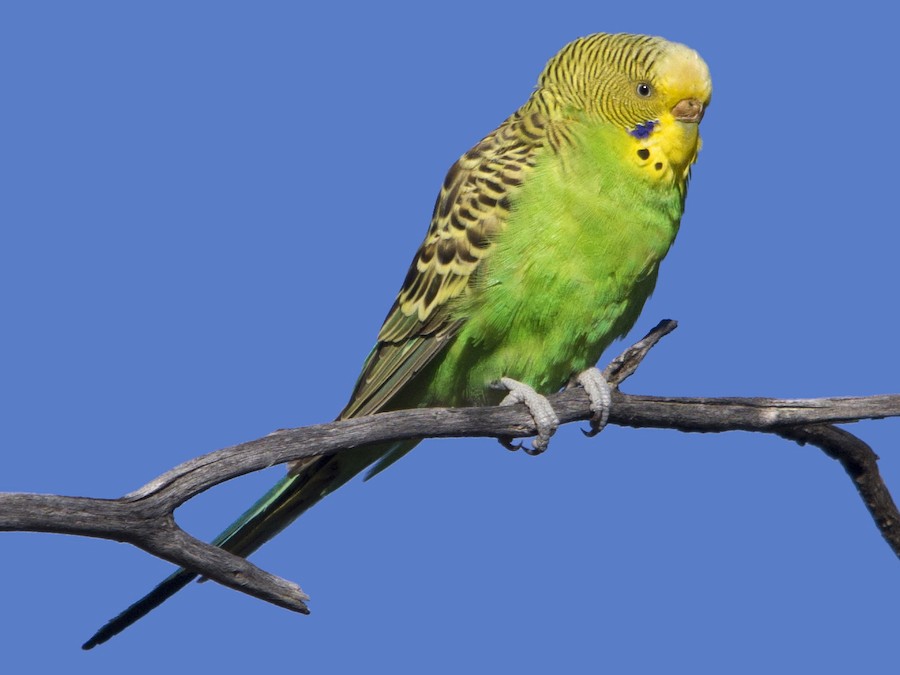
Wild-type Budgerigars have a bright green abdomen and rump, fading to a yellow chest and face. The forehead and crown are yellow, often with fine black barring. The back of the head, nape, and wing coverts are yellow with prominent black scalloped markings. Primary flight feathers are dark blue-green. The tail is dark blue with yellow flashes on the outer feathers. Captive-bred varieties exhibit a vast array of color mutations including blue, white, yellow, grey, violet, and various pied patterns.
- 2
Beak shape
Shape and color of the bill: a key field mark.
Small, hooked, and strong beak, adapted for cracking seeds. Color is typically olive-grey to horn-colored in wild birds, but can vary in captive mutations.
- 3
Eye color
Iris color and any distinctive eye markings.
Dark brown with a white iris ring in adults. Juveniles have solid dark eyes.
- 4
Leg color
Leg and foot color.
Greyish-blue to greyish-pink, zygodactyl feet (two toes forward, two backward).
- 5
Distinguishing features
Standout features that separate this species.
The distinctive black scalloped markings on the back and wings, the small size, and the long, pointed tail are key features. The cere (fleshy area above the beak) color is a reliable indicator of sex in adults.
- 6
Juvenile appearance
How young birds differ from adults.
Juveniles have duller plumage, less distinct black barring on the head extending closer to the cere, and solid dark eyes without the white iris ring. Their cere is pinkish-purple regardless of sex. The tail is also shorter.
- 7
Seasonal changes
Plumage variation between breeding and non-breeding seasons.
No significant seasonal changes in plumage. The cere color of females can change with breeding condition, becoming more crusty and brown when ready to breed, and paler or bluish when not.
- 8
Sexual dimorphism
How males and females differ.
Adult males typically have a bright blue cere, while adult females have a pale brown, tan, or crusty brown cere (which can turn bluish when not in breeding condition). Juveniles of both sexes have a pinkish-purple cere. In some color mutations (e.g., recessive pied, dark-eyed clear), the cere color may not be a reliable indicator.
Key field marks
- Size and Shape. Small, slender parrot with a relatively long, pointed tail. Overall length is about 18-20 cm.
- Plumage Pattern. Look for the bright green lower body, yellow face, and distinctive black scalloped markings on the back of the head, nape, and wings. The dark blue tail with yellow flashes is also characteristic.
- Head Markings. Adults have a yellow forehead and crown, often with fine black barring. Juveniles have barring extending closer to the cere.
- Cere Color (Sexing). In adults, a bright blue cere indicates a male, while a tan to crusty brown cere indicates a female. Juveniles have a pinkish-purple cere.
- Eye Color. Adults have dark eyes with a white iris ring; juveniles have solid dark eyes.
- Flight. Observe their fast, direct, and undulating flight pattern, often in large, cohesive flocks.
- Vocalizations. Listen for their characteristic chattering, chirping, and warbling calls, especially when in a flock.
Explore the Budgerigar
Identify birds anywhere
Free on iOS, Android, and Web. Photo & sound identification, full species database, and your personal life list.