
Spotted a bird? Identify it instantly with the Birdby app
Open the appAbout
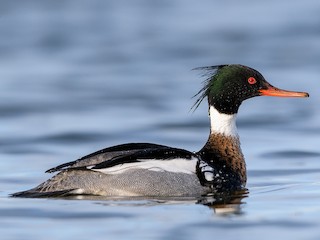
The Red-breasted Merganser is a medium-sized diving duck known for its slender, serrated bill, which is adapted for catching fish. Males in breeding plumage are striking with a dark green head, shaggy crest, and a rusty-red breast band. Females and immatures are duller with a reddish-brown head and a less defined crest. They are primarily found in coastal marine environments and large freshwater bodies, especially during migration and winter.
Size & lifespan
- Length
- 51-62 cm (20-24 in)
- Wingspan
- 70-86 cm (28-34 in)
- Weight
- 700-1350 g (1.5-3.0 lbs)
- Lifespan
- Up to 10-12 years in the wild
- Diet
- Carnivore (primarily piscivorous)
Physical characteristics
- Plumage
- Adult breeding male: Dark iridescent green head with a shaggy double crest, white neck collar, rusty-red breast streaked with black, white flanks finely vermiculated with black, black back, and a prominent white patch on the inner wing (speculum) visible in flight and at rest. Adult female: Reddish-brown head with a shaggy crest, white chin and throat, grayish body plumage, and a white wing patch. Non-breeding male (eclipse plumage): Resembles the female but often retains some darker back feathers and a more defined white wing patch.
- Beak shape
- Long, slender, and pointed bill with serrated edges (lamellae) for gripping fish. Bill color is red in adults, duller orange-red in immatures.
- Eye color
- Red in adult males, reddish-brown in adult females and immatures.
- Leg color
- Bright orange-red in adults, duller orange in immatures.
- Distinguishing features
- Shaggy crest on both sexes, slender serrated bill, and the distinctive rusty-red breast band on breeding males. The white wing patch (speculum) is a key field mark for both sexes.
- Juvenile appearance
- Juveniles resemble adult females but have a shorter, less shaggy crest, duller bill and leg coloration, and often a more mottled appearance to their body plumage.
- Seasonal changes
- Males undergo an eclipse plumage in late summer/early autumn, resembling females but often retaining some darker back feathers and a more distinct white wing patch. They regain their breeding plumage by late autumn/early winter.
- Sexual dimorphism
- Pronounced sexual dimorphism in breeding plumage, with males being much more brightly colored and patterned than females. Females are generally duller brown and gray.
How to identify
- 1
Crest
Look for the shaggy, often messy-looking crest on the back of the head in both sexes. It's more pronounced in males.
- 2
Bill Shape and Color
Observe the long, slender, pointed, and serrated red bill. This is a key feature distinguishing mergansers from other ducks.
- 3
Male Breeding Plumage
Identify the iridescent dark green head, white neck collar, and the rusty-red breast band streaked with black. The white flanks with fine black vermiculations are also distinctive.
- 4
Female/Immature Plumage
Note the reddish-brown head with a shaggy crest, contrasting with a paler throat/chin, and a grayish body. The white wing patch is still visible.
- 5
White Wing Patch (Speculum)
Look for a prominent white patch on the inner wing, visible both in flight and when the bird is at rest on the water. This is present in both sexes and all plumages.
- 6
Behavior
Watch for their characteristic diving behavior to catch fish. They often swim low in the water.
Habitat & range
- Biomes
- Coastal marine environments, large freshwater lakes, rivers, estuaries, and brackish waters.
- Geographic range
- Holarctic breeder, found across northern North America, Europe, and Asia. Winters along temperate coasts and large inland waters in North America, Europe, and parts of Asia.
- Elevation range
- Primarily found at sea level, but can occur on large freshwater bodies at moderate elevations during migration.
- Preferred environments
- Prefers clear, shallow coastal waters, estuaries, and large lakes with abundant fish populations. During breeding, they favor sheltered bays, islands, and shorelines with dense vegetation for nesting.
Behavior
- Activity time
- Diurnal, actively feeding and moving during daylight hours.
- Feeding habits
- Primarily piscivorous, diving underwater to pursue and catch fish, often using their serrated bill to hold slippery prey. They also consume crustaceans, aquatic insects, and occasionally amphibians. Dives typically last 10-30 seconds.
- Social behavior
- Highly social outside the breeding season, forming large flocks on wintering grounds. During breeding, they are more solitary or found in pairs.
- Flight pattern
- Strong, direct flight with rapid wingbeats. Often flies low over the water. When taking off, they run across the water surface before becoming airborne.
- Migration pattern
- Migratory, moving from northern breeding grounds to more temperate coastal and inland waters for winter. Migration occurs in flocks, often along coastlines.
- Territoriality
- Males defend a small territory around the nest site during the breeding season, though they are not as aggressively territorial as some other duck species.
Song & calls
- Song
- Males have a low, guttural 'croak' or 'rattle' during courtship displays. Not considered to have a true song.
- Call
- Females give a harsh, grating 'karr-r-r' or 'prrak-prrak' call, especially when alarmed or with young. Males produce a softer, more nasal 'garr-garr' or 'whee-oo' during courtship.
- When they vocalize
- Most vocal during the breeding season and courtship displays. Females are more vocal when disturbed or with ducklings.
Breeding & reproduction
- Breeding season
- May to July, with peak nesting in June.
- Nesting habits
- Nests are typically concealed on the ground near water, often under dense vegetation, in rock crevices, or sometimes in old tree cavities. The nest is a shallow depression lined with grass, leaves, and down feathers plucked from the female's breast.
- Clutch size
- 6-12 eggs, usually 8-10.
- Egg description
- 6-12 eggs, typically pale buff, olive-buff, or greenish-buff, unspotted. Average size is about 64 x 45 mm.
- Incubation period
- 29-35 days, primarily by the female.
- Fledging period
- 60-65 days. Ducklings are precocial and leave the nest shortly after hatching, able to feed themselves under the female's supervision.
- Parental care
- Only the female cares for the ducklings. Males depart shortly after incubation begins.
Where to find
Coastal Waters
Look in sheltered bays, estuaries, and along rocky coastlines, especially during winter and migration.
Large Lakes and Rivers
Can be found on large freshwater bodies, particularly during migration and in some breeding areas.
Breeding Grounds
During summer, seek them on northern freshwater lakes, rivers, and coastal islands with dense vegetation.
Field tips
- Scan open water. Red-breasted Mergansers prefer open water for feeding. Use binoculars or a spotting scope to scan for them, especially where fish are abundant.
- Observe diving behavior. Their frequent diving for fish is a strong indicator. Watch for them to disappear underwater and resurface a short distance away.
- Look for flocks. Outside of the breeding season, they often congregate in flocks, sometimes mixed with other diving ducks.
- Check for crest and bill. Even at a distance, the shaggy crest and slender bill can help distinguish them from other ducks.
Similar species
Common Merganser (Goosander)
Mergus merganser
The Common Merganser male lacks the shaggy crest and rusty breast band; its head is smooth and dark green, and its body is mostly white. The female Common Merganser has a more sharply defined reddish-brown head with a distinct white chin patch and a less shaggy crest. Both species have different bill shapes; the Common Merganser's bill is thicker at the base and less slender.
Hooded Merganser
Lophodytes cucullatus
The Hooded Merganser is smaller and has a distinctive fan-shaped crest. Males have a large white patch on the side of the head bordered by black, and a black-and-white patterned body. Females have a reddish-brown crest that is less shaggy than the Red-breasted Merganser's.
Quick facts
- Diet:
- Fish, crustaceans, aquatic insects
- Habitat:
- Coastal marine, large freshwater
- Migration:
- Long-distance migrant
- Nesting:
- Ground nests, often concealed
- Distinguishing Feature:
- Shaggy crest, serrated red bill, white wing patch
Fun facts
- The 'serrator' in its scientific name refers to the saw-like serrations on its bill, which are perfectly adapted for grasping slippery fish.
- Red-breasted Mergansers are among the fastest flying ducks, capable of reaching speeds over 100 km/h (60 mph).
- They are one of the few duck species where the male often leaves the female shortly after incubation begins, leaving her to raise the young alone.
- In some areas, Red-breasted Mergansers have been observed 'herding' fish into shallow water to make them easier to catch.
Scientific classification
- Kingdom
- Animalia
- Phylum
- Chordata
- Class
- Aves
- Order
- Anseriformes
- Family
- Anatidae
- Genus
- Mergus
- Species
- Mergus serrator
Explore the Red-breasted Merganser
Identify birds anywhere
Free on iOS, Android, and Web. Photo & sound identification, full species database, and your personal life list.