
Spotted a bird? Identify it instantly with the Birdby app
Open the appAbout
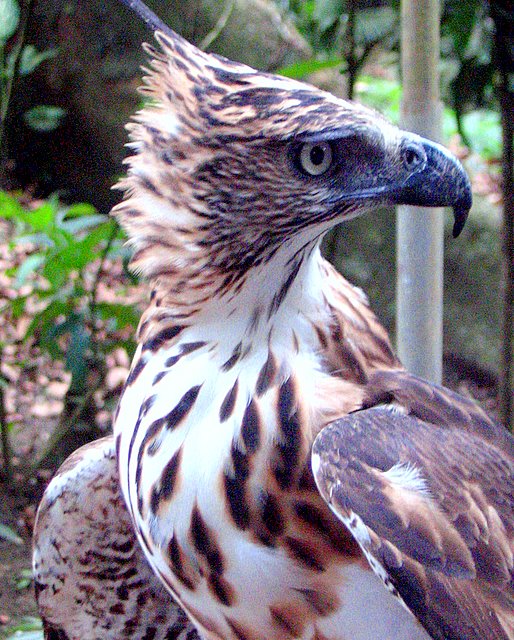
The Philippine Hawk-Eagle is a medium-sized raptor endemic to the Philippines. It is characterized by its crested head, powerful build, and striking plumage, adapted for hunting in forest environments. It is a true forest eagle, typically found perched inconspicuously within the canopy or soaring above forest clearings.
Size & lifespan
- Length
- 55-70 cm (21.5-27.5 in)
- Wingspan
- 110-125 cm (43-49 in)
- Weight
- 1.1-1.6 kg (2.4-3.5 lbs)
- Lifespan
- Up to 20 years in the wild, potentially longer in captivity.
- Diet
- Primarily small to medium-sized birds, including hornbills and pigeons, as well as mammals such as bats and rodents, and occasionally reptiles and amphibians.
Physical characteristics
- Plumage
- Adults have dark brown upperparts, a dark brown crest, and pale underparts with heavy rufous-brown streaking on the breast and belly. The underwing coverts are rufous, contrasting with pale flight feathers that have dark barring. The tail is dark with several broad dark bands. The facial disc is often rufous-brown.
- Beak shape
- Robust, hooked beak, typical of raptors, dark grey to black with a pale cere.
- Eye color
- Yellow to orange-yellow in adults, paler in immatures.
- Leg color
- Yellow
- Distinguishing features
- Prominent dark crest, heavily streaked rufous underparts, rufous underwing coverts, and banded tail. The deep, penetrating yellow eyes are also distinctive.
- Juvenile appearance
- Juveniles are paler overall, with a whiter head and underparts, less streaking on the body, and a shorter, less prominent crest. The flight feathers are pale with dark barring, and the tail is also barred. Eyes are generally paler yellow.
- Seasonal changes
- No significant seasonal plumage changes.
- Sexual dimorphism
- Females are generally larger and heavier than males, but plumage is similar.
How to identify
- 1
Crest
Look for the prominent dark brown crest, often held erect, giving the head a distinctive shape.
- 2
Underparts
Observe the pale underparts with heavy, rich rufous-brown streaking on the breast and belly. This is a key field mark for adults.
- 3
Underwing
Note the rufous underwing coverts which strongly contrast with the paler, barred flight feathers during flight.
- 4
Eyes
Adults have striking bright yellow to orange-yellow eyes, which stand out against the relatively dark head.
- 5
Call
Listen for its characteristic high-pitched, whistled 'pi-wit... pi-wit...' calls, especially when soaring or near nesting sites.
Habitat & range
- Biomes
- Tropical and subtropical moist broadleaf forests.
- Geographic range
- Endemic to the Philippines, found on various islands including Luzon, Mindoro, Mindanao, Negros, Panay, and Samar.
- Elevation range
- Sea level up to 2,000 meters (6,560 feet), primarily in lowland and montane forests.
- Preferred environments
- Primary and secondary forest, forest edges, and sometimes clearings within extensive forest blocks.
Behavior
- Activity time
- Diurnal, active during daylight hours.
- Feeding habits
- Opportunistic predator, hunting by soaring and stooping on prey or by ambushing from a perch within the forest canopy. They have powerful talons to seize and carry prey.
- Social behavior
- Typically solitary or found in pairs, especially during the breeding season. Not known to form large flocks.
- Flight pattern
- Powerful direct flight, often soaring high above the forest, or gliding silently through the canopy. Known for spectacular aerial displays during breeding season.
- Migration pattern
- Sedentary; not known to migrate.
- Territoriality
- Highly territorial, particularly around nesting sites, which they defend against other raptors and potential threats.
Song & calls
- Song
- Generally silent outside the breeding season. During courtship, a series of high-pitched, whistled calls, sometimes described as 'wee-oo-wee-oo' or 'klee-klee-weeeu'.
- Call
- A distinctive, far-carrying, high-pitched whistle 'pi-wit... pi-wit...' or 'keewit... keewit...' repeated. Also a sharper 'kyip' call when agitated.
- When they vocalize
- Most vocal during the breeding season, particularly in the mornings and evenings, and when soaring over nesting territories.
Breeding & reproduction
- Breeding season
- Varies slightly by island, but generally October to May, peaking around February to April.
- Nesting habits
- Builds large stick nests high in emergent trees within dense forest. Nests are often reused for several years.
- Clutch size
- 1-2 eggs
- Egg description
- Typically one, sometimes two (rarely), blunt elliptical eggs, usually dull white with light reddish-brown blotches or streaks.
- Incubation period
- Approximately 45-50 days.
- Fledging period
- Chicks fledge around 70-85 days after hatching, but remain dependent on parents for several more months.
- Parental care
- Both parents participate in incubation and chick rearing. The female does most of the incubation, while the male provides food during that period and after hatching. Both parents actively feed and defend the nestling(s).
Where to find
National Parks
Protected forests within national parks such as Mount Apo National Park, Northern Sierra Madre Natural Park, and Samar Island Natural Park are prime locations.
Forested Mountain Slopes
Search in areas with extensive primary and good secondary forest cover on mountain slopes throughout its range.
Forest Edges and Clearings
They can sometimes be seen soaring over forest edges or clearings, or perched on tall emergent trees overlooking the forest canopy.
Field tips
- Scan the sky. Spend time scanning the sky above forest patches, especially during mid-morning and late afternoon, for soaring individuals. They often soar at considerable heights.
- Listen for calls. Their distinctive calls are often the first indication of their presence, especially when they are hidden in the dense canopy. Learn their vocalizations.
- Look for perches. Observe tall, emergent trees at the forest edge or within clearings, as they often perch conspicuously on high branches.
- Visit known sites. Consult local bird guides or eBird reports for specific sites where they have been recently recorded.
- Be patient. Forest raptors can be elusive. Patience and quiet observation are key to spotting this species.
Similar species
Changeable Hawk-Eagle
Nisaetus cirrhatus
The Philippine Hawk-Eagle (N. philippensis) has a more distinctly rufous streaked underside and rufous underwing coverts, contrasting with paler flight feathers. The Changeable Hawk-Eagle (N. cirrhatus) typically has a less prominent crest, more varying plumage (including a pale morph with unstreaked underparts), and wider distribution outside the Philippines.
Pinsker's Hawk-Eagle
Nisaetus pinskeri
Pinsker's Hawk-Eagle (N. pinskeri) was formerly considered a subspecies of Philippine Hawk-Eagle (N. philippensis) but is now recognized as a distinct species. It is found on Mindanao and has a darker, more densely streaked underside and a more uniform dark brown head and slightly darker rufous on the underwing. The two species overlap in range in Mindanao, requiring careful observation of plumage details for differentiation where they co-occur. N. philippensis generally appears 'cleaner' on the underparts and has more contrasting rufous underwing.
Philippine Eagle
Pithecophaga jefferyi
The Philippine Eagle is much larger, with a shaggy cream and brown crest, massive bill, and distinctly barred underparts and primary feathers. The Philippine Hawk-Eagle is considerably smaller and lacks the dramatically large bill and shaggy nape of the Philippine Eagle.
Quick facts
- Conservation Status:
- Endangered (EN)
- Diet:
- Birds, mammals, reptiles
- Habitat:
- Tropical and subtropical moist broadleaf forests
- Distribution:
- Endemic to the Philippines
- Special Feature:
- Prominent dark crest
- Vocalization:
- High-pitched whistled calls
Fun facts
- The Philippine Hawk-Eagle is one of two species of Hawk-Eagle endemic to the Philippines, the other being Pinsker's Hawk-Eagle (Nisaetus pinskeri), which was only recently elevated to full species status.
- Despite its endangered status, it is sometimes successfully bred in captivity as part of conservation efforts.
- Its powerful flight and keen eyesight make it an apex predator in its forest ecosystem, playing a vital role in regulating prey populations.
- The specific epithet 'philippensis' directly refers to the Philippines, highlighting its restricted geographic range.
Scientific classification
- Kingdom
- Animalia
- Phylum
- Chordata
- Class
- Aves
- Order
- Accipitriformes
- Family
- Accipitridae
- Genus
- Nisaetus
- Species
- Nisaetus philippensis
Explore the Philippine Hawk-Eagle
Identify birds anywhere
Free on iOS, Android, and Web. Photo & sound identification, full species database, and your personal life list.