
Spotted a bird? Identify it instantly with the Birdby app
Open the appAbout
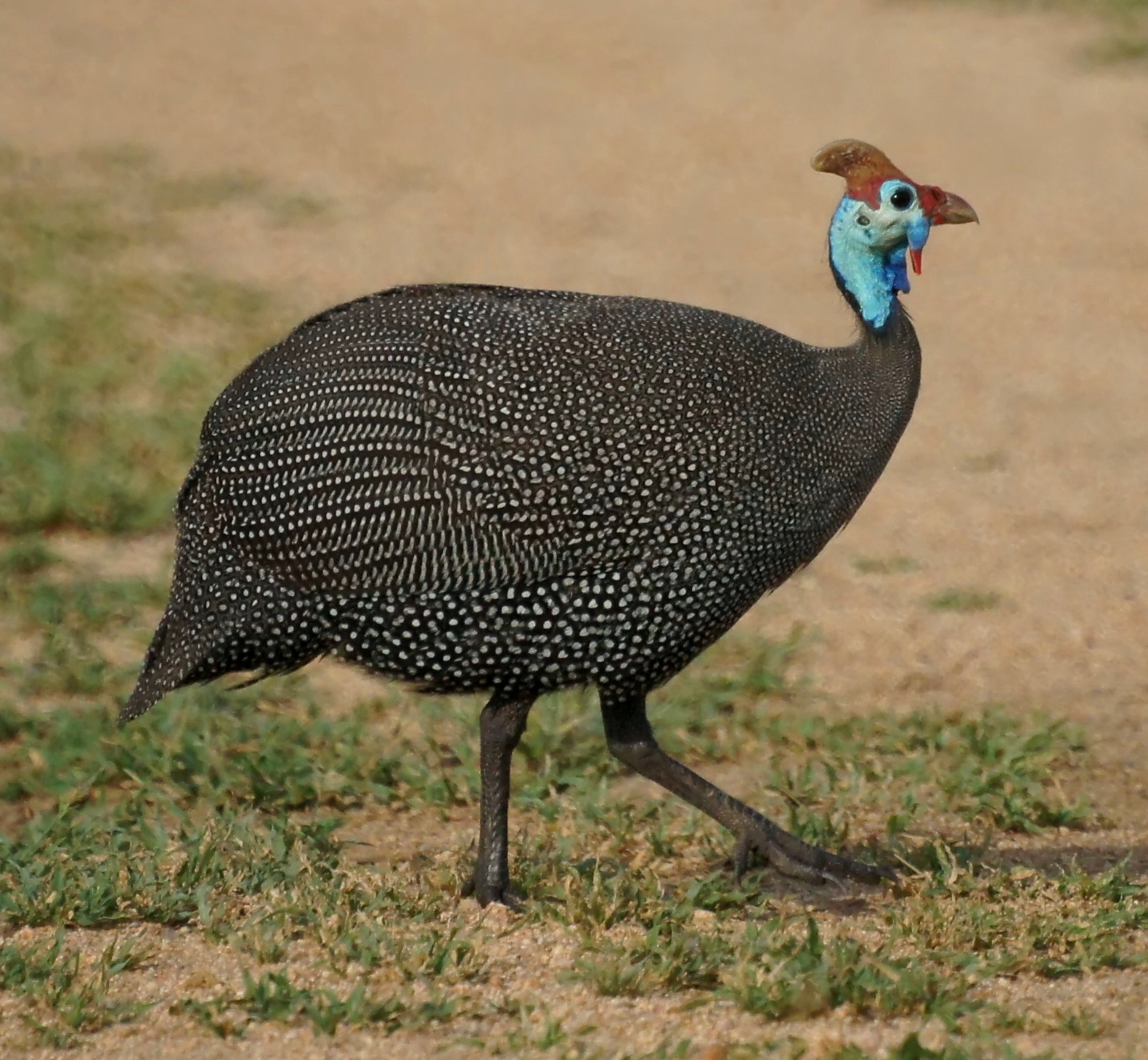
The Helmeted Guineafowl is a well-known and widespread species of guineafowl, native to Africa. It is characterized by its distinctive bony casque on the head and unfeathered, colorful facial skin. Often seen in large flocks, they are terrestrial birds that forage for insects and seeds.
Size & lifespan
- Length
- 53-58 cm (21-23 in)
- Wingspan
- 90-100 cm (35-39 in)
- Weight
- 1.1-1.6 kg (2.4-3.5 lbs)
- Lifespan
- Up to 12 years in the wild, longer in captivity
- Diet
- Omnivore
Physical characteristics
- Plumage
- The body plumage is uniformly dark grey-black, densely speckled with small white spots. The wings are relatively short and rounded, also spotted. The tail is short.
- Beak shape
- Short, stout, and decurved, typically horn-colored or yellowish at the base, darkening towards the tip.
- Eye color
- Dark brown.
- Leg color
- Dark grey to blackish, strong and adapted for running.
- Distinguishing features
- The most striking features are the unfeathered head and neck, which are typically bluish-grey to reddish. A prominent, bony, horn-like casque (helmet) sits atop the head, varying in size and shape among subspecies. Red or orange wattles hang from the sides of the beak, and a patch of red skin is often present on the nape.
- Juvenile appearance
- Juveniles are duller overall, with less distinct spotting and a smaller, less developed casque and wattles. Their head and neck coloration is less vibrant, often more brownish-grey. The plumage is more streaky brown initially, gradually developing the adult spotting.
- Seasonal changes
- No significant seasonal plumage changes. The casque and wattles may appear more vibrant and pronounced in males during the breeding season due to hormonal influences.
- Sexual dimorphism
- Males and females are generally similar in plumage. Males tend to be slightly larger with a more prominent casque and wattles, especially during the breeding season. The casque can be a reliable indicator of sex in mature birds, with males typically having larger and more upright casques.
How to identify
- 1
Head and Neck
Look for the bare, bluish-grey to reddish head and neck, topped by a distinctive bony casque. Red wattles below the beak are also key.
- 2
Plumage
Observe the dark grey-black body plumage uniformly speckled with small white spots. This 'pearl' pattern is characteristic.
- 3
Behavior
Watch for their terrestrial, ground-foraging behavior in large, noisy flocks. They prefer to run rather than fly when disturbed.
- 4
Vocalizations
Listen for their loud, repetitive 'kek-kek-kek' or 'buck-wheat' calls, often given in chorus by the flock.
Habitat & range
- Biomes
- Savannas, grasslands, open woodlands, agricultural areas, and scrubland.
- Geographic range
- Widespread across sub-Saharan Africa, from the Sahel south to South Africa. Introduced populations exist in the West Indies, southern France, and other parts of the world.
- Elevation range
- Sea level up to 3,000 meters (9,800 feet).
- Preferred environments
- Prefers dry, open habitats with scattered trees and shrubs for cover, and access to water. They often frequent areas near human habitation and cultivated fields.
Behavior
- Activity time
- Diurnal, active during daylight hours, especially in the morning and late afternoon.
- Feeding habits
- Forages primarily on the ground, scratching and pecking for a wide variety of food. Diet includes insects (grasshoppers, beetles, termites, ants), spiders, snails, seeds, berries, roots, and small reptiles or amphibians. They are known to consume ticks, making them beneficial in some agricultural settings.
- Social behavior
- Highly social birds, typically found in flocks of 20-30 individuals, sometimes much larger (hundreds) outside the breeding season. They maintain contact through constant vocalizations. They roost communally in trees at night.
- Flight pattern
- Reluctant fliers, preferring to run when disturbed. Flight is strong and direct, but usually for short distances, often to escape predators or roost in trees. They have rapid wingbeats.
- Migration pattern
- Resident throughout their range; they do not undertake long-distance migrations. Local movements may occur in response to food availability or water sources.
- Territoriality
- During the breeding season, pairs or small groups may establish temporary territories around nesting sites, but generally, they are not highly territorial outside of this period.
Song & calls
- Song
- Not a true songbird. Their vocalizations are often described as harsh, grating, and repetitive calls.
- Call
- The most characteristic call is a loud, repetitive, two-syllable 'kek-kek-kek' or 'buck-wheat, buck-wheat' sound, often given in chorus by the flock. They also produce a harsh, alarm 'chrrrrr' and various clucking and chattering sounds. The female's call is often described as a 'come-back' or 'go-back' sound.
- When they vocalize
- Vocalize frequently throughout the day, especially when foraging, moving, or when disturbed. Calls are particularly prominent at dawn and dusk.
Breeding & reproduction
- Breeding season
- Varies geographically, typically coinciding with the rainy season (e.g., November-April in southern Africa, June-September in West Africa).
- Nesting habits
- Nests are simple scrapes on the ground, often concealed under a bush, in tall grass, or among rocks. The female typically prepares the nest, sometimes lined with a few leaves or grass stems.
- Clutch size
- Typically 6-15 eggs, but can lay up to 20-30 eggs, especially when multiple females lay in the same nest (dump nesting).
- Egg description
- Eggs are pale buff to reddish-brown, often speckled with darker spots, and have a thick, hard shell. They are relatively small for the bird's size.
- Incubation period
- 26-28 days.
- Fledging period
- Chicks are precocial and able to walk and feed themselves shortly after hatching. They fledge (become capable of sustained flight) within a few weeks, but remain with the parents for several months.
- Parental care
- Both parents may attend to the chicks, though the female does most of the incubation. The male often guards the nest and helps protect the young. Chicks are led to food and taught foraging skills by the adults.
Where to find
Savannas and Grasslands
Common in open African savannas and grasslands with scattered trees.
Agricultural Areas
Often found near farms and cultivated fields, where they can find abundant food.
Game Reserves and National Parks
Easily observed in most protected areas across their African range.
Field tips
- Listen for their calls. Their loud, distinctive calls often betray their presence before they are seen. Follow the sound.
- Look for flocks. They are rarely solitary. Scan open areas for groups of birds foraging on the ground.
- Observe at dawn and dusk. They are most active and vocal during these times, often moving to and from roosting sites.
- Check near water sources. Like many ground birds, they need regular access to water, so check near rivers, ponds, and waterholes.
Similar species
Crested Guineafowl
Guttera pucherani
Distinguished by a prominent crest of black, curly feathers on its head instead of a bony casque. Its plumage spots are often larger and more irregular.
Vulturine Guineafowl
Acryllium vulturinum
Much larger, with a bare, vulture-like blue head and neck, and long, hackle-like feathers on the neck and breast. Its body plumage is also spotted but with finer white streaks.
White-breasted Guineafowl
Agelastes meleagrides
Has a distinctive white breast and a black head with a red patch on the nape. Lacks a casque or prominent crest. Found in West African forests.
Quick facts
- Social Structure:
- Highly gregarious, forming large flocks
- Flight:
- Reluctant, short-distance flier
- Dietary Role:
- Important consumer of insects, including agricultural pests
- Domestication:
- Widely domesticated for meat and eggs
- Distinctive Feature:
- Bony casque on head
Fun facts
- Helmeted Guineafowl are one of the oldest domesticated fowl, with evidence of their domestication dating back thousands of years in Africa.
- Their loud alarm calls make them excellent 'watchdogs' for farmers, alerting them to intruders or predators.
- They are known to eat ticks, which can help control tick populations in areas where they are present.
- Despite their reluctance to fly, they can run surprisingly fast to escape danger.
Scientific classification
- Kingdom
- Animalia
- Phylum
- Chordata
- Class
- Aves
- Order
- Galliformes
- Family
- Numididae
- Genus
- Numida
- Species
- Numida meleagris
Explore the Helmeted Guineafowl
Identify birds anywhere
Free on iOS, Android, and Web. Photo & sound identification, full species database, and your personal life list.