
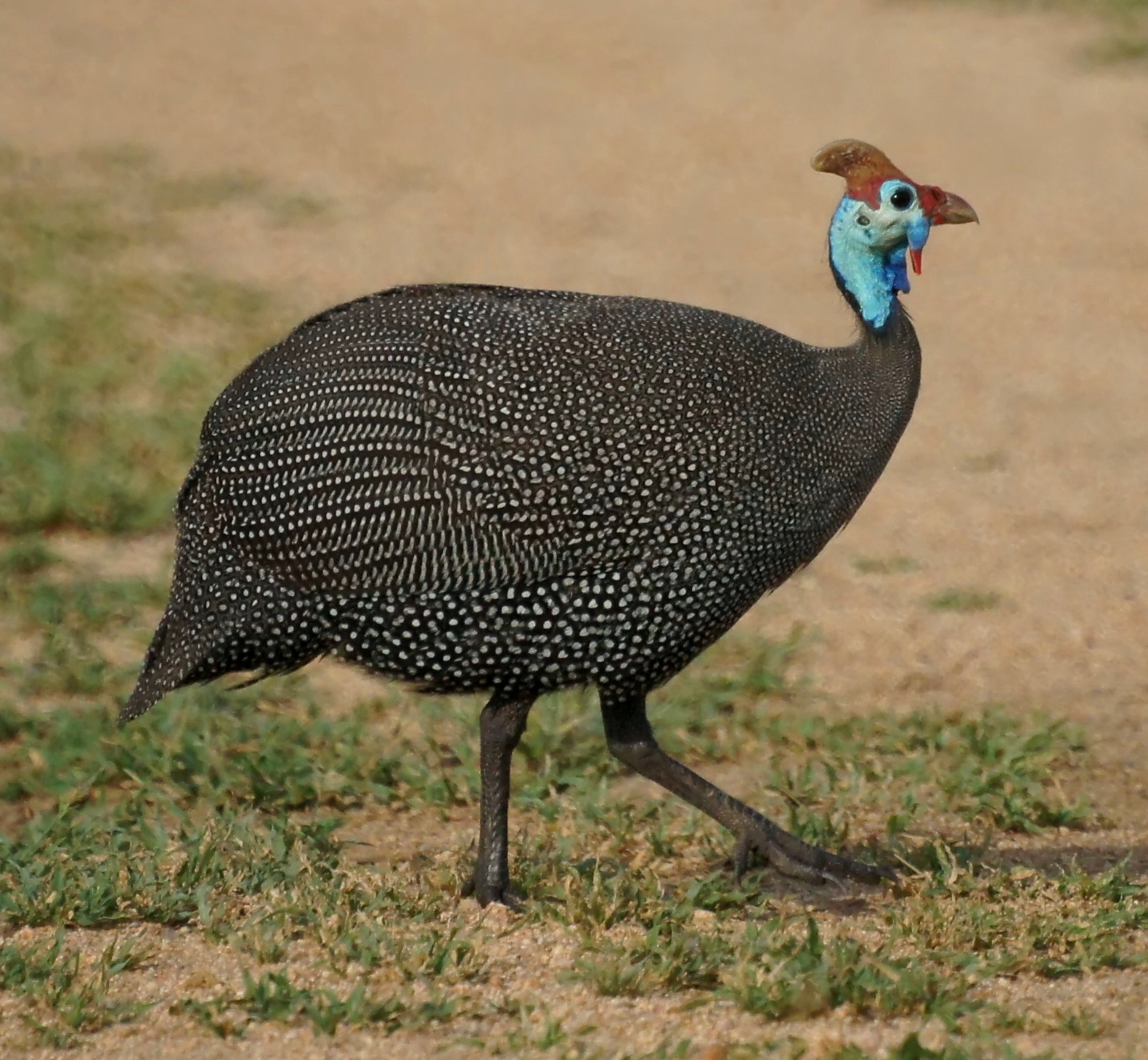
How to identify the Helmeted Guineafowl
Numida meleagris
Spotted a bird? Identify it instantly with the Birdby app
Open the appTo correctly identify the Helmeted Guineafowl (Numida meleagris), check each of these features. Birds can be tricky: habit, habitat, and call often confirm a sighting that a single photo cannot.
Size at a glance
- Length
- 53-58 cm (21-23 in)
- Wingspan
- 90-100 cm (35-39 in)
- Weight
- 1.1-1.6 kg (2.4-3.5 lbs)
Physical features to check
- 1
Plumage
Overall feather coloration and pattern.
The body plumage is uniformly dark grey-black, densely speckled with small white spots. The wings are relatively short and rounded, also spotted. The tail is short.
- 2
Beak shape
Shape and color of the bill: a key field mark.
Short, stout, and decurved, typically horn-colored or yellowish at the base, darkening towards the tip.
- 3
Eye color
Iris color and any distinctive eye markings.
Dark brown.
- 4
Leg color
Leg and foot color.
Dark grey to blackish, strong and adapted for running.
- 5
Distinguishing features
Standout features that separate this species.
The most striking features are the unfeathered head and neck, which are typically bluish-grey to reddish. A prominent, bony, horn-like casque (helmet) sits atop the head, varying in size and shape among subspecies. Red or orange wattles hang from the sides of the beak, and a patch of red skin is often present on the nape.
- 6
Juvenile appearance
How young birds differ from adults.
Juveniles are duller overall, with less distinct spotting and a smaller, less developed casque and wattles. Their head and neck coloration is less vibrant, often more brownish-grey. The plumage is more streaky brown initially, gradually developing the adult spotting.
- 7
Seasonal changes
Plumage variation between breeding and non-breeding seasons.
No significant seasonal plumage changes. The casque and wattles may appear more vibrant and pronounced in males during the breeding season due to hormonal influences.
- 8
Sexual dimorphism
How males and females differ.
Males and females are generally similar in plumage. Males tend to be slightly larger with a more prominent casque and wattles, especially during the breeding season. The casque can be a reliable indicator of sex in mature birds, with males typically having larger and more upright casques.
Key field marks
- Head and Neck. Look for the bare, bluish-grey to reddish head and neck, topped by a distinctive bony casque. Red wattles below the beak are also key.
- Plumage. Observe the dark grey-black body plumage uniformly speckled with small white spots. This 'pearl' pattern is characteristic.
- Behavior. Watch for their terrestrial, ground-foraging behavior in large, noisy flocks. They prefer to run rather than fly when disturbed.
- Vocalizations. Listen for their loud, repetitive 'kek-kek-kek' or 'buck-wheat' calls, often given in chorus by the flock.
Explore the Helmeted Guineafowl
Identify birds anywhere
Free on iOS, Android, and Web. Photo & sound identification, full species database, and your personal life list.