
Spotted a bird? Identify it instantly with the Birdby app
Open the appAbout
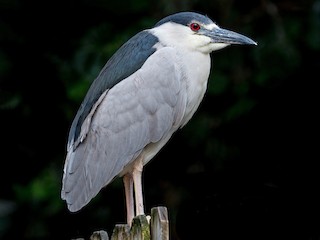
The Black-crowned Night Heron is a medium-sized heron with a stocky build, short legs, and a relatively short neck. It is primarily nocturnal or crepuscular, spending its days roosting in trees or dense vegetation and becoming active at dusk to hunt. Its distinctive appearance, especially the adult's black cap and back contrasting with grey wings and white underparts, makes it readily identifiable.
Size & lifespan
- Length
- 58-66 cm (23-26 in)
- Wingspan
- 99-112 cm (39-44 in)
- Weight
- 500-1000 g (1.1-2.2 lbs)
- Lifespan
- Up to 20 years in the wild, typically 10-15 years.
- Diet
- Carnivore, primarily piscivorous but highly opportunistic.
Physical characteristics
- Plumage
- Adults have a black cap extending to the nape, a black back, and pale grey wings and tail. The underparts are white. Two or three long, white, filamentous plumes extend from the back of the head during the breeding season. Juveniles are mottled brown with streaky underparts and pale spots on the back and wings.
- Beak shape
- Stout, conical, and sharply pointed. Black in adults, yellowish-green to blackish in juveniles.
- Eye color
- Bright red in adults, dull yellow to orange in juveniles.
- Leg color
- Yellowish-green, turning bright pinkish-red during the breeding season in adults. Dull yellow to greenish in juveniles.
- Distinguishing features
- Stocky build, short neck, and nocturnal habits. Adults have a distinctive black cap and back, grey wings, and red eyes. Juveniles are heavily streaked brown.
- Juvenile appearance
- Juveniles are entirely different from adults. They are mottled brown overall, with heavy brown streaking on the neck and underparts, and pale, yellowish-white spots on the back and wing coverts. Their eyes are dull yellow to orange, and legs are dull yellow-green. They gradually acquire adult plumage over 2-3 years.
- Seasonal changes
- Adults show brighter leg coloration (pinkish-red) and more prominent head plumes during the breeding season. Otherwise, plumage is largely consistent year-round.
- Sexual dimorphism
- Minimal; sexes are generally similar in plumage and size, though males may be slightly larger.
How to identify
- 1
Overall Shape and Size
Look for a stocky, medium-sized heron with a relatively short neck and legs, often appearing hunched when perched.
- 2
Adult Plumage
Distinctive black cap and back, contrasting with pale grey wings and white underparts. Red eyes are a key field mark.
- 3
Juvenile Plumage
Heavily mottled brown with pale spots on the back and wings, and streaky underparts. Dull yellow eyes and legs.
- 4
Behavior
Observe its activity patterns; if it's active at dusk or night, it's a strong indicator. Look for it standing motionless at the water's edge or flying with retracted neck.
- 5
Call
Listen for the characteristic loud, harsh 'quok' call, especially at twilight or during nocturnal flight.
Habitat & range
- Biomes
- Wetlands, marshes, swamps, estuaries, lakes, rivers, ponds, coastal areas, and occasionally urban parks with water bodies.
- Geographic range
- Nearly cosmopolitan, found on all continents except Antarctica and Australia. Widespread across North and South America, Europe, Asia, and Africa.
- Elevation range
- Typically found from sea level up to 2,000 meters (6,500 feet), occasionally higher in some regions.
- Preferred environments
- Prefers freshwater and saltwater wetlands with emergent vegetation (reeds, cattails) for roosting and nesting, and shallow water for foraging. Often found near human habitation.
Behavior
- Activity time
- Nocturnal and crepuscular, active from dusk through dawn. Spends daylight hours roosting quietly in dense vegetation.
- Feeding habits
- Primarily nocturnal or crepuscular hunters. They stand motionless at the water's edge or wade slowly in shallow water, waiting to ambush prey. They also employ 'foot-stirring' to disturb prey, 'bill-vibrating' to attract fish, and occasionally 'plunge-diving'. Diet includes fish, amphibians, aquatic invertebrates (crabs, crayfish, insects), small mammals, and even other birds' chicks.
- Social behavior
- Highly colonial, especially during breeding season, forming large mixed-species colonies (rookeries) with other herons, egrets, and ibises. Roost communally during the day. Forage solitarily or in small groups.
- Flight pattern
- Strong, direct flight with slow, deliberate wingbeats. Neck is retracted into an 'S' shape, and legs trail behind the body, extending beyond the tail. Often flies at dusk or dawn.
- Migration pattern
- Northern populations are migratory, moving south for the winter. Southern populations are resident. Migration occurs at night, often in small flocks.
- Territoriality
- Defends a small area around the nest within the colony, but foraging grounds are generally not strictly defended outside of the immediate feeding area.
Song & calls
- Song
- Does not have a complex song. Vocalizations are primarily calls.
- Call
- The most characteristic call is a loud, harsh, guttural 'quok' or 'kwahk', often given in flight, especially at dusk or dawn. Also produces a variety of croaks, squawks, and hisses, particularly around the nest or when disturbed.
- When they vocalize
- Most vocal during twilight hours (dusk and dawn) and throughout the night, especially when flying or interacting within the colony. Less vocal during the day while roosting.
Breeding & reproduction
- Breeding season
- Varies geographically, typically spring and early summer (March-July in North America, often year-round in tropical regions).
- Nesting habits
- Nests colonially, often in large mixed-species rookeries. Nests are typically flimsy platforms of sticks and twigs, built in trees, shrubs, or sometimes on the ground in dense marsh vegetation, usually over water. Both parents participate in nest building.
- Clutch size
- 3-5 eggs.
- Egg description
- 3-5 (occasionally 2-6) pale blue-green, unmarked eggs.
- Incubation period
- 24-26 days, incubated by both parents.
- Fledging period
- Young leave the nest and begin climbing in nearby vegetation at about 3-4 weeks, capable of flight at 6-7 weeks. They remain dependent on parents for several more weeks.
- Parental care
- Both parents share incubation duties and care for the young, feeding them regurgitated food.
Where to find
Freshwater Wetlands
Marshes, swamps, edges of lakes, and slow-moving rivers with dense vegetation.
Saltwater and Brackish Habitats
Estuaries, tidal creeks, mangrove swamps, and coastal lagoons.
Urban and Suburban Areas
Parks with ponds, golf courses, and botanical gardens, especially if they have suitable roosting trees and foraging areas.
Colonial Roosts/Rookeries
Look for large groups of herons and egrets nesting or roosting communally in tall trees or dense thickets.
Field tips
- Time of Day. Best observed at dusk, dawn, or during the night when they are most active. During the day, look for them roosting quietly in dense trees or shrubs near water.
- Listen for Calls. Their distinctive 'quok' call is often heard before the bird is seen, especially when they fly overhead at night.
- Scan Roosts. Carefully scan dense foliage in trees near water bodies during the day; they can be well-camouflaged while roosting.
- Look for Juveniles. Juveniles are often more conspicuous during the day as they are still learning to forage and may be less wary.
Similar species
Yellow-crowned Night Heron
Nyctanassa violacea
Adult Yellow-crowned Night Herons have a grey body, a black head with a white cheek patch, and a pale yellow crown. Their bill is heavier and darker. Juveniles are also mottled brown but have finer streaking and smaller, less distinct spots than juvenile Black-crowned Night Herons. Yellow-crowned Night Herons prefer brackish or saltwater habitats and are more active during the day.
Green Heron
Butorides virescens
Green Herons are much smaller, have a dark green-black cap, a chestnut neck, and greenish-black back and wings. They are typically diurnal and have a more hunched posture. Their call is a sharp 'skeow'.
Juvenile Little Blue Heron
Egretta caerulea
Juvenile Little Blue Herons are entirely white, gradually acquiring patchy blue plumage as they mature. They lack the heavy brown streaking and spotting of juvenile Black-crowned Night Herons.
Quick facts
- Primary Activity:
- Nocturnal/Crepuscular
- Diet:
- Fish, amphibians, invertebrates
- Nesting:
- Colonial in trees/shrubs
- Adult Eye Color:
- Red
- Distinctive Call:
- 'Quok' or 'Kwahk'
Fun facts
- The Black-crowned Night Heron is one of the most widespread heron species in the world, found on almost every continent.
- Its scientific name, Nycticorax, means 'night raven' in Greek, referring to its nocturnal habits and crow-like call.
- They have specialized vision that allows them to hunt effectively in low light conditions.
- Juvenile Black-crowned Night Herons look so different from adults that they were once thought to be a separate species.
- These herons are known to drop bait (like insects or bread) onto the water surface to attract fish, a form of tool use.
Scientific classification
- Kingdom
- Animalia
- Phylum
- Chordata
- Class
- Aves
- Order
- Pelecaniformes
- Family
- Ardeidae
- Genus
- Nycticorax
- Species
- Nycticorax nycticorax
Explore the Black-crowned Night Heron
Identify birds anywhere
Free on iOS, Android, and Web. Photo & sound identification, full species database, and your personal life list.