
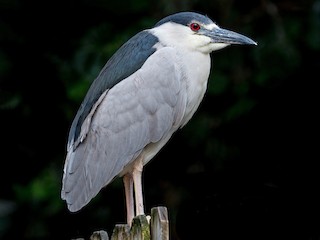
Where does the Black-crowned Night Heron live?
Nycticorax nycticorax
Spotted a bird? Identify it instantly with the Birdby app
Open the appThe Black-crowned Night Heron lives in specific habitats and regions. Knowing where, and when, to look improves your chances of a successful sighting.
Biomes
Wetlands, marshes, swamps, estuaries, lakes, rivers, ponds, coastal areas, and occasionally urban parks with water bodies.
Geographic range
Nearly cosmopolitan, found on all continents except Antarctica and Australia. Widespread across North and South America, Europe, Asia, and Africa.
Preferred environments
Prefers freshwater and saltwater wetlands with emergent vegetation (reeds, cattails) for roosting and nesting, and shallow water for foraging. Often found near human habitation.
Elevation range
Typically found from sea level up to 2,000 meters (6,500 feet), occasionally higher in some regions.
Where to look
Freshwater Wetlands
Marshes, swamps, edges of lakes, and slow-moving rivers with dense vegetation.
Saltwater and Brackish Habitats
Estuaries, tidal creeks, mangrove swamps, and coastal lagoons.
Urban and Suburban Areas
Parks with ponds, golf courses, and botanical gardens, especially if they have suitable roosting trees and foraging areas.
Colonial Roosts/Rookeries
Look for large groups of herons and egrets nesting or roosting communally in tall trees or dense thickets.
Field tips
- Time of Day. Best observed at dusk, dawn, or during the night when they are most active. During the day, look for them roosting quietly in dense trees or shrubs near water.
- Listen for Calls. Their distinctive 'quok' call is often heard before the bird is seen, especially when they fly overhead at night.
- Scan Roosts. Carefully scan dense foliage in trees near water bodies during the day; they can be well-camouflaged while roosting.
- Look for Juveniles. Juveniles are often more conspicuous during the day as they are still learning to forage and may be less wary.
Migration
Northern populations are migratory, moving south for the winter. Southern populations are resident. Migration occurs at night, often in small flocks.
Explore the Black-crowned Night Heron
Identify birds anywhere
Free on iOS, Android, and Web. Photo & sound identification, full species database, and your personal life list.