
Spotted a bird? Identify it instantly with the Birdby app
Open the appAbout
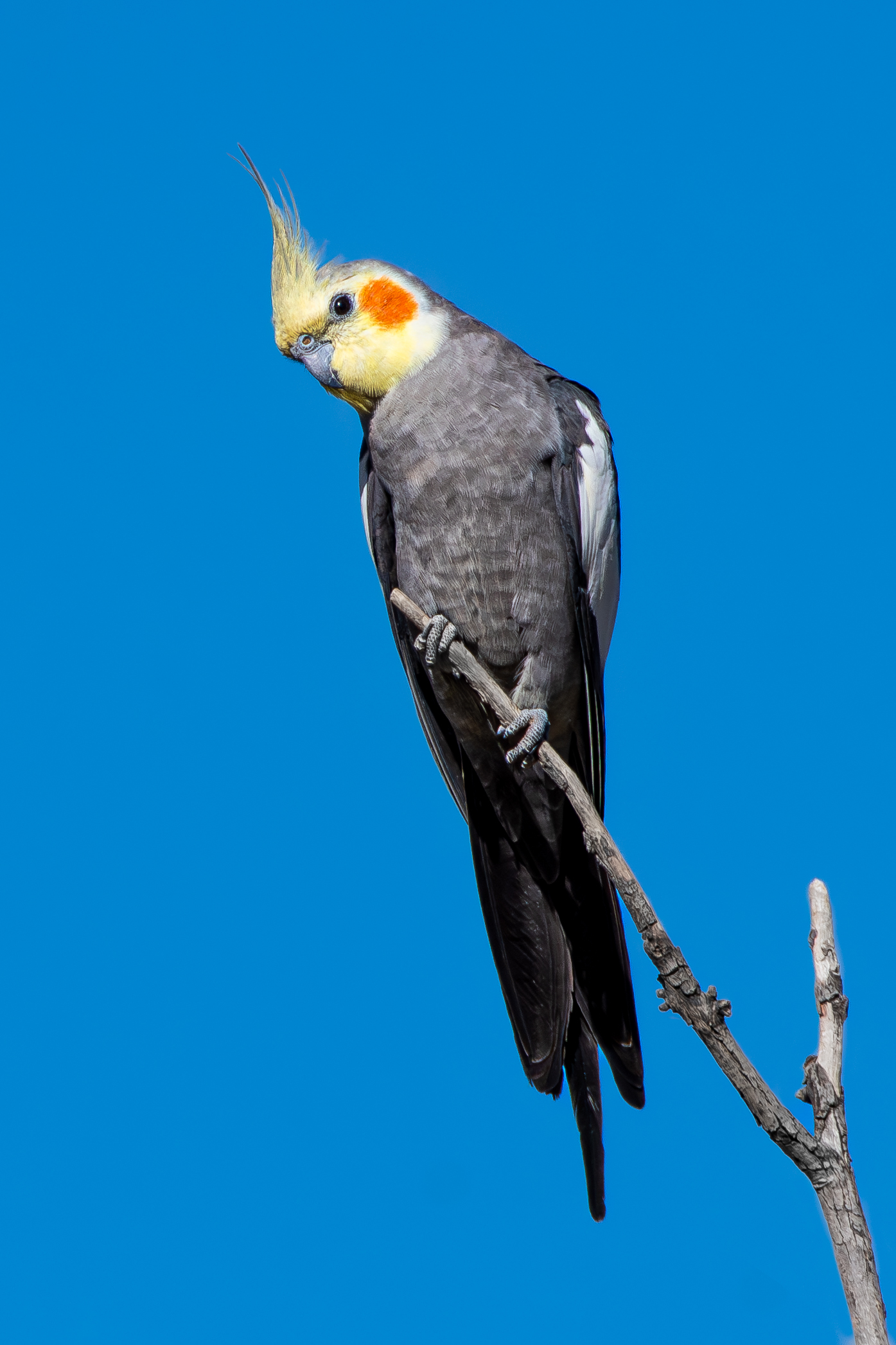
The Cockatiel, also known as the Weiro or Quarrion, is a medium-sized parrot native to Australia. It is the smallest member of the cockatoo family (Cacatuidae). Renowned for its distinctive erectile crest, long tail, and often vibrant facial patches, it is a highly popular pet bird worldwide due to its gentle nature and ability to mimic sounds. In the wild, they are nomadic, moving in response to water and food availability.
Size & lifespan
- Length
- 30-33 cm (12-13 in) including tail
- Wingspan
- 30-35 cm (12-14 in)
- Weight
- 70-120 g (2.5-4.2 oz)
- Lifespan
- 10-14 years in the wild, up to 15-20 years in captivity
- Diet
- Herbivore (granivore/frugivore)
Physical characteristics
- Plumage
- Wild-type (normal grey) Cockatiels have a predominantly grey body with prominent white flashes on the outer edges of each wing. The face is typically yellow or white, with a distinct orange patch covering the ear opening. The crest is grey, often tipped with yellow. The underside of the tail feathers is dark grey.
- Beak shape
- Short, strongly curved, dark grey to black beak, typical of parrots for cracking seeds.
- Eye color
- Dark brown.
- Leg color
- Dark grey to blackish-grey zygodactyl feet (two toes forward, two toes backward).
- Distinguishing features
- The most distinctive feature is the prominent, erectile crest on the head, which can be raised or lowered to indicate the bird's mood. The long, tapering tail, often nearly half the bird's total length, is also characteristic. The bright orange ear patches on a yellow or white face are key identifiers for wild-type males.
- Juvenile appearance
- Juveniles of both sexes resemble adult females, with duller facial coloration, less vibrant orange cheek patches, and barring on the underside of the tail feathers. Males will gradually develop their brighter adult plumage after their first molt, typically around 6-9 months of age.
- Seasonal changes
- No significant seasonal plumage changes. Plumage remains consistent year-round, with variations primarily due to age and sex.
- Sexual dimorphism
- Pronounced in wild-type birds: Adult males have bright yellow faces and crests with vivid orange cheek patches. Adult females have duller grey faces and crests, with less intense orange cheek patches, and horizontal barring on the underside of their tail feathers and sometimes on the primary flight feathers. Juvenile birds resemble females.
How to identify
- 1
Crest
Look for the prominent, erectile crest on the head. Its position indicates the bird's mood (upright when alert/excited, flattened when relaxed/fearful).
- 2
Facial Markings
Observe the bright orange cheek patches on a yellow or white face (more vivid in males, duller in females/juveniles). This is a key field mark for wild-type birds.
- 3
Tail Length
Note the long, tapering tail, which is almost as long as the body, giving the bird a slender silhouette.
- 4
Wing Patches
Identify the distinct white flashes on the outer edges of the wings, visible in flight and when perched.
- 5
Vocalization
Listen for their characteristic 'weero' call or the male's complex whistling songs.
- 6
Behavior
Look for them foraging on the ground in open areas, often near water, or flying in cohesive flocks.
Habitat & range
- Biomes
- Arid and semi-arid regions, grasslands, shrublands, open woodlands, and agricultural areas.
- Geographic range
- Endemic to Australia, found throughout the mainland, avoiding the coastal fringes and the densest forests. Most common in the interior, particularly in the northern and central parts.
- Elevation range
- Typically found from sea level up to approximately 1,000 meters (3,300 feet).
- Preferred environments
- Prefers open country near water sources, such as rivers, lakes, and dams. They are often seen in areas with scattered trees and shrubs, particularly Eucalyptus and Acacia species, which provide roosting and nesting sites.
Behavior
- Activity time
- Diurnal. Most active during the early morning and late afternoon, resting during the hottest parts of the day.
- Feeding habits
- Primarily ground feeders, foraging for seeds of grasses, herbs, and shrubs. They also consume berries, fruits, and occasionally insects. They are often seen feeding in large flocks, especially after rain when seeds are abundant.
- Social behavior
- Highly social birds, typically found in pairs or small flocks, but can gather in very large flocks (hundreds to thousands) around water sources, especially during dry periods. They are generally peaceful and communicative within their groups.
- Flight pattern
- Strong, direct, and undulating flight with rapid wing beats. They are capable of sustained flight over long distances, which is essential for their nomadic lifestyle in search of water and food.
- Migration pattern
- Nomadic rather than migratory. Their movements are largely dictated by the availability of water and food, particularly in response to rainfall patterns across the Australian interior. They do not follow fixed migratory routes.
- Territoriality
- Generally not highly territorial outside of the immediate nesting site during breeding season. Flocks share feeding and roosting areas.
Song & calls
- Song
- Males are known for their ability to whistle complex melodies and mimic sounds. Their 'song' is often a series of varied whistles, chirps, and trills, sometimes incorporating mimicked sounds or phrases. It is used for courtship and communication.
- Call
- Common calls include a distinctive 'weero' or 'quarrion' call (hence their alternative names), a sharp 'kweel' alarm call, and various chirps and squawks for contact and warning. They also produce a soft 'chatter' when content.
- When they vocalize
- Vocalize throughout the day, particularly when feeding, flying, or interacting within a flock. Males are most vocal during courtship displays.
Breeding & reproduction
- Breeding season
- Highly opportunistic, breeding primarily after rainfall, typically from August to December in the south and April to June in the north, but can breed year-round if conditions are favorable.
- Nesting habits
- Nest in tree hollows, usually in dead or living Eucalyptus trees, often near water. They do not build elaborate nests, instead laying eggs directly on wood dust or debris at the bottom of the hollow.
- Clutch size
- 4-7 eggs.
- Egg description
- Typically 4-7 (range 1-9) pure white, oval eggs, measuring approximately 24 x 19 mm.
- Incubation period
- 18-21 days, shared by both parents.
- Fledging period
- Approximately 4-5 weeks (28-35 days) after hatching. Young are fed by both parents for several weeks after fledging.
- Parental care
- Both male and female participate equally in incubation and raising the young. The male often incubates during the day, and the female at night.
Where to find
Open Woodlands
Areas with scattered trees, particularly Eucalyptus, near water sources.
Grasslands and Shrublands
Open plains with native grasses and low shrubs, especially after rain.
Agricultural Areas
Farmlands where they can feed on spilled grains and seeds.
Waterholes and Rivers
They congregate in large numbers around water bodies, especially during dry periods.
Field tips
- Look near water. Cockatiels are highly dependent on water and are often found congregating around waterholes, rivers, and dams, particularly in the morning and late afternoon.
- Scan open areas. They prefer open country for feeding. Look for them on the ground among grasses or perched in scattered trees.
- Listen for calls. Their distinctive 'weero' call and male's whistling can often be heard before they are seen, especially when flocks are moving.
- Observe flock behavior. Cockatiels are social and often move in flocks. Look for groups flying or feeding together.
- Check tree hollows. During breeding season, they will be found near suitable tree hollows for nesting.
Quick facts
- Native Range:
- Australia
- Diet:
- Seeds, grains, some fruits and berries
- Sociality:
- Highly social, found in pairs or flocks
- Distinguishing Feature:
- Erectile crest and orange cheek patches
- Conservation Status:
- Least Concern
Fun facts
- The Cockatiel is the only species in the genus Nymphicus, and it is the smallest of the cockatoo family.
- Their scientific name, Nymphicus hollandicus, means 'nymph of New Holland' (an old name for Australia), referring to their beauty.
- Cockatiels are known for their ability to mimic sounds and can be taught to 'talk' or whistle complex tunes, though they are generally better at whistling.
- The position of their crest is a clear indicator of their mood: a flattened crest indicates fear or aggression, a slightly raised crest indicates curiosity or relaxation, and a fully erect crest indicates excitement or alarm.
- They are highly nomadic in the wild, constantly moving to find food and water, which is a survival strategy in Australia's often harsh interior.
Scientific classification
- Kingdom
- Animalia
- Phylum
- Chordata
- Class
- Aves
- Order
- Psittaciformes
- Family
- Cacatuidae
- Genus
- Nymphicus
- Species
- Nymphicus hollandicus
Explore the Cockatiel
Identify birds anywhere
Free on iOS, Android, and Web. Photo & sound identification, full species database, and your personal life list.