
Spotted a bird? Identify it instantly with the Birdby app
Open the appAbout
The Common Tailorbird is a small passerine bird found across tropical Asia. It is well-known for its unique nest-building technique, where it literally 'sews' leaves together to form a cradle for its nest. This species is typically found in gardens, scrubland, and open woodland, often close to human habitation. Its distinctive call and active foraging behavior make it a noticeable presence in its habitat.
Size & lifespan
- Length
- 10-14 cm
- Wingspan
- 15-18 cm
- Weight
- 6-10 g
- Lifespan
- 2-4 years in the wild
- Diet
- Insectivore
Physical characteristics
- Plumage
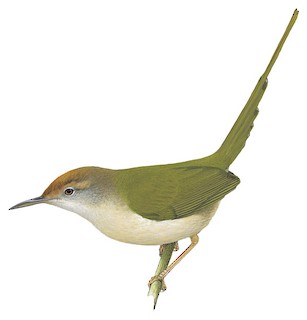
- Upperparts are bright olive-green, underparts are whitish to pale buff. The crown is rufous (chestnut-red), extending to the nape. The throat and upper breast are whitish, often with a faint dusky wash. The flanks are greyish-buff. The tail is relatively long, often held cocked, and has white tips on the outer tail feathers, which are visible in flight or when fanned.
- Beak shape
- Slender, slightly decurved, pointed bill, dark horn-colored.
- Eye color
- Pale yellowish-white to creamy white.
- Leg color
- Pinkish-brown to flesh-colored.
- Distinguishing features
- Rufous crown, olive-green upperparts, whitish underparts, and a long, often cocked tail. The pale eye is also a good field mark.
- Juvenile appearance
- Juveniles resemble adults but have a duller rufous cap, less distinct olive-green on the back, and often a more yellowish wash on the underparts. Their tail feathers are shorter and less developed.
- Seasonal changes
- No significant seasonal plumage changes. The primary seasonal difference is the elongation of the central tail feathers in breeding males.
- Sexual dimorphism
- Males and females are generally similar in plumage. However, during the breeding season, males develop elongated central tail feathers, which are noticeably longer than those of the female. This is the primary distinguishing feature.
How to identify
- 1
Rufous Crown
Look for the distinctive chestnut-red cap on the head, which is a key identifier.
- 2
Olive-green Back
Observe the bright olive-green coloration on its upperparts, contrasting with the rufous crown.
- 3
Whitish Underparts
Note the pale, often whitish to pale buff, underparts.
- 4
Long, Cocked Tail
Pay attention to its relatively long tail, which is frequently held cocked upwards. Breeding males will have noticeably longer central tail feathers.
- 5
Pale Eye
The pale yellowish-white eye stands out against the rufous and olive plumage.
- 6
Vocalizations
Listen for its loud, repetitive 'chee-up' or 'twee-twee-twee' song and sharp 'chick-chick' alarm calls.
- 7
Behavior
Watch for its active foraging style, flitting and hopping through dense foliage, often hanging upside down.
Habitat & range
- Biomes
- Tropical and subtropical moist broadleaf forests, scrubland, gardens, agricultural areas, and urban parks.
- Geographic range
- Widely distributed across tropical Asia, from India and Sri Lanka eastward through Southeast Asia, including parts of China, Myanmar, Thailand, Laos, Cambodia, Vietnam, Malaysia, Singapore, and Indonesia (Sumatra, Java, Bali).
- Elevation range
- Typically found from sea level up to 1,500 meters, occasionally higher in some regions.
- Preferred environments
- Dense undergrowth, bushes, hedges, and small trees in open country, gardens, orchards, and forest edges. They prefer areas with ample foliage for foraging and nesting.
Behavior
- Activity time
- Diurnal, most active during the morning and late afternoon.
- Feeding habits
- Primarily insectivorous, foraging actively among foliage for small insects, larvae, and spiders. They glean insects from leaves and twigs, often hanging upside down or making short, quick sallies to catch flying insects. Occasionally consumes nectar.
- Social behavior
- Usually seen singly or in pairs. They are generally territorial, especially during the breeding season, and will actively defend their nesting area.
- Flight pattern
- Short, undulating flights between bushes and trees. They are not strong fliers and prefer to hop and flit through dense vegetation.
- Migration pattern
- Resident throughout its range; it does not undertake long-distance migrations. Local movements may occur in response to food availability or habitat changes.
- Territoriality
- Highly territorial, especially during the breeding season. Pairs will defend their territory with vocalizations and occasional chases.
Song & calls
- Song
- A loud, repetitive, and often monotonous 'chee-up, chee-up, chee-up' or 'twee-twee-twee' song, sometimes described as a 'whip-whip-whip' or 'pee-pee-pee'. The song is often delivered from a prominent perch within a bush.
- Call
- A sharp, scolding 'chick-chick-chick' or 'tchip-tchip' call, often given when agitated or in alarm. Also a softer 'prrrrt' contact call.
- When they vocalize
- Vocalizes frequently throughout the day, especially during the breeding season, and often in response to intruders or other birds.
Breeding & reproduction
- Breeding season
- Varies geographically, but generally during the monsoon season or warmer months, typically from March to September in most parts of its range, with peaks in April-June.
- Nesting habits
- Famous for its unique nest. The pair selects one or more large leaves, often at the edge of a bush or tree, and uses plant fibers (often spider silk or fine plant down) to 'sew' the edges of the leaves together, forming a cup or pouch. The actual nest cup, made of soft plant fibers, cotton, and hair, is then built inside this sewn leaf structure. The nest is typically low to the ground, well-concealed.
- Clutch size
- 2-5 eggs, commonly 3-4.
- Egg description
- 2-5 eggs, typically 3-4. Eggs are oval, white to pale blue or greenish-white, with reddish-brown or purplish-brown spots and speckles, often concentrated at the broader end.
- Incubation period
- Approximately 10-12 days, primarily by the female.
- Fledging period
- Chicks fledge around 11-14 days after hatching.
- Parental care
- Both parents participate in feeding the young. The female primarily incubates, but both sexes contribute to nest construction and chick rearing.
Where to find
Gardens and Parks
Commonly found in urban and suburban gardens, parks, and cultivated areas with dense shrubbery.
Scrubland and Forest Edges
Look for them in areas with thick undergrowth, scrubland, and the edges of forests.
Agricultural Areas
Can be found in orchards, plantations, and other agricultural landscapes with suitable vegetation.
Field tips
- Listen for its call. The Tailorbird's loud and distinctive song is often the first indication of its presence. Once you hear it, try to locate the source.
- Scan dense foliage. They are small and often hidden within dense bushes and hedges. Look for movement in the leaves as they forage.
- Be patient and still. Tailorbirds are active but can be shy. Remaining still and observing quietly will increase your chances of a good sighting.
- Look for movement. Their constant flitting and tail-cocking behavior can draw attention to them even when partially obscured by leaves.
Similar species
Dark-necked Tailorbird
Orthotomus atrogularis
The Dark-necked Tailorbird has a prominent black throat and upper breast, which the Common Tailorbird lacks. Its rufous cap is also typically less extensive.
Ashy Tailorbird
Orthotomus ruficeps
The Ashy Tailorbird has a grey head and underparts, contrasting with its rufous crown and olive-green back. The Common Tailorbird has a whitish throat and underparts.
Rufous-tailed Tailorbird
Orthotomus sericeus
The Rufous-tailed Tailorbird has a rufous tail and a grey head with a rufous crown, but its underparts are white. The Common Tailorbird has an olive-green back and a less prominent rufous wash on the tail.
Quick facts
- Family:
- Cisticolidae
- Diet:
- Insects, larvae, spiders
- Nest Type:
- Sewn-leaf nest
- Conservation Status:
- Least Concern
- Key Feature:
- Rufous crown, unique nest
Fun facts
- The Common Tailorbird gets its name from its remarkable nest-building technique, where it uses its bill as a needle and spider silk or plant fibers as thread to 'sew' leaves together.
- Despite its small size, its loud and persistent song makes it one of the most easily heard birds in its habitat.
- The male's elongated central tail feathers during the breeding season are a unique display feature, often used in courtship.
- Tailorbirds are often found close to human habitation, making them a familiar sight in many Asian gardens.
Scientific classification
- Kingdom
- Animalia
- Phylum
- Chordata
- Class
- Aves
- Order
- Passeriformes
- Family
- Cisticolidae
- Genus
- Orthotomus
- Species
- Orthotomus sutorius
Explore the Common Tailorbird
Identify birds anywhere
Free on iOS, Android, and Web. Photo & sound identification, full species database, and your personal life list.