
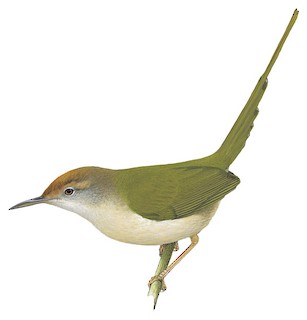
Where does the Common Tailorbird live?
Orthotomus sutorius
Spotted a bird? Identify it instantly with the Birdby app
Open the appThe Common Tailorbird lives in specific habitats and regions. Knowing where, and when, to look improves your chances of a successful sighting.
Biomes
Tropical and subtropical moist broadleaf forests, scrubland, gardens, agricultural areas, and urban parks.
Geographic range
Widely distributed across tropical Asia, from India and Sri Lanka eastward through Southeast Asia, including parts of China, Myanmar, Thailand, Laos, Cambodia, Vietnam, Malaysia, Singapore, and Indonesia (Sumatra, Java, Bali).
Preferred environments
Dense undergrowth, bushes, hedges, and small trees in open country, gardens, orchards, and forest edges. They prefer areas with ample foliage for foraging and nesting.
Elevation range
Typically found from sea level up to 1,500 meters, occasionally higher in some regions.
Where to look
Gardens and Parks
Commonly found in urban and suburban gardens, parks, and cultivated areas with dense shrubbery.
Scrubland and Forest Edges
Look for them in areas with thick undergrowth, scrubland, and the edges of forests.
Agricultural Areas
Can be found in orchards, plantations, and other agricultural landscapes with suitable vegetation.
Field tips
- Listen for its call. The Tailorbird's loud and distinctive song is often the first indication of its presence. Once you hear it, try to locate the source.
- Scan dense foliage. They are small and often hidden within dense bushes and hedges. Look for movement in the leaves as they forage.
- Be patient and still. Tailorbirds are active but can be shy. Remaining still and observing quietly will increase your chances of a good sighting.
- Look for movement. Their constant flitting and tail-cocking behavior can draw attention to them even when partially obscured by leaves.
Migration
Resident throughout its range; it does not undertake long-distance migrations. Local movements may occur in response to food availability or habitat changes.
Explore the Common Tailorbird
Identify birds anywhere
Free on iOS, Android, and Web. Photo & sound identification, full species database, and your personal life list.