
Spotted a bird? Identify it instantly with the Birdby app
Open the appAbout
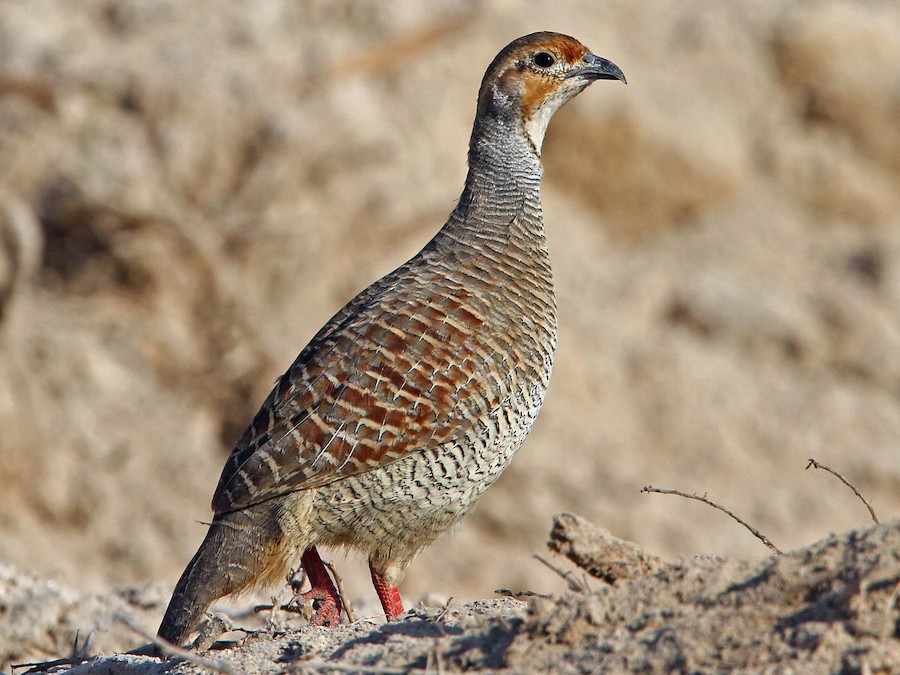
The Grey Francolin is a medium-sized gamebird found across the Indian subcontinent and parts of the Middle East. It is known for its distinctive 'kati-kat-kati-kat' call and its preference for open, dry habitats. It is a ground-dwelling bird, often seen foraging in pairs or small coveys.
Size & lifespan
- Length
- 29-34 cm
- Wingspan
- 45-50 cm
- Weight
- 250-370 g
- Lifespan
- 3-5 years in the wild, up to 10 years in captivity
- Diet
- Omnivore
Physical characteristics
- Plumage
- Overall grey-brown plumage with fine barring and mottling. The face is pale buff with a chestnut collar and a dark eye-stripe. The underparts are buffy-white with fine black vermiculations. The tail is short and rufous, visible in flight. The wings are rounded with rufous primary coverts.
- Beak shape
- Short, stout, and slightly decurved, typically dark horn-colored.
- Eye color
- Dark brown.
- Leg color
- Dull reddish-orange to brownish-red, with males often having a single spur on each leg.
- Distinguishing features
- The most distinctive features are the chestnut collar, the pale buff face, and the finely barred underparts. The rufous tail is also a good field mark, especially when flushed.
- Juvenile appearance
- Juveniles resemble adults but have duller plumage, less distinct facial markings, and lack the chestnut collar. Their barring is also less defined.
- Seasonal changes
- No significant seasonal changes in plumage. Plumage remains consistent throughout the year.
- Sexual dimorphism
- Males and females are largely similar in plumage. Males are typically slightly larger and possess one or two spurs on their tarsi, which are usually absent or rudimentary in females.
How to identify
- 1
Plumage Coloration
Look for the overall grey-brown body with fine barring and mottling. The pale buff face and chestnut collar are key identifiers.
- 2
Facial Markings
Note the pale buff face with a dark eye-stripe and the distinct chestnut band around the neck.
- 3
Underparts
Observe the buffy-white underparts with fine black vermiculations (wavy lines).
- 4
Tail in Flight
When flushed, the short, rufous tail is a good distinguishing feature.
- 5
Vocalization
Learn its characteristic 'kati-kat-kati-kat' call, which is often the first indication of its presence.
- 6
Behavior
They are typically ground-dwelling, running for cover rather than flying, and are often seen in pairs or small coveys in open, dry habitats.
Habitat & range
- Biomes
- Grasslands, scrublands, agricultural fields, open woodlands, semi-deserts.
- Geographic range
- Indian subcontinent (India, Pakistan, Nepal, Bangladesh, Sri Lanka), parts of Iran, Afghanistan, and the Arabian Peninsula. Introduced to some other regions, including the United States (Hawaii).
- Elevation range
- Sea level up to approximately 2,000 meters.
- Preferred environments
- Dry, open country with scattered bushes, thorny scrub, and cultivated areas. They prefer areas with good ground cover for foraging and roosting, often near human habitation.
Behavior
- Activity time
- Diurnal, most active during early morning and late afternoon.
- Feeding habits
- Primarily ground feeders, foraging for seeds, grains, shoots, berries, and insects (termites, ants, beetles). They scratch the ground with their feet to uncover food.
- Social behavior
- Typically found in pairs or small family coveys (up to 10-15 individuals). They are quite vocal, especially at dawn and dusk, maintaining contact with their calls.
- Flight pattern
- Reluctant to fly, preferring to run and hide. When flushed, they fly low and fast for a short distance with rapid wing beats, often gliding before landing and running into cover.
- Migration pattern
- Sedentary and non-migratory throughout its range.
- Territoriality
- Pairs or coveys maintain territories, especially during the breeding season, defending them with calls and occasional aggressive displays.
Song & calls
- Song
- The primary call, often referred to as a 'song', is a loud, repetitive, and distinctive 'kati-kat-kati-kat' or 'patila-patila-patila' which can be heard from a considerable distance. It often accelerates towards the end.
- Call
- In addition to the 'song', they have various alarm calls, contact calls, and softer clucking sounds. An alarm call is a sharp 'kek-kek-kek' when disturbed.
- When they vocalize
- Most vocal at dawn and dusk, but can call throughout the day, especially when disturbed or trying to locate other members of their covey.
Breeding & reproduction
- Breeding season
- Varies geographically, but generally March to October, with peaks during the monsoon season (June-September) in many parts of its range.
- Nesting habits
- Nests are shallow scrapes on the ground, often concealed under a bush, tussock of grass, or in agricultural fields. Lined with grass, leaves, and sometimes feathers.
- Clutch size
- 4-12 eggs, commonly 6-9.
- Egg description
- Typically 6-9 eggs, but can range from 4 to 12. Eggs are pale buff, creamy white, or olive-brown, unspotted, and oval-shaped.
- Incubation period
- 18-21 days.
- Fledging period
- Chicks are precocial and leave the nest shortly after hatching. They can fly short distances within 2-3 weeks and are independent within a few months.
- Parental care
- Mainly by the female, who incubates the eggs and cares for the young. The male may stay nearby and help guard the territory.
Where to find
Agricultural Fields
Often found in cultivated lands, especially those with standing crops or stubble, providing both food and cover.
Scrublands and Grasslands
Dry, open areas with scattered bushes, thorny scrub, and tall grasses are prime habitats.
Roadsides and Edges of Villages
They frequently venture near human settlements, foraging along roadsides and in village outskirts where cover is available.
Field tips
- Listen for Calls. Their loud and distinctive 'kati-kat' call is often the easiest way to locate them, especially at dawn and dusk.
- Scan Open Areas. Look for them foraging on the ground in open fields, often near cover. They can be surprisingly well-camouflaged.
- Watch for Movement. They are shy and will often run for cover if approached. Look for subtle movements in the undergrowth.
- Be Patient. Francolins can be elusive. Sitting quietly in a suitable habitat and waiting for them to emerge or call can be effective.
Similar species
Black Francolin
Francolinus francolinus
The Black Francolin male is distinctly black on the underparts with white spots, a prominent white cheek patch, and a chestnut collar. Females are browner overall with a pale supercilium. The Grey Francolin lacks the extensive black plumage and white cheek patch.
Painted Francolin
Francolinus pictus
The Painted Francolin has a more rufous-brown plumage with distinct white spots and black barring on the underparts, and a prominent white supercilium. Its overall appearance is much more patterned and colorful than the Grey Francolin.
Quick facts
- Call:
- Loud, repetitive 'kati-kat-kati-kat'
- Habitat:
- Dry grasslands, scrub, agricultural fields
- Diet:
- Seeds, grains, insects
- Social Structure:
- Pairs or small coveys
- Flight:
- Short, fast bursts when flushed
Fun facts
- The Grey Francolin is the state bird of Haryana, India.
- Its distinctive call is often used in local folklore and literature in its native range.
- Despite being a game bird, it is often found in close proximity to human habitation, adapting well to agricultural landscapes.
- The species has been introduced to various parts of the world for hunting purposes, though not always successfully establishing populations.
Scientific classification
- Kingdom
- Animalia
- Phylum
- Chordata
- Class
- Aves
- Order
- Galliformes
- Family
- Phasianidae
- Genus
- Ortygornis
- Species
- Ortygornis pondicerianus
Explore the Grey Francolin
Identify birds anywhere
Free on iOS, Android, and Web. Photo & sound identification, full species database, and your personal life list.