
How to identify the Grey Francolin
Ortygornis pondicerianus
Spotted a bird? Identify it instantly with the Birdby app
Open the appTo correctly identify the Grey Francolin (Ortygornis pondicerianus), check each of these features. Birds can be tricky: habit, habitat, and call often confirm a sighting that a single photo cannot.
Size at a glance
- Length
- 29-34 cm
- Wingspan
- 45-50 cm
- Weight
- 250-370 g
Physical features to check
- 1
Plumage
Overall feather coloration and pattern.
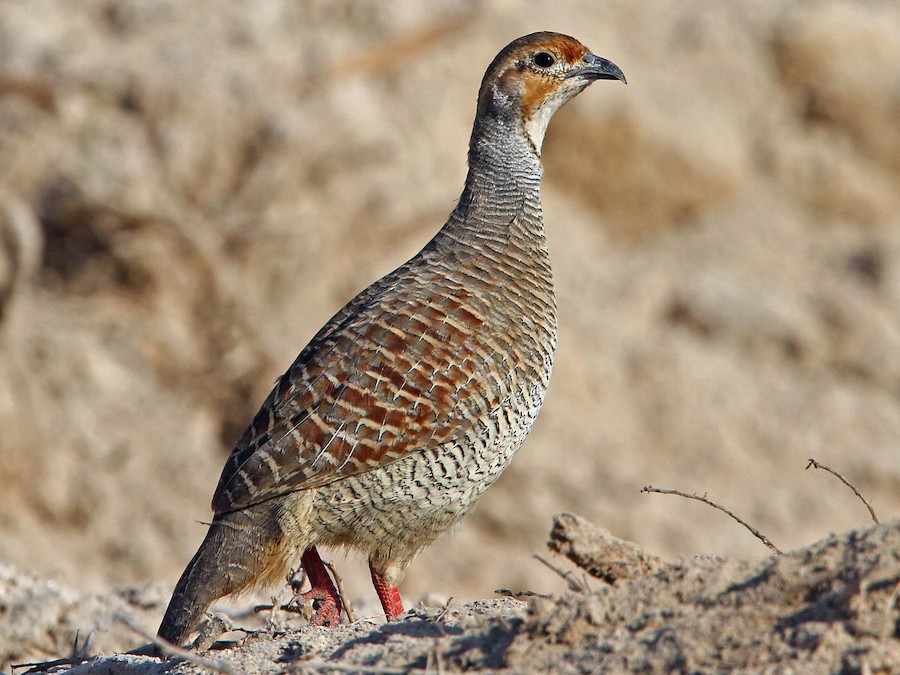
Overall grey-brown plumage with fine barring and mottling. The face is pale buff with a chestnut collar and a dark eye-stripe. The underparts are buffy-white with fine black vermiculations. The tail is short and rufous, visible in flight. The wings are rounded with rufous primary coverts.
- 2
Beak shape
Shape and color of the bill: a key field mark.
Short, stout, and slightly decurved, typically dark horn-colored.
- 3
Eye color
Iris color and any distinctive eye markings.
Dark brown.
- 4
Leg color
Leg and foot color.
Dull reddish-orange to brownish-red, with males often having a single spur on each leg.
- 5
Distinguishing features
Standout features that separate this species.
The most distinctive features are the chestnut collar, the pale buff face, and the finely barred underparts. The rufous tail is also a good field mark, especially when flushed.
- 6
Juvenile appearance
How young birds differ from adults.
Juveniles resemble adults but have duller plumage, less distinct facial markings, and lack the chestnut collar. Their barring is also less defined.
- 7
Seasonal changes
Plumage variation between breeding and non-breeding seasons.
No significant seasonal changes in plumage. Plumage remains consistent throughout the year.
- 8
Sexual dimorphism
How males and females differ.
Males and females are largely similar in plumage. Males are typically slightly larger and possess one or two spurs on their tarsi, which are usually absent or rudimentary in females.
Key field marks
- Plumage Coloration. Look for the overall grey-brown body with fine barring and mottling. The pale buff face and chestnut collar are key identifiers.
- Facial Markings. Note the pale buff face with a dark eye-stripe and the distinct chestnut band around the neck.
- Underparts. Observe the buffy-white underparts with fine black vermiculations (wavy lines).
- Tail in Flight. When flushed, the short, rufous tail is a good distinguishing feature.
- Vocalization. Learn its characteristic 'kati-kat-kati-kat' call, which is often the first indication of its presence.
- Behavior. They are typically ground-dwelling, running for cover rather than flying, and are often seen in pairs or small coveys in open, dry habitats.
Explore the Grey Francolin
Identify birds anywhere
Free on iOS, Android, and Web. Photo & sound identification, full species database, and your personal life list.