
Spotted a bird? Identify it instantly with the Birdby app
Open the appAbout
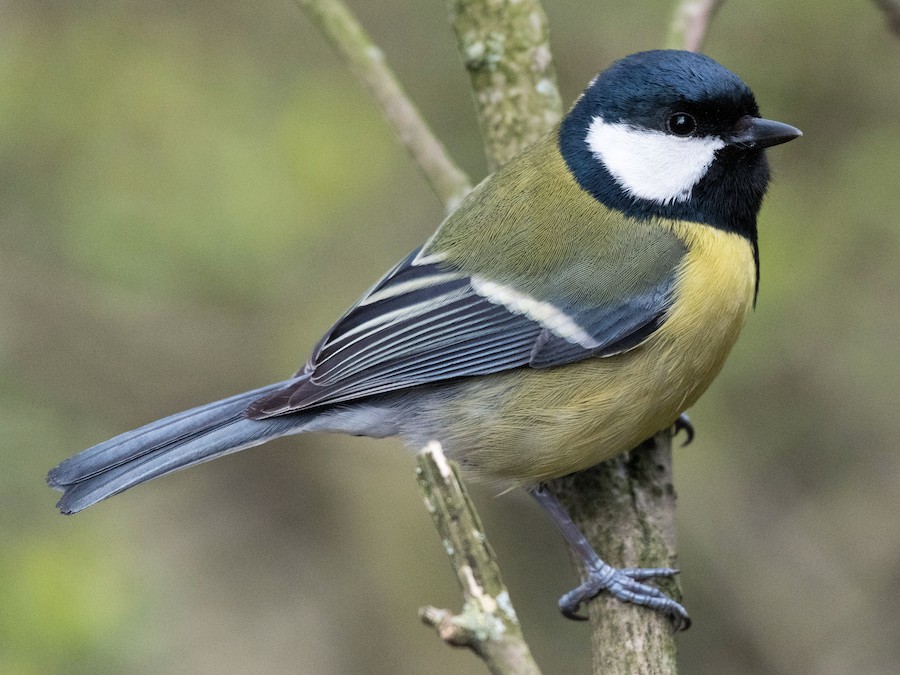
The Great Tit (Parus major) is a widespread and common passerine bird in the tit family Paridae. It is a distinctive and easily recognizable bird, known for its bold black stripe down its yellow breast, black head, and white cheek patches. Great Tits are highly adaptable and can be found in a variety of habitats across Europe, Asia, and parts of North Africa. They are primarily insectivorous but also consume seeds and nuts, especially in winter. Their loud, often repetitive songs are a familiar sound in many gardens and woodlands.
Size & lifespan
- Length
- 13.5-15 cm
- Wingspan
- 22-25 cm
- Weight
- 14-22 g
- Lifespan
- 2-3 years (up to 10 years recorded in the wild)
- Diet
- Omnivore (primarily insectivorous, especially during breeding season; also consumes seeds, nuts, berries, and suet)
Physical characteristics
- Plumage
- Adults have a glossy black head and nape, prominent white cheek patches, and a distinctive black stripe running down the center of a bright yellow breast and belly. The back is olive-green, and the wings are bluish-grey with a white wing-bar. The undertail coverts are white.
- Beak shape
- Short, conical, and stout; blackish-grey in color.
- Eye color
- Dark brown
- Leg color
- Bluish-grey
- Distinguishing features
- The combination of a black head, white cheeks, olive-green back, and a prominent black central stripe on a yellow underside is diagnostic. The white wing-bar is also a good field mark.
- Juvenile appearance
- Juveniles are duller overall, with a yellowish-brown tinge to the black areas of the head and breast stripe. The white cheek patches are often tinged yellow, and the yellow underparts are paler. The olive-green back is also duller.
- Seasonal changes
- No significant seasonal plumage changes. Plumage may appear slightly duller due to wear towards the end of the breeding season before molting.
- Sexual dimorphism
- Males typically have a broader and more continuous black stripe down the breast and belly, extending further between the legs. Females have a narrower, often broken, and less extensive black stripe. The yellow on the underside of males is often brighter.
How to identify
- 1
Size and Shape
A medium-sized, plump tit with a relatively short tail. Larger than Blue Tits and Coal Tits.
- 2
Head Pattern
Look for the glossy black cap and nape, contrasting sharply with bright white cheek patches.
- 3
Underparts
The bright yellow breast and belly with a prominent, broad black stripe running down the center is the most distinctive feature. The stripe is broader in males.
- 4
Back and Wings
Olive-green back and bluish-grey wings with a single white wing-bar.
- 5
Vocalization
Listen for its characteristic 'teacher, teacher' song, a clear, ringing, two-note or three-note phrase, often repeated.
- 6
Behavior
Active and agile, often seen clinging upside down on branches or foraging on the ground. Readily visits bird feeders.
Habitat & range
- Biomes
- Temperate forests, deciduous woodlands, mixed woodlands, parks, gardens, orchards, hedgerows, urban areas.
- Geographic range
- Widespread across Europe, North Africa, and much of Asia, from the British Isles and Iberia east to Japan and Indonesia. Absent from Iceland and parts of northern Scandinavia.
- Elevation range
- Sea level up to 2,000 meters, occasionally higher in some mountain ranges.
- Preferred environments
- Prefers areas with mature trees, especially deciduous, and a good understory. Highly adaptable to human-modified landscapes, including suburban gardens and city parks, as long as suitable nesting sites and food sources are available.
Behavior
- Activity time
- Diurnal, active from dawn to dusk.
- Feeding habits
- Forages actively in trees and shrubs, gleaning insects and spiders from leaves and bark. Also feeds on the ground. In winter, readily visits bird feeders for seeds (especially sunflower seeds), peanuts, and suet. Known to hold larger food items with its feet and hammer them open with its beak. Will also consume buds, fruits, and nectar.
- Social behavior
- During the breeding season, they are territorial and typically seen in pairs. Outside the breeding season, they often join mixed-species foraging flocks, particularly with other tit species, to exploit food resources and for increased vigilance against predators.
- Flight pattern
- Undulating flight pattern, typical of many small passerines, with rapid wing beats interspersed with short glides.
- Migration pattern
- Mostly resident throughout its range. Northern populations may undertake short-distance, irruptive movements in harsh winters or when food is scarce. Some populations in eastern Europe and Asia show more regular migratory movements.
- Territoriality
- Highly territorial during the breeding season, with males defending nesting and foraging areas through song and aggressive displays.
Song & calls
- Song
- Highly varied and often described as a 'teacher, teacher' or 'tee-cher, tee-cher' song, a clear, ringing, two-note or three-note phrase repeated rhythmically. Males have a repertoire of several song types, which they switch between. The song is loud and far-carrying.
- Call
- A wide range of calls, including a sharp 'pink' or 'chink' contact call, a scolding 'churr' or 'tsee-tsee-tsee' alarm call, and various other conversational notes. The alarm call is often given when predators are present.
- When they vocalize
- Most vocal during the breeding season (late winter to summer) when males sing to attract mates and defend territory. Calls are given year-round.
Breeding & reproduction
- Breeding season
- Typically March to July, with peak activity in April-May. Often raises two broods, sometimes three, in a season.
- Nesting habits
- Nests in cavities, primarily natural tree holes, but readily uses nest boxes. Also uses crevices in walls, pipes, and other artificial structures. The female builds the nest, which is a cup-shaped structure of moss, grass, hair, wool, and feathers.
- Clutch size
- 6-12 eggs (typically 7-9)
- Egg description
- 8-12 eggs (average 7-9), white with reddish-brown speckles, particularly concentrated at the broader end. Smooth and slightly glossy.
- Incubation period
- 12-15 days, primarily by the female.
- Fledging period
- 16-22 days after hatching. Both parents feed the nestlings.
- Parental care
- Both parents feed the young. After fledging, the young remain dependent on the parents for several days to a week, learning to forage independently.
Where to find
Gardens and Parks
Very common in suburban and urban green spaces, especially those with mature trees and bird feeders.
Woodlands
Abundant in deciduous, mixed, and coniferous woodlands, particularly those with an open understory.
Orchards and Hedgerows
Found in agricultural landscapes with suitable tree cover and nesting opportunities.
Forest Edges
Often seen at the edges of forests where they can exploit both woodland and open habitats.
Field tips
- Listen for their song. Their loud and distinctive 'teacher, teacher' song is often the first indication of their presence, especially in spring and early summer.
- Check bird feeders. Great Tits are frequent visitors to garden bird feeders, particularly for sunflower seeds and peanuts, especially in winter.
- Scan tree branches. Look for them actively foraging on branches, gleaning insects from leaves and bark. They are often quite bold and approachable.
- Look for mixed flocks. Outside the breeding season, they often join mixed-species tit flocks, so if you see other tits, a Great Tit might be nearby.
- Observe nesting sites. In spring, look for activity around tree holes or nest boxes, as they are cavity nesters.
Similar species
Blue Tit
Cyanistes caeruleus
Smaller than Great Tit. Blue Tits have a blue cap, blue wings, and a white face with a black eye-stripe, lacking the Great Tit's black breast stripe and olive-green back. Their underparts are yellow but without the prominent black stripe.
Coal Tit
Periparus ater
Smaller and more slender than Great Tit. Coal Tits have a black cap, white cheek patches, and a distinctive white patch on the nape (back of the neck). Their underparts are buffy-white, not yellow, and they lack the black breast stripe. Their back is greyish-olive.
Marsh Tit
Poecile palustris
Similar size but lacks the yellow underparts and black breast stripe. Marsh Tits have a plain black cap, plain white cheeks, and buffy-grey underparts. They lack any white wing-bar.
Willow Tit
Poecile montanus
Very similar to Marsh Tit, but often distinguished by a slightly larger, duller black cap and a pale panel on the secondary wing feathers (often difficult to see). Like Marsh Tit, it lacks the yellow underparts and black breast stripe of the Great Tit.
Quick facts
- Diet:
- Insects, seeds, nuts
- Habitat:
- Woodlands, gardens, parks
- Nesting:
- Cavity nester (tree holes, nest boxes)
- Song:
- 'Teacher, teacher' call
- Conservation Status:
- Least Concern
- Social Behavior:
- Pairs in breeding season, mixed flocks in winter
Fun facts
- Great Tits are known for their intelligence and problem-solving abilities. They have been observed learning to open milk bottle tops to get at the cream in the past, and can learn complex foraging techniques.
- The width of the black breast stripe in male Great Tits is an indicator of their dominance and fitness, with broader stripes generally indicating a more dominant individual.
- They have a remarkably varied song repertoire, with individual males often having several distinct song types they can switch between, which is thought to be attractive to females.
- Great Tits are one of the most studied bird species in Europe, providing valuable insights into ecology, behavior, and population dynamics.
- In some parts of their range, Great Tits have been observed preying on hibernating bats, entering caves to kill and eat them, especially during harsh winters when insect prey is scarce.
Scientific classification
- Kingdom
- Animalia
- Phylum
- Chordata
- Class
- Aves
- Order
- Passeriformes
- Family
- Paridae
- Genus
- Parus
- Species
- Parus major
Explore the Great Tit
Identify birds anywhere
Free on iOS, Android, and Web. Photo & sound identification, full species database, and your personal life list.