
How to identify the Great Tit
Parus major
Spotted a bird? Identify it instantly with the Birdby app
Open the appTo correctly identify the Great Tit (Parus major), check each of these features. Birds can be tricky: habit, habitat, and call often confirm a sighting that a single photo cannot.
Size at a glance
- Length
- 13.5-15 cm
- Wingspan
- 22-25 cm
- Weight
- 14-22 g
Physical features to check
- 1
Plumage
Overall feather coloration and pattern.
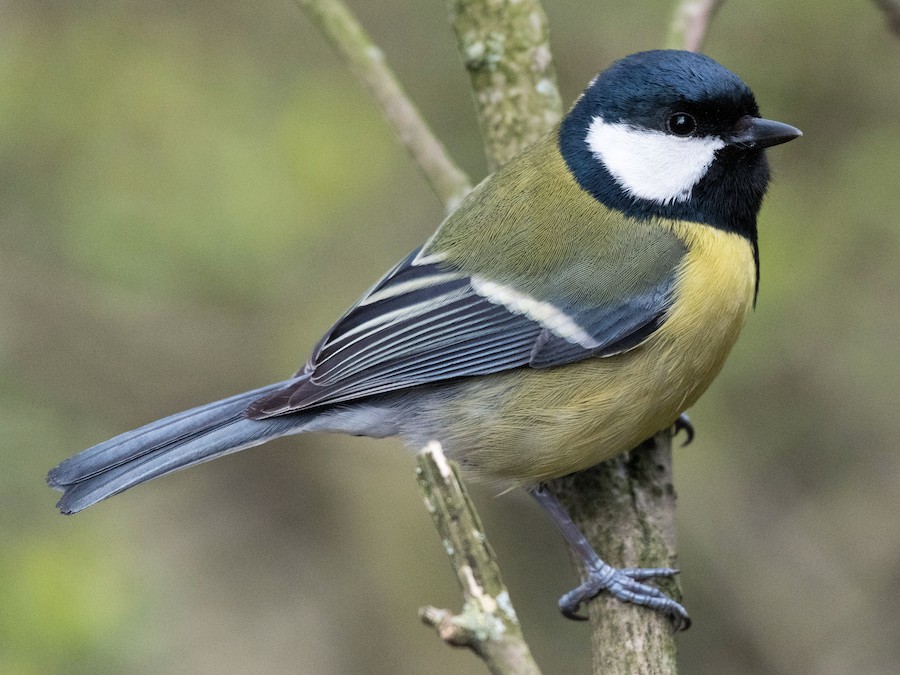
Adults have a glossy black head and nape, prominent white cheek patches, and a distinctive black stripe running down the center of a bright yellow breast and belly. The back is olive-green, and the wings are bluish-grey with a white wing-bar. The undertail coverts are white.
- 2
Beak shape
Shape and color of the bill: a key field mark.
Short, conical, and stout; blackish-grey in color.
- 3
Eye color
Iris color and any distinctive eye markings.
Dark brown
- 4
Leg color
Leg and foot color.
Bluish-grey
- 5
Distinguishing features
Standout features that separate this species.
The combination of a black head, white cheeks, olive-green back, and a prominent black central stripe on a yellow underside is diagnostic. The white wing-bar is also a good field mark.
- 6
Juvenile appearance
How young birds differ from adults.
Juveniles are duller overall, with a yellowish-brown tinge to the black areas of the head and breast stripe. The white cheek patches are often tinged yellow, and the yellow underparts are paler. The olive-green back is also duller.
- 7
Seasonal changes
Plumage variation between breeding and non-breeding seasons.
No significant seasonal plumage changes. Plumage may appear slightly duller due to wear towards the end of the breeding season before molting.
- 8
Sexual dimorphism
How males and females differ.
Males typically have a broader and more continuous black stripe down the breast and belly, extending further between the legs. Females have a narrower, often broken, and less extensive black stripe. The yellow on the underside of males is often brighter.
Key field marks
- Size and Shape. A medium-sized, plump tit with a relatively short tail. Larger than Blue Tits and Coal Tits.
- Head Pattern. Look for the glossy black cap and nape, contrasting sharply with bright white cheek patches.
- Underparts. The bright yellow breast and belly with a prominent, broad black stripe running down the center is the most distinctive feature. The stripe is broader in males.
- Back and Wings. Olive-green back and bluish-grey wings with a single white wing-bar.
- Vocalization. Listen for its characteristic 'teacher, teacher' song, a clear, ringing, two-note or three-note phrase, often repeated.
- Behavior. Active and agile, often seen clinging upside down on branches or foraging on the ground. Readily visits bird feeders.
Explore the Great Tit
Identify birds anywhere
Free on iOS, Android, and Web. Photo & sound identification, full species database, and your personal life list.