
Spotted a bird? Identify it instantly with the Birdby app
Open the appAbout
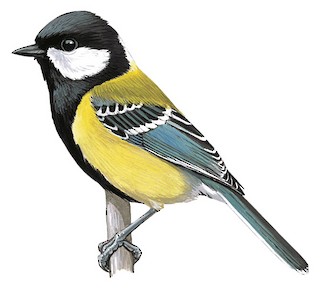
The Green-backed Tit is a medium-sized tit, characterized by its distinctive plumage with a prominent broad black central stripe on its underparts extending from the bib to the vent. It is recognized by its olive-green back and yellowish underparts. Active and vocal, it is a common resident in its range, often seen foraging in the canopy and mid-story of forests and woodlands.
Size & lifespan
- Length
- 12-13 cm
- Wingspan
- 18-20 cm
- Weight
- 11-15 g
- Lifespan
- 3-5 years (in the wild)
- Diet
- Primarily insects and other invertebrates, especially during breeding season. Also consumes seeds, nuts, and berries, particularly in winter.
Physical characteristics
- Plumage
- Adults have a black head with large white cheek patches, a broad black bib extending down the breast and belly as a thick central stripe. The upperparts are olive-green with two prominent white wing-bars. Underparts are bright yellow, becoming paler towards the vent, with the central black stripe being a key identification feature. The tail is blackish with white outer tail feathers. The rump is grayish-green.
- Beak shape
- Small, conical, and sharp, typical of insectivorous birds, adapted for probing and cracking small seeds.
- Eye color
- Dark brown.
- Leg color
- Dark gray to blackish.
- Distinguishing features
- The broad black stripe down the center of the yellow underparts from the bib to the vent, combined with the olive-green back and white wing-bars, are the most distinct features. The large white cheek patches contrasting with the black head are also very noticeable.
- Juvenile appearance
- Juveniles resemble adults but have duller plumage. Their black areas are often brownish or dusky, the yellow on the underparts is paler, and the white cheek patches may be tinged with yellow. The black central stripe on the underparts is less distinct and may appear mottled.
- Seasonal changes
- Plumage does not show significant seasonal variation; it remains consistent year-round, although colors may appear fresher after molting.
- Sexual dimorphism
- Males and females are generally similar in plumage. Males may have a slightly broader and more intensely black central stripe on the underparts, and their colors may appear marginally brighter, but the differences are subtle and not reliable for field identification.
How to identify
- 1
Plumage
Look for the olive-green back, bright yellow underparts, and especially the broad, continuous black stripe running down the center of the yellow belly from the black bib. White cheek patches on a black head and two white wing-bars are also key.
- 2
Behavior
Observe its active foraging style, often hanging upside down. Its presence in mixed-species flocks outside the breeding season can also be indicative.
- 3
Vocalization
Listen for its clear, ringing, high-pitched song, 'sisi-sisi-si-tui-tui', and sharp 'pee-tit' calls.
- 4
Habitat
Confirm the elevation and forest type. If found in mountainous, forested regions of the Himalayas or Southeast Asia, it increases the likelihood.
Habitat & range
- Biomes
- Temperate forests, subtropical/tropical moist montane forests.
- Geographic range
- Himalayan region (from Pakistan eastward through northern India, Nepal, Bhutan) and mountainous regions of Southeast Asia (Myanmar, southern China, Vietnam, Laos, Taiwan).
- Elevation range
- Typically found at elevations between 900 to 3,000 meters, but sometimes observed lower in winter.
- Preferred environments
- Coniferous, broadleaf, and mixed deciduous forests, oak forests, rhododendron forests. Also frequents gardens and parks with mature trees in hill stations.
Behavior
- Activity time
- Diurnal. Most active during the morning and late afternoon.
- Feeding habits
- Arboreal forager, gleaning insects and larvae from leaves, twigs, and bark. Also hangs upside down to extract food. Will visit bird feeders for seeds and peanuts, especially in winter. Often observed in mixed-species foraging flocks during non-breeding seasons.
- Social behavior
- Usually seen in pairs during the breeding season. Outside of breeding, they often join mixed-species foraging flocks, particularly with other tit species, warblers, and leafbirds.
- Flight pattern
- Undulating flight pattern, typical of many tits, characterized by short bursts of wing beats followed by a glide with wings closed.
- Migration pattern
- Generally resident throughout its range. Altitudinal migrant, moving to lower elevations during harsh winter months, but not typically a long-distance migrant.
- Territoriality
- Territorial during the breeding season, with pairs defending nesting areas. Outside of this period, they are less territorial and often associate with other birds.
Song & calls
- Song
- A clear, ringing, high-pitched song, often described as 'sisi-sisi-si-tui-tui' or 'weety-weety-witty-witty'. It is varied and can include repeated phrases, often quite musical and loud for its size.
- Call
- A variety of calls including a sharp 'pee-tit', a churring 'chick-a-dee-dee-dee' alarm call, and conversational 'sit-chick' notes while foraging. Also a scolding 'chrr' when disturbed.
- When they vocalize
- Most vocal during the breeding season (spring and early summer) to establish territories and attract mates. Also calls frequently while foraging year-round to maintain contact within flocks.
Breeding & reproduction
- Breeding season
- Typically April to July, varying slightly with geographical location and altitude.
- Nesting habits
- Nests in natural cavities in trees, old woodpecker holes, or occasionally in artificial nest boxes. The nest is a cup-shaped structure made of moss, animal hair, feathers, and spider silk.
- Clutch size
- 4-8 eggs.
- Egg description
- Usually 4-8 eggs, white with reddish-brown spots, particularly concentrated at the larger end.
- Incubation period
- Approximately 12-14 days, primarily by the female.
- Fledging period
- Chicks fledge around 16-18 days after hatching.
- Parental care
- Both parents participate in feeding the young. The male often feeds the female during incubation. Once hatched, both parents actively forage to provide insects and larvae for the chicks.
Where to find
Forest Trails
Walk along trails in broadleaf, conifer, and mixed forests in its altitudinal range.
Tree Canopies and Mid-story
Scan the upper and middle layers of trees where they actively forage for insects.
Gardens and Parks
In some hill stations and surrounding areas, they can be found in well-wooded gardens and parks, particularly during winter.
Field tips
- Look for mixed-species flocks. During non-breeding seasons, Green-backed Tits frequently join mixed-species foraging flocks, which can be noisy and easier to spot.
- Listen for calls. Their distinct calls and songs are often the first indication of their presence, especially when they are hidden by foliage.
- Scan tree trunks and branches. They actively glean insects from bark and leaves, so careful observation of tree surfaces can reveal them.
- Visit bird feeders in winter. In areas where feeders are present within their range, especially at higher altitudes, they may visit for seeds and nuts.
Similar species
Great Tit
Parus major
The Green-backed Tit is very similar to the Great Tit. Key distinctions include the Green-backed Tit's olive-green back (versus gray-blue or greenish-yellow in Great Tit), much brighter yellow underparts (versus duller yellow-green or off-white), and two distinct white wing-bars (versus a single or fainter bar in Great Tit). The black central stripe on the underparts is generally thicker and more uniform in the Green-backed Tit, extending further down. The nape patch is usually white in Great Tit but can be less distinct or absent in Green-backed Tit.
Himalayan Tit
Parus rufonuchalis
The Himalayan Tit has a black head and chest, but lacks the broad black central stripe on the belly. Its underparts are white to pale gray, not yellow. It also has a rufous nape patch, unlike the Green-backed Tit.
Quick facts
- Distinctive Mark:
- Broad black central stripe on yellow underparts
- Habitat Preference:
- Montane forests (coniferous, broadleaf, mixed)
- Diet Specialty:
- Insects and larvae, also seeds in winter
- Social Behavior:
- Often joins mixed-species flocks
- Migration:
- Altitudinal migrant (downslope in winter)
Fun facts
- The Green-backed Tit's close resemblance to the Great Tit has sometimes led to confusion in field identification, highlighting the importance of looking for subtle plumage differences.
- Like many tits, they are highly acrobatic foragers, capable of hanging upside down from branches and twigs to access food.
- Their presence is often a good indicator of healthy forest ecosystems, as they rely on a steady supply of insects found in these environments.
Scientific classification
- Kingdom
- Animalia
- Phylum
- Chordata
- Class
- Aves
- Order
- Passeriformes
- Family
- Paridae
- Genus
- Parus
- Species
- monticolus
Explore the Green-backed Tit
Identify birds anywhere
Free on iOS, Android, and Web. Photo & sound identification, full species database, and your personal life list.