
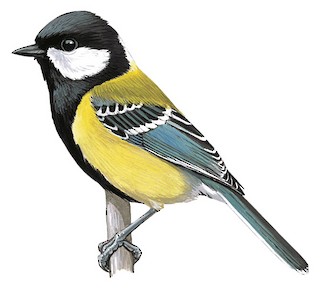
Where does the Green-backed Tit live?
Parus monticolus
Spotted a bird? Identify it instantly with the Birdby app
Open the appThe Green-backed Tit lives in specific habitats and regions. Knowing where, and when, to look improves your chances of a successful sighting.
Biomes
Temperate forests, subtropical/tropical moist montane forests.
Geographic range
Himalayan region (from Pakistan eastward through northern India, Nepal, Bhutan) and mountainous regions of Southeast Asia (Myanmar, southern China, Vietnam, Laos, Taiwan).
Preferred environments
Coniferous, broadleaf, and mixed deciduous forests, oak forests, rhododendron forests. Also frequents gardens and parks with mature trees in hill stations.
Elevation range
Typically found at elevations between 900 to 3,000 meters, but sometimes observed lower in winter.
Where to look
Forest Trails
Walk along trails in broadleaf, conifer, and mixed forests in its altitudinal range.
Tree Canopies and Mid-story
Scan the upper and middle layers of trees where they actively forage for insects.
Gardens and Parks
In some hill stations and surrounding areas, they can be found in well-wooded gardens and parks, particularly during winter.
Field tips
- Look for mixed-species flocks. During non-breeding seasons, Green-backed Tits frequently join mixed-species foraging flocks, which can be noisy and easier to spot.
- Listen for calls. Their distinct calls and songs are often the first indication of their presence, especially when they are hidden by foliage.
- Scan tree trunks and branches. They actively glean insects from bark and leaves, so careful observation of tree surfaces can reveal them.
- Visit bird feeders in winter. In areas where feeders are present within their range, especially at higher altitudes, they may visit for seeds and nuts.
Migration
Generally resident throughout its range. Altitudinal migrant, moving to lower elevations during harsh winter months, but not typically a long-distance migrant.
Explore the Green-backed Tit
Identify birds anywhere
Free on iOS, Android, and Web. Photo & sound identification, full species database, and your personal life list.