
Spotted a bird? Identify it instantly with the Birdby app
Open the appAbout
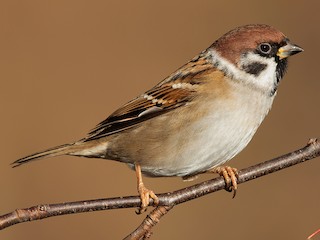
The Eurasian Tree Sparrow is a small passerine bird in the sparrow family Passeridae. It is a widespread species in Eurasia, characterized by its chestnut crown, black ear patch, and relatively small size compared to its close relative, the House Sparrow. It is often found in rural areas, woodlands, and human settlements, but generally avoids dense urban centers.
Size & lifespan
- Length
- 12.5-14 cm
- Wingspan
- 20-22 cm
- Weight
- 19-24 g
- Lifespan
- 2-5 years (up to 10 years recorded)
- Diet
- Omnivore (primarily seeds, insects, and some plant matter)
Physical characteristics
- Plumage
- Adults have a rich chestnut-brown crown and nape, a white collar extending from the nape to the sides of the neck, and a distinct black patch on the white cheek. The upperparts are streaked brown and black, while the underparts are plain greyish-white. The wings are brownish with two distinct white wing bars. The rump is greyish-brown.
- Beak shape
- Conical and stout, dark grey to black, especially during breeding season.
- Eye color
- Dark brown.
- Leg color
- Pale brown to yellowish-brown.
- Distinguishing features
- The most distinctive features are the chestnut crown, white collar, and the prominent black ear patch on a white cheek. These marks differentiate it clearly from the House Sparrow.
- Juvenile appearance
- Juveniles resemble adults but have duller plumage. The chestnut crown is less vibrant, the black ear patch is less defined, and the overall coloration is softer and more muted. The bill is often paler, yellowish at the base.
- Seasonal changes
- No significant seasonal changes in plumage. The plumage may appear slightly fresher after the autumn molt and more worn by late spring.
- Sexual dimorphism
- None; males and females are virtually identical in plumage.
How to identify
- 1
Head Pattern
Look for the distinctive chestnut-brown crown and nape, a clear white collar, and a prominent black patch on the white cheek. This combination is unique among sparrows in its range.
- 2
Plumage Coloration
Note the streaked brown upperparts and plain greyish-white underparts. Two clear white wing bars are also a good field mark.
- 3
Size and Shape
It's a small, compact sparrow, slightly smaller and more slender than a House Sparrow.
- 4
Vocalization
Listen for its characteristic sharp, metallic 'chip' call, which is distinct from the House Sparrow's more varied chirps.
- 5
Behavior
Observe its preference for more rural or semi-open habitats compared to the House Sparrow's strong association with dense urban areas.
Habitat & range
- Biomes
- Temperate forests, grasslands, agricultural lands, urban and suburban areas (less common in dense cities than House Sparrow).
- Geographic range
- Widespread across most of temperate Eurasia, from Western Europe to East Asia. Introduced populations exist in parts of North America (primarily around St. Louis, Missouri) and Australia.
- Elevation range
- Sea level up to 2,000 meters, occasionally higher in some parts of its range.
- Preferred environments
- Prefers open woodland, farmland with hedgerows, orchards, parks, gardens, and rural villages. It is often associated with human habitation but less dependent on it than the House Sparrow, frequently nesting in natural tree cavities away from buildings.
Behavior
- Activity time
- Diurnal.
- Feeding habits
- Primarily ground feeders, foraging for seeds (especially cereals and weeds) and insects. They will also visit bird feeders. During the breeding season, insects form a larger proportion of their diet, particularly for feeding young. They often feed in small flocks.
- Social behavior
- Highly social, often forming flocks outside the breeding season, sometimes mixed with other finches and sparrows. During breeding, they are colonial or semi-colonial, nesting in close proximity to other pairs.
- Flight pattern
- Strong, direct, and undulating flight, typical of sparrows. They often fly in loose flocks.
- Migration pattern
- Mostly resident throughout its range, though northern populations may undertake short-distance migratory movements to milder areas in winter. Juveniles may disperse further from their natal sites.
- Territoriality
- During the breeding season, pairs defend a small territory around the nest site, but foraging often occurs communally.
Song & calls
- Song
- The song is a series of cheerful, chattering notes, often described as a rapid 'chip-chip-chip' or 'twee-twee-twee' with some variations. It is less complex and more monotonous than the House Sparrow's song.
- Call
- Common calls include a sharp, metallic 'chip' or 'chup', often repeated. Also a softer 'teck' or 'tseep'. Alarm calls are harsher and more insistent.
- When they vocalize
- Vocalizes year-round, but most frequently and intensely during the breeding season (spring and early summer).
Breeding & reproduction
- Breeding season
- Typically April to August, with two to three broods per year.
- Nesting habits
- Nests are typically built in tree cavities, old woodpecker holes, nest boxes, crevices in buildings, or sometimes in dense bushes. The nest is a messy, domed structure made of grass, stems, roots, and feathers, often with a side entrance.
- Clutch size
- 4-6 eggs (occasionally 3-8).
- Egg description
- 4-6 eggs, white to pale greyish-white, heavily speckled and blotched with dark brown or grey, particularly at the broader end. Eggs measure approximately 19 x 14 mm.
- Incubation period
- 11-14 days, primarily by the female, but both parents participate.
- Fledging period
- 15-18 days after hatching. Young are fed by both parents.
- Parental care
- Both male and female participate in nest building, incubation, and feeding of the young. After fledging, the young are still fed by parents for a short period.
Where to find
Rural Areas
Farmlands, orchards, and villages with scattered trees and hedgerows are prime locations.
Parks and Gardens
Especially those with mature trees and less human disturbance than city centers.
Woodland Edges
Open woodlands and forest edges provide suitable nesting and foraging sites.
Bird Feeders
They will readily visit feeders, especially in winter, for seeds.
Field tips
- Look for the distinctive head pattern. The chestnut crown and black ear patch are the most reliable identification features, visible even at a distance.
- Listen for calls. Their sharp 'chip' call is a good indicator of their presence and can help distinguish them from other sparrows.
- Observe habitat preference. If you're in a rural or semi-rural setting, especially near trees or old buildings, you're more likely to encounter them than in a bustling city center.
- Check tree cavities and nest boxes. They frequently nest in natural holes or artificial nest boxes, so observing these can reveal their presence.
Similar species
House Sparrow
Passer domesticus
The House Sparrow male has a grey crown, a black bib, and white cheeks without a black patch. The female House Sparrow is duller brown overall with a plain buffy supercilium. The Eurasian Tree Sparrow has a distinctive chestnut crown, white collar, and black ear patch on both sexes, making it easily distinguishable.
Russet Sparrow
Passer rutilans
The Russet Sparrow male has a bright rufous-chestnut head and upperparts, a black bib, and white cheeks. The female is duller but still shows rufous tones. The Eurasian Tree Sparrow has a chestnut crown but a white collar and black ear patch, which the Russet Sparrow lacks.
Quick facts
- Crown Color:
- Chestnut-brown
- Cheek Mark:
- Black patch on white cheek
- Sexual Dimorphism:
- Absent
- Primary Diet:
- Seeds and insects
- Nesting Site:
- Tree cavities, nest boxes, building crevices
Fun facts
- Unlike the House Sparrow, both male and female Eurasian Tree Sparrows look identical, making sexing in the field impossible without close examination or genetic testing.
- In some parts of its range, particularly in East Asia, the Eurasian Tree Sparrow is a common urban bird, filling the niche often occupied by the House Sparrow in Europe and North America.
- The introduced population in North America originated from 12 pairs released in St. Louis, Missouri, in 1870, and has since spread to surrounding areas but has not expanded as widely as the House Sparrow.
- They are known to be quite adaptable and will readily use artificial nest boxes, which has been beneficial for their populations in some areas.
Scientific classification
- Kingdom
- Animalia
- Phylum
- Chordata
- Class
- Aves
- Order
- Passeriformes
- Family
- Passeridae
- Genus
- Passer
- Species
- Passer montanus
Explore the Eurasian Tree Sparrow
Identify birds anywhere
Free on iOS, Android, and Web. Photo & sound identification, full species database, and your personal life list.