
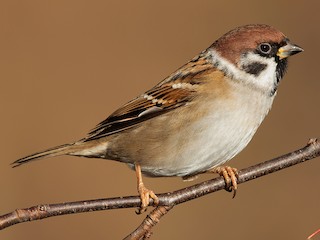
Where does the Eurasian Tree Sparrow live?
Passer montanus
Spotted a bird? Identify it instantly with the Birdby app
Open the appThe Eurasian Tree Sparrow lives in specific habitats and regions. Knowing where, and when, to look improves your chances of a successful sighting.
Biomes
Temperate forests, grasslands, agricultural lands, urban and suburban areas (less common in dense cities than House Sparrow).
Geographic range
Widespread across most of temperate Eurasia, from Western Europe to East Asia. Introduced populations exist in parts of North America (primarily around St. Louis, Missouri) and Australia.
Preferred environments
Prefers open woodland, farmland with hedgerows, orchards, parks, gardens, and rural villages. It is often associated with human habitation but less dependent on it than the House Sparrow, frequently nesting in natural tree cavities away from buildings.
Elevation range
Sea level up to 2,000 meters, occasionally higher in some parts of its range.
Where to look
Rural Areas
Farmlands, orchards, and villages with scattered trees and hedgerows are prime locations.
Parks and Gardens
Especially those with mature trees and less human disturbance than city centers.
Woodland Edges
Open woodlands and forest edges provide suitable nesting and foraging sites.
Bird Feeders
They will readily visit feeders, especially in winter, for seeds.
Field tips
- Look for the distinctive head pattern. The chestnut crown and black ear patch are the most reliable identification features, visible even at a distance.
- Listen for calls. Their sharp 'chip' call is a good indicator of their presence and can help distinguish them from other sparrows.
- Observe habitat preference. If you're in a rural or semi-rural setting, especially near trees or old buildings, you're more likely to encounter them than in a bustling city center.
- Check tree cavities and nest boxes. They frequently nest in natural holes or artificial nest boxes, so observing these can reveal their presence.
Migration
Mostly resident throughout its range, though northern populations may undertake short-distance migratory movements to milder areas in winter. Juveniles may disperse further from their natal sites.
Explore the Eurasian Tree Sparrow
Identify birds anywhere
Free on iOS, Android, and Web. Photo & sound identification, full species database, and your personal life list.