
Spotted a bird? Identify it instantly with the Birdby app
Open the appAbout
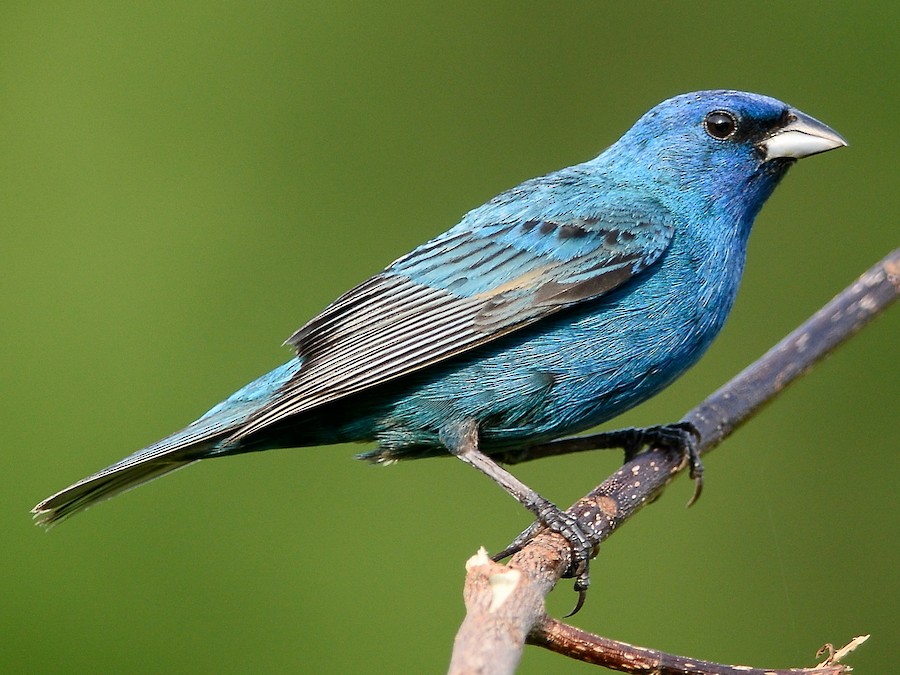
The Indigo Bunting is a small, migratory passerine bird in the cardinal family, Cardinalidae. Males are striking deep blue during the breeding season, while females are duller brown. They are known for their persistent, high-pitched songs and preference for brushy, open habitats.
Size & lifespan
- Length
- 11.5-15 cm (4.5-5.9 in)
- Wingspan
- 18-23 cm (7.1-9.1 in)
- Weight
- 11.2-19.3 g (0.4-0.7 oz)
- Lifespan
- Typically 2-3 years in the wild, up to 10 years recorded.
- Diet
- Omnivore, primarily insects and seeds.
Physical characteristics
- Plumage
- Breeding male: Entirely iridescent deep blue, appearing blackish in poor light or from certain angles. Non-breeding male: Mottled blue and brown. Female: Plain warm brown overall, often with faint streaking on breast and buffy wing bars. Juvenile: Similar to female, but more heavily streaked below.
- Beak shape
- Conical, short, and stout, adapted for crushing seeds. Dark gray to blackish on males, brownish on females.
- Eye color
- Dark brown.
- Leg color
- Dark gray to blackish.
- Distinguishing features
- Males are unmistakable with their vibrant blue plumage. Females are identified by their plain brown coloration, often with a hint of blue on the rump or tail, and a relatively short, conical bill. No wing bars on adult males, faint buffy wing bars on females and juveniles.
- Juvenile appearance
- Juveniles resemble adult females but are more heavily streaked on the underparts and have a more prominent buffy wash. Young males gradually acquire blue feathers during their first fall and winter.
- Seasonal changes
- Adult males undergo a complete molt after breeding, transitioning to a duller, mottled blue and brown plumage for the non-breeding season. They molt back to brilliant blue before the next breeding season. Females and juveniles show less dramatic seasonal changes, primarily related to wear and freshness of feathers.
- Sexual dimorphism
- Pronounced. Males are brilliant blue, females are dull brown.
How to identify
- 1
Male Plumage
Look for the brilliant, uniform deep blue coloration. Note that the blue is structural, meaning it's due to light refraction, so the bird can appear blackish in poor light or from certain angles. In direct sunlight, it glows.
- 2
Female Plumage
Identify by the plain warm brown plumage, often with faint streaking on the breast and sometimes a hint of blue on the rump or tail. Look for faint buffy wing bars and a relatively short, conical bill.
- 3
Song
Listen for the distinctive, high-pitched, rapid, and often doubled phrases: 'sweet-sweet, where-where, here-here, see-it, see-it'. Males sing persistently from prominent perches.
- 4
Habitat
Search in brushy, open areas, forest edges, overgrown fields, and clearings. They prefer areas with dense shrubby cover for nesting and foraging.
- 5
Behavior
Observe males singing from high, exposed perches (e.g., treetops, utility wires) and then dropping into dense cover. They are often shy and can be difficult to spot once they descend.
Habitat & range
- Biomes
- Temperate forests, grasslands, shrublands, agricultural lands.
- Geographic range
- Breeds across eastern North America, from southern Canada to the Gulf Coast. Winters in southern Florida, Mexico, Central America, and the Caribbean.
- Elevation range
- Typically found from sea level up to about 1,500 meters (5,000 feet), occasionally higher in some parts of its range.
- Preferred environments
- Prefers brushy, open woodlands, forest edges, overgrown fields, clearings, powerline cuts, roadsides, and riparian thickets. Requires dense shrubby vegetation for nesting and singing perches.
Behavior
- Activity time
- Diurnal.
- Feeding habits
- Forages on the ground and in low vegetation for insects (caterpillars, grasshoppers, beetles, spiders) and seeds (grasses, thistles, dandelions). Will also eat small fruits and berries. Often seen gleaning insects from foliage.
- Social behavior
- Generally solitary or in pairs during the breeding season. During migration and winter, they can form mixed-species flocks, sometimes in large numbers at feeding sites.
- Flight pattern
- Undulating flight pattern, typical of many small passerines. Males often sing from prominent perches, then drop into dense cover.
- Migration pattern
- Long-distance nocturnal migrant. Migrates south in late summer/early fall (August-October) and returns north in spring (April-May). Males typically arrive on breeding grounds before females.
- Territoriality
- Males are highly territorial during the breeding season, defending their territory with persistent singing and occasional aggressive displays against other males.
Song & calls
- Song
- A high-pitched, sweet, and often rapid series of paired notes, typically described as 'sweet-sweet, where-where, here-here, see-it, see-it'. The song is often delivered from a prominent perch and can be quite persistent, especially on sunny mornings. Each phrase is usually doubled, and the pitch often rises or falls.
- Call
- A sharp 'spik' or 'chip' call, often given when agitated or in flight. Also a soft 'tsit' contact call.
- When they vocalize
- Males sing frequently throughout the breeding season, from dawn until dusk, especially in the morning. Song activity peaks in late spring and early summer. Calls are given year-round.
Breeding & reproduction
- Breeding season
- May to August, with peak activity in June and July.
- Nesting habits
- Nests are typically built by the female, low in dense shrubs, small trees, or thickets, usually 0.5-3 meters (1.5-10 feet) above the ground. The nest is a compact, open cup made of leaves, grasses, twigs, and bark strips, lined with fine grasses, hair, and rootlets.
- Clutch size
- 2-5 eggs, most commonly 3-4.
- Egg description
- Typically 3-4 (sometimes 2-5) pale bluish-white eggs, unmarked. Approximately 19 x 14 mm (0.75 x 0.55 in).
- Incubation period
- 11-14 days, primarily by the female.
- Fledging period
- 9-11 days after hatching. Young are fed by both parents.
- Parental care
- Both parents feed the nestlings and fledglings. Females often initiate a second brood while the male continues to feed the first brood of fledglings.
Where to find
Forest Edges
Look along the transition zones between forests and open fields or clearings.
Overgrown Fields
Areas with dense shrubs, brambles, and tall weeds are prime habitat.
Powerline Cuts/Roadsides
These disturbed areas often provide the brushy habitat they prefer.
Riparian Thickets
Along streams and rivers where dense vegetation grows.
Field tips
- Listen for the song. The persistent song of the male is often the first indication of its presence. Once heard, scan prominent perches in the vicinity.
- Visit early mornings. Males are most active and vocal during the early morning hours, especially on sunny days.
- Use binoculars. Their small size and tendency to perch high or in dense cover make binoculars essential for good views.
- Be patient. They can be elusive. If you hear a song, wait quietly; the male may reappear on a prominent perch.
Similar species
Lazuli Bunting
Passerina amoena
Male Lazuli Bunting has a blue head and back, white belly, and a distinct rusty breast band. Male Indigo Bunting is entirely blue. Female Lazuli Bunting is duller brown than female Indigo, often with a pale blue wash on the rump and two distinct white wing bars, which are usually absent or very faint on female Indigo.
Blue Grosbeak
Passerina caerulea
Blue Grosbeak is larger (15-17 cm) and has a much larger, conical bill. Male Blue Grosbeak is a darker, purplish-blue with two rusty wing bars. Female Blue Grosbeak is warm brown with two rusty wing bars, and a larger bill than female Indigo Bunting.
Eastern Bluebird
Sialia sialis
Eastern Bluebird is larger (16-21 cm) and has a more upright posture. Male Eastern Bluebird has a bright blue back, rusty breast, and white belly. Its bill is slender, unlike the stout bill of the Indigo Bunting. Females are duller but retain the blue and rusty pattern.
Quick facts
- Coloration:
- Males are brilliant blue, females are plain brown.
- Diet:
- Insects and seeds.
- Habitat:
- Brushy fields, forest edges.
- Migration:
- Long-distance nocturnal migrant.
- Song:
- High-pitched, doubled phrases.
Fun facts
- The male Indigo Bunting's blue color is not due to pigment, but rather to the microscopic structure of its feathers, which scatters blue light. Without this structure, the feathers would appear black.
- Indigo Buntings are nocturnal migrants, using the stars for navigation. Studies have shown they can orient themselves using the patterns of stars around Polaris.
- Males often sing over 200 songs per hour during peak breeding season, sometimes singing well into the afternoon.
- Indigo Buntings are frequent hosts for Brown-headed Cowbird brood parasitism, with up to 40% of nests affected in some areas.
Scientific classification
- Kingdom
- Animalia
- Phylum
- Chordata
- Class
- Aves
- Order
- Passeriformes
- Family
- Cardinalidae
- Genus
- Passerina
- Species
- Passerina cyanea
Explore the Indigo Bunting
Identify birds anywhere
Free on iOS, Android, and Web. Photo & sound identification, full species database, and your personal life list.