
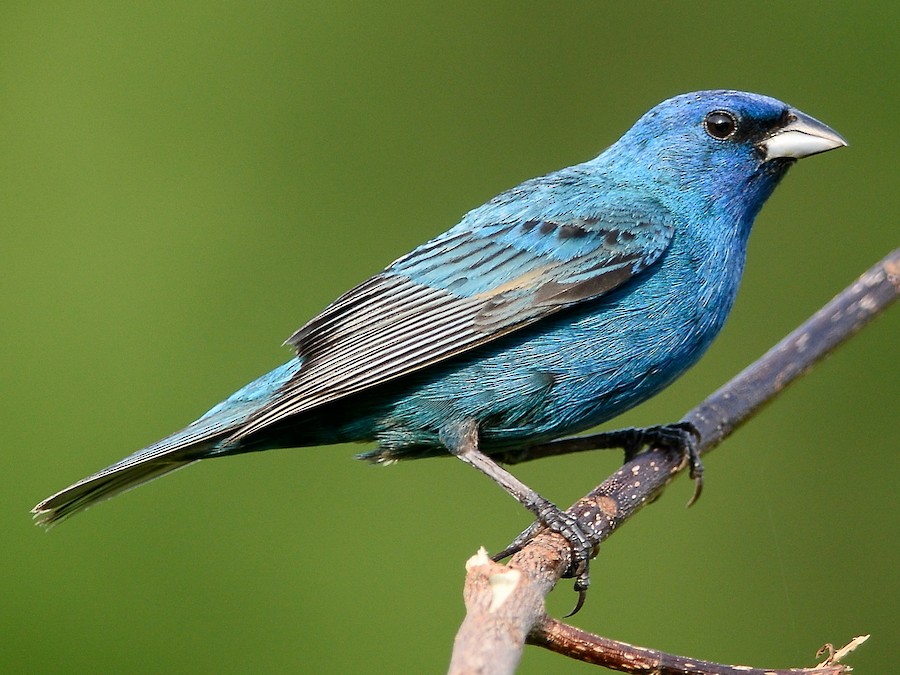
How to identify the Indigo Bunting
Passerina cyanea
Spotted a bird? Identify it instantly with the Birdby app
Open the appTo correctly identify the Indigo Bunting (Passerina cyanea), check each of these features. Birds can be tricky: habit, habitat, and call often confirm a sighting that a single photo cannot.
Size at a glance
- Length
- 11.5-15 cm (4.5-5.9 in)
- Wingspan
- 18-23 cm (7.1-9.1 in)
- Weight
- 11.2-19.3 g (0.4-0.7 oz)
Physical features to check
- 1
Plumage
Overall feather coloration and pattern.
Breeding male: Entirely iridescent deep blue, appearing blackish in poor light or from certain angles. Non-breeding male: Mottled blue and brown. Female: Plain warm brown overall, often with faint streaking on breast and buffy wing bars. Juvenile: Similar to female, but more heavily streaked below.
- 2
Beak shape
Shape and color of the bill: a key field mark.
Conical, short, and stout, adapted for crushing seeds. Dark gray to blackish on males, brownish on females.
- 3
Eye color
Iris color and any distinctive eye markings.
Dark brown.
- 4
Leg color
Leg and foot color.
Dark gray to blackish.
- 5
Distinguishing features
Standout features that separate this species.
Males are unmistakable with their vibrant blue plumage. Females are identified by their plain brown coloration, often with a hint of blue on the rump or tail, and a relatively short, conical bill. No wing bars on adult males, faint buffy wing bars on females and juveniles.
- 6
Juvenile appearance
How young birds differ from adults.
Juveniles resemble adult females but are more heavily streaked on the underparts and have a more prominent buffy wash. Young males gradually acquire blue feathers during their first fall and winter.
- 7
Seasonal changes
Plumage variation between breeding and non-breeding seasons.
Adult males undergo a complete molt after breeding, transitioning to a duller, mottled blue and brown plumage for the non-breeding season. They molt back to brilliant blue before the next breeding season. Females and juveniles show less dramatic seasonal changes, primarily related to wear and freshness of feathers.
- 8
Sexual dimorphism
How males and females differ.
Pronounced. Males are brilliant blue, females are dull brown.
Key field marks
- Male Plumage. Look for the brilliant, uniform deep blue coloration. Note that the blue is structural, meaning it's due to light refraction, so the bird can appear blackish in poor light or from certain angles. In direct sunlight, it glows.
- Female Plumage. Identify by the plain warm brown plumage, often with faint streaking on the breast and sometimes a hint of blue on the rump or tail. Look for faint buffy wing bars and a relatively short, conical bill.
- Song. Listen for the distinctive, high-pitched, rapid, and often doubled phrases: 'sweet-sweet, where-where, here-here, see-it, see-it'. Males sing persistently from prominent perches.
- Habitat. Search in brushy, open areas, forest edges, overgrown fields, and clearings. They prefer areas with dense shrubby cover for nesting and foraging.
- Behavior. Observe males singing from high, exposed perches (e.g., treetops, utility wires) and then dropping into dense cover. They are often shy and can be difficult to spot once they descend.
Explore the Indigo Bunting
Identify birds anywhere
Free on iOS, Android, and Web. Photo & sound identification, full species database, and your personal life list.