
Spotted a bird? Identify it instantly with the Birdby app
Open the appAbout
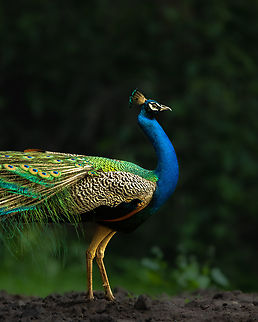
The Indian Peafowl, also known as the Blue Peafowl, is a large and brightly colored bird native to South Asia. It is renowned for the male's elaborate, iridescent tail feathers, which it displays during courtship. It is the national bird of India and is widely recognized for its striking beauty and distinctive calls.
Size & lifespan
- Length
- Male: 195-225 cm (including train); Female: 90-100 cm
- Wingspan
- Male: 130-160 cm; Female: 80-100 cm
- Weight
- Male: 4-6 kg; Female: 2.75-4 kg
- Lifespan
- 10-25 years (wild), up to 30 years (captivity)
- Diet
- Omnivore
Physical characteristics
- Plumage
- Male (peacock): Head, neck, and breast are iridescent blue. A crest of short, fan-shaped feathers tops the head. The most striking feature is the elongated upper tail coverts (train), which can reach up to 1.6 meters in length, covered with elaborate 'eyespot' patterns (ocelli) of blue, green, and gold. The actual tail feathers are short and dull brown. Back is bronze-green, and wings are barred black and buff. Female (peahen): Generally duller, lacking the long train. Head and neck are greenish-blue, breast is brownish-green, and the rest of the body is mottled brown and buff. She has a crest similar to the male but less prominent. Juveniles: Resemble adult females, but are duller and lack the distinct crest. Young males gradually develop iridescent plumage and a short train over several years.
- Beak shape
- Strong, conical, and dark grey to black.
- Eye color
- Dark brown, surrounded by a patch of white skin.
- Leg color
- Dull greyish-brown, strong, with spurs on males.
- Distinguishing features
- Male's elaborate, iridescent train with 'eyespot' patterns; iridescent blue head and neck in males; distinctive crest on both sexes; loud, piercing calls.
- Juvenile appearance
- Juveniles resemble adult females, with duller plumage and a less developed crest. Young males begin to show iridescent blue on the neck and a short train around 2-3 years of age, reaching full maturity around 4-5 years.
- Seasonal changes
- Males shed their long train feathers annually after the breeding season (typically late summer/early autumn) and regrow them in time for the next breeding season (spring). Females do not undergo significant seasonal plumage changes.
- Sexual dimorphism
- Highly dimorphic. Males are significantly larger, possess a long, elaborate train, and have vibrant iridescent blue and green plumage. Females are smaller, lack the train, and have duller, mottled brown and green plumage.
How to identify
- 1
Male's Train
The most unmistakable feature of the male Indian Peafowl is its extraordinarily long, iridescent train, covered with numerous 'eyespot' patterns. This train is displayed in a large fan during courtship.
- 2
Plumage Color (Male)
Look for the vibrant, iridescent blue on the head, neck, and breast of the male. The back is bronze-green.
- 3
Crest
Both sexes have a distinctive crest of short, fan-shaped feathers on their head, though it is more prominent in males.
- 4
Female Plumage
Females are duller, with a greenish-blue neck and mottled brown and buff body plumage, lacking the long train. They are also smaller than males.
- 5
Vocalizations
The loud, piercing 'may-AWE' call is highly characteristic and often heard before the bird is seen.
- 6
Behavior
Observe their ground-dwelling habits, foraging by scratching the soil, and their tendency to roost in tall trees.
Habitat & range
- Biomes
- Dry deciduous forests, scrublands, cultivated areas, and human settlements.
- Geographic range
- Native to the Indian subcontinent, including India, Sri Lanka, Pakistan, Nepal, Bhutan, and Bangladesh. Introduced and naturalized in many parts of the world.
- Elevation range
- Sea level up to 2,000 meters (6,500 feet).
- Preferred environments
- Prefers open forest areas with access to water, clearings for foraging, and tall trees for roosting. Often found near human habitation, agricultural fields, and gardens.
Behavior
- Activity time
- Diurnal, most active during early morning and late afternoon.
- Feeding habits
- Forages on the ground, primarily eating grains, seeds, fruits, insects, small reptiles, amphibians, and sometimes small mammals. They scratch the ground with their feet to uncover food.
- Social behavior
- Gregarious, typically living in small groups consisting of one male and several females, or bachelor groups of males outside the breeding season. During breeding, males establish territories and display to attract females.
- Flight pattern
- Capable of strong, albeit short, flights, especially when escaping predators or reaching roosting trees. Their flight is characterized by rapid wing beats followed by glides. They are primarily terrestrial.
- Migration pattern
- Resident; non-migratory throughout its range.
- Territoriality
- Males are territorial during the breeding season, defending display grounds (leks) where they perform courtship rituals. Females are less territorial.
Song & calls
- Song
- The male's primary vocalization is a loud, piercing, and somewhat mournful 'may-AWE, may-AWE' or 'kee-OW, kee-OW' call, often repeated. This call is used to attract mates and announce its presence.
- Call
- Both sexes produce a variety of other calls, including alarm calls (a sharp 'kak-kak-kak'), contact calls, and softer clucking sounds. Females may make a 'goh-goh' sound when leading chicks.
- When they vocalize
- Most vocal during the breeding season, especially at dawn and dusk, and often before rain. Alarm calls can be heard at any time if a predator is detected.
Breeding & reproduction
- Breeding season
- Typically monsoon season, from April to September, varying geographically.
- Nesting habits
- Nests are shallow scrapes on the ground, often concealed under dense bushes, in tall grass, or in a hollow of a tree stump. The nest is sparsely lined with leaves, sticks, and grass.
- Clutch size
- 3-6 eggs, occasionally up to 8.
- Egg description
- Eggs are oval, pale buff to creamy white, and unspotted. They are relatively large.
- Incubation period
- 28-30 days.
- Fledging period
- Chicks are precocial and can follow the mother shortly after hatching. They become independent around 2-3 months.
- Parental care
- Only the female incubates the eggs and cares for the chicks. Males play no role in parental care after mating.
Where to find
Forest Edges
Look along the edges of dry deciduous forests and scrublands, especially near clearings.
Agricultural Areas
Often found in and around cultivated fields, where they can find grains and insects.
Villages and Temples
Commonly seen in and around human settlements, particularly near temples and gardens, where they are often protected.
Water Sources
They require access to water, so look near rivers, ponds, and other water bodies.
Field tips
- Listen for Calls. Their loud, distinctive calls are often the first indication of their presence. Listen especially at dawn and dusk.
- Look on the Ground. Peafowl are primarily ground-dwelling. Scan open areas, forest floors, and agricultural fields.
- Check Roosting Trees. In the evening, look for them roosting in tall trees, often in groups.
- Visit During Breeding Season. During the monsoon season (April-September), males are more likely to display their trains, making them easier to spot and identify.
- Be Patient and Quiet. While often accustomed to humans, they can be wary. Approach quietly and observe from a distance.
Similar species
Green Peafowl
Pavo muticus
The Green Peafowl has iridescent green body plumage (not blue), a more upright, pointed crest (not fan-shaped), and a bare patch of yellow facial skin. Its calls are also different, typically a louder 'ki-wao' or 'o-yoi'.
Congo Peafowl
Afropavo congensis
The Congo Peafowl is much smaller, found only in central Africa, and lacks the elaborate train of the Asian peafowl species. Males have a short, dense black crest and a metallic blue-green body. Females are duller brown with a green sheen.
Quick facts
- National Bird:
- India
- Display:
- Male's elaborate tail feather display during courtship
- Diet Type:
- Omnivorous, feeding on grains, insects, small reptiles
- Habitat:
- Forests, scrublands, cultivated areas
- Vocalization:
- Loud, piercing 'may-AWE' call
Fun facts
- The male's elaborate 'tail' is not actually its tail feathers, but rather greatly elongated upper tail coverts. The true tail feathers are short and brown, hidden beneath the train.
- Peafowl are known to eat snakes, including venomous ones, making them beneficial in areas where snakes are a concern.
- The 'eyespot' patterns on the male's train are believed to play a crucial role in mate selection, with females preferring males with more and larger ocelli.
- In many cultures, the peafowl is a symbol of beauty, royalty, immortality, and spirituality.
- Despite their large size and elaborate train, peafowl are capable of flying, especially to escape predators or reach high roosting spots.
Scientific classification
- Kingdom
- Animalia
- Phylum
- Chordata
- Class
- Aves
- Order
- Galliformes
- Family
- Phasianidae
- Genus
- Pavo
- Species
- Pavo cristatus
Explore the Indian Peafowl
Identify birds anywhere
Free on iOS, Android, and Web. Photo & sound identification, full species database, and your personal life list.