
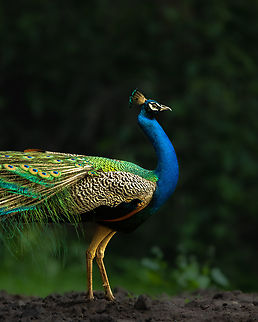
How to identify the Indian Peafowl
Pavo cristatus
Spotted a bird? Identify it instantly with the Birdby app
Open the appTo correctly identify the Indian Peafowl (Pavo cristatus), check each of these features. Birds can be tricky: habit, habitat, and call often confirm a sighting that a single photo cannot.
Size at a glance
- Length
- Male: 195-225 cm (including train); Female: 90-100 cm
- Wingspan
- Male: 130-160 cm; Female: 80-100 cm
- Weight
- Male: 4-6 kg; Female: 2.75-4 kg
Physical features to check
- 1
Plumage
Overall feather coloration and pattern.
Male (peacock): Head, neck, and breast are iridescent blue. A crest of short, fan-shaped feathers tops the head. The most striking feature is the elongated upper tail coverts (train), which can reach up to 1.6 meters in length, covered with elaborate 'eyespot' patterns (ocelli) of blue, green, and gold. The actual tail feathers are short and dull brown. Back is bronze-green, and wings are barred black and buff. Female (peahen): Generally duller, lacking the long train. Head and neck are greenish-blue, breast is brownish-green, and the rest of the body is mottled brown and buff. She has a crest similar to the male but less prominent. Juveniles: Resemble adult females, but are duller and lack the distinct crest. Young males gradually develop iridescent plumage and a short train over several years.
- 2
Beak shape
Shape and color of the bill: a key field mark.
Strong, conical, and dark grey to black.
- 3
Eye color
Iris color and any distinctive eye markings.
Dark brown, surrounded by a patch of white skin.
- 4
Leg color
Leg and foot color.
Dull greyish-brown, strong, with spurs on males.
- 5
Distinguishing features
Standout features that separate this species.
Male's elaborate, iridescent train with 'eyespot' patterns; iridescent blue head and neck in males; distinctive crest on both sexes; loud, piercing calls.
- 6
Juvenile appearance
How young birds differ from adults.
Juveniles resemble adult females, with duller plumage and a less developed crest. Young males begin to show iridescent blue on the neck and a short train around 2-3 years of age, reaching full maturity around 4-5 years.
- 7
Seasonal changes
Plumage variation between breeding and non-breeding seasons.
Males shed their long train feathers annually after the breeding season (typically late summer/early autumn) and regrow them in time for the next breeding season (spring). Females do not undergo significant seasonal plumage changes.
- 8
Sexual dimorphism
How males and females differ.
Highly dimorphic. Males are significantly larger, possess a long, elaborate train, and have vibrant iridescent blue and green plumage. Females are smaller, lack the train, and have duller, mottled brown and green plumage.
Key field marks
- Male's Train. The most unmistakable feature of the male Indian Peafowl is its extraordinarily long, iridescent train, covered with numerous 'eyespot' patterns. This train is displayed in a large fan during courtship.
- Plumage Color (Male). Look for the vibrant, iridescent blue on the head, neck, and breast of the male. The back is bronze-green.
- Crest. Both sexes have a distinctive crest of short, fan-shaped feathers on their head, though it is more prominent in males.
- Female Plumage. Females are duller, with a greenish-blue neck and mottled brown and buff body plumage, lacking the long train. They are also smaller than males.
- Vocalizations. The loud, piercing 'may-AWE' call is highly characteristic and often heard before the bird is seen.
- Behavior. Observe their ground-dwelling habits, foraging by scratching the soil, and their tendency to roost in tall trees.
Explore the Indian Peafowl
Identify birds anywhere
Free on iOS, Android, and Web. Photo & sound identification, full species database, and your personal life list.