
Spotted a bird? Identify it instantly with the Birdby app
Open the appAbout
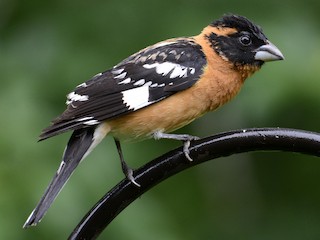
The Black-headed Grosbeak is a medium-sized, stocky songbird known for its striking plumage, particularly in males, and its melodious, robin-like song. It is a common and widespread species across western North America, favoring deciduous and mixed woodlands.
Size & lifespan
- Length
- 18-20 cm (7.1-7.9 in)
- Wingspan
- 31-33 cm (12.2-13.0 in)
- Weight
- 38-55 g (1.3-1.9 oz)
- Lifespan
- Typically 3-5 years in the wild, with records up to 10 years.
- Diet
- Omnivore, primarily insects and seeds, supplemented with fruits and berries.
Physical characteristics
- Plumage
- Adult males have a black head, orange-cinnamon breast and belly, white lower belly, and a black back with white streaking. The wings are black with prominent white patches and bars. The tail is black with white outer tail feathers. Adult females are duller, with a streaky brown head and back, buffy-orange breast, and streaked flanks. They have two buffy wing bars and a pale supercilium. Juveniles resemble females but are often more heavily streaked.
- Beak shape
- Large, conical, and stout, pale gray to horn-colored, ideal for cracking seeds.
- Eye color
- Dark brown.
- Leg color
- Dark gray to black.
- Distinguishing features
- Males are unmistakable with their black head and orange-cinnamon underparts. Females are identified by their large, conical bill, streaky brown plumage, and buffy-orange wash on the breast, often with a pale supercilium.
- Juvenile appearance
- Juveniles resemble adult females but are generally more heavily streaked on the underparts and back, with less distinct markings. Young males may show hints of orange on the breast.
- Seasonal changes
- No significant seasonal plumage changes. Breeding and non-breeding plumages are essentially the same for both sexes, though colors may appear slightly brighter after a fresh molt.
- Sexual dimorphism
- Pronounced. Males are much more brightly colored with a black head and vibrant orange-cinnamon underparts, while females are duller, streaky brown and buff.
How to identify
- 1
Male Plumage
Look for the solid black head, vibrant orange-cinnamon breast and belly, and black back with white streaking. The large white wing patches are also distinctive.
- 2
Female Plumage
Identify by the large, conical bill, streaky brown upperparts, buffy-orange wash on the breast, and two buffy wing bars. A pale supercilium is often present.
- 3
Song
Listen for the rich, warbling, robin-like song, which is a continuous, flowing series of phrases. It's often described as 'liquid' or 'sweet'.
- 4
Call
Listen for the sharp, metallic 'chink' or 'spink' call, often given in flight or as an alarm.
- 5
Bill Shape
The large, conical bill is a key feature for both sexes, distinguishing them from many other songbirds.
Habitat & range
- Biomes
- Deciduous forests, mixed woodlands, riparian corridors, suburban gardens, orchards.
- Geographic range
- Breeds across western North America, from southern British Columbia and Alberta south through the western United States to central Mexico. Winters in Mexico and Central America.
- Elevation range
- Sea level up to 2,700 meters (9,000 feet), primarily in foothills and lower mountain slopes.
- Preferred environments
- Prefers open deciduous or mixed woodlands with a dense understory, especially along streams and rivers. Also found in suburban areas with mature trees and shrubs.
Behavior
- Activity time
- Diurnal.
- Feeding habits
- Forages in trees and shrubs, gleaning insects from foliage and bark. Also eats seeds, berries, and fruits. Will visit bird feeders for sunflower seeds. Known to eat monarch butterflies, which are toxic to many other birds.
- Social behavior
- Typically solitary or found in pairs during the breeding season. May form small flocks during migration and in wintering grounds.
- Flight pattern
- Strong, undulating flight, typical of many finch-like birds. Often flies high between trees.
- Migration pattern
- Long-distance Neotropical migrant. Arrives on breeding grounds in late April to May and departs for wintering grounds in Mexico and Central America from August to October.
- Territoriality
- Males establish and defend breeding territories through song and displays.
Song & calls
- Song
- A rich, warbling, robin-like song, often described as a 'liquid' or 'sweet' whistle. It is a continuous, flowing series of phrases, often delivered from a prominent perch. Both sexes sing, though the male's song is more elaborate.
- Call
- Common calls include a sharp, metallic 'chink' or 'spink', often given in flight or as an alarm call. Also a softer 'peek' or 'whit'.
- When they vocalize
- Most vocal during the breeding season, from spring through early summer. Males sing frequently to attract mates and defend territory. Calls are given year-round.
Breeding & reproduction
- Breeding season
- May to July.
- Nesting habits
- Nests are typically built by both sexes, usually in a deciduous tree or large shrub, 2-10 meters (6-30 feet) above the ground. The nest is a loose, open cup made of twigs, rootlets, weeds, and sometimes lined with finer materials.
- Clutch size
- 3-5 eggs, typically 4.
- Egg description
- 3-5 eggs, pale blue to greenish-blue, speckled with reddish-brown or purplish spots, particularly at the larger end.
- Incubation period
- 12-14 days, primarily by the female, though the male may assist.
- Fledging period
- 10-14 days after hatching.
- Parental care
- Both parents feed the nestlings and fledglings. Males are known to be very attentive fathers.
Where to find
Deciduous and Mixed Woodlands
Look in the canopy and mid-story of trees, especially along forest edges, riparian areas, and open woodlands.
Suburban Gardens and Parks
They are often attracted to mature trees and shrubs in residential areas, particularly if feeders are present.
Bird Feeders
They are frequent visitors to feeders offering black oil sunflower seeds.
Field tips
- Listen for the song. Their distinctive, rich song is often the first indication of their presence, especially during the breeding season. They often sing from high, exposed perches.
- Check feeders. If you have a feeder with sunflower seeds, keep an eye out, especially in spring and early summer. Their large bill makes them efficient seed crackers.
- Scan tree canopies. They often forage high in trees. Use binoculars to scan the upper branches of deciduous trees and shrubs.
Similar species
Rose-breasted Grosbeak
Pheucticus ludovicianus
Males are easily distinguished by the prominent rose-red patch on the breast and black-and-white plumage. Females are very similar to female Black-headed Grosbeaks but typically have a whiter supercilium, more distinct streaking on the underparts, and often a pinkish wash under the wings (visible in flight). Their ranges overlap in the Great Plains, where hybridization can occur.
Blue Grosbeak
Passerina caerulea
Smaller, with a more uniform blue plumage (males) and two rusty wing bars. Females are warm brown with two buffy wing bars, but lack the strong orange wash of the Black-headed Grosbeak and have a smaller bill.
Evening Grosbeak
Coccothraustes vespertinus
Larger, with a massive pale bill. Males are bright yellow and black with a prominent white wing patch. Females are duller gray and yellow. Their overall shape and coloration are quite different.
Quick facts
- Diet:
- Omnivorous (insects, seeds, fruits)
- Habitat:
- Deciduous and mixed woodlands
- Migration:
- Long-distance Neotropical migrant
- Song:
- Rich, warbling, robin-like
- Conservation Status:
- Least Concern
Fun facts
- Black-headed Grosbeaks are one of the few birds that can safely eat monarch butterflies, which are toxic to most other birds due to the milkweed toxins they ingest as caterpillars. The grosbeaks are able to tolerate these toxins.
- Males and females often sing duets, especially during courtship. Both sexes also sing while incubating eggs.
- In areas where their range overlaps with the Rose-breasted Grosbeak (Pheucticus ludovicianus), particularly in the Great Plains, hybridization is common, leading to individuals with mixed plumage characteristics.
- Their large, powerful bill allows them to crack open tough seeds that many other birds cannot access.
Scientific classification
- Kingdom
- Animalia
- Phylum
- Chordata
- Class
- Aves
- Order
- Passeriformes
- Family
- Cardinalidae
- Genus
- Pheucticus
- Species
- Pheucticus melanocephalus
Explore the Black-headed Grosbeak
Identify birds anywhere
Free on iOS, Android, and Web. Photo & sound identification, full species database, and your personal life list.