
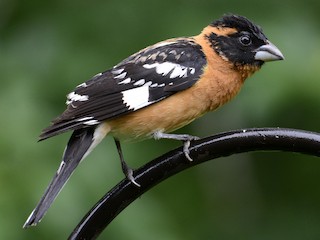
How to identify the Black-headed Grosbeak
Pheucticus melanocephalus
Spotted a bird? Identify it instantly with the Birdby app
Open the appTo correctly identify the Black-headed Grosbeak (Pheucticus melanocephalus), check each of these features. Birds can be tricky: habit, habitat, and call often confirm a sighting that a single photo cannot.
Size at a glance
- Length
- 18-20 cm (7.1-7.9 in)
- Wingspan
- 31-33 cm (12.2-13.0 in)
- Weight
- 38-55 g (1.3-1.9 oz)
Physical features to check
- 1
Plumage
Overall feather coloration and pattern.
Adult males have a black head, orange-cinnamon breast and belly, white lower belly, and a black back with white streaking. The wings are black with prominent white patches and bars. The tail is black with white outer tail feathers. Adult females are duller, with a streaky brown head and back, buffy-orange breast, and streaked flanks. They have two buffy wing bars and a pale supercilium. Juveniles resemble females but are often more heavily streaked.
- 2
Beak shape
Shape and color of the bill: a key field mark.
Large, conical, and stout, pale gray to horn-colored, ideal for cracking seeds.
- 3
Eye color
Iris color and any distinctive eye markings.
Dark brown.
- 4
Leg color
Leg and foot color.
Dark gray to black.
- 5
Distinguishing features
Standout features that separate this species.
Males are unmistakable with their black head and orange-cinnamon underparts. Females are identified by their large, conical bill, streaky brown plumage, and buffy-orange wash on the breast, often with a pale supercilium.
- 6
Juvenile appearance
How young birds differ from adults.
Juveniles resemble adult females but are generally more heavily streaked on the underparts and back, with less distinct markings. Young males may show hints of orange on the breast.
- 7
Seasonal changes
Plumage variation between breeding and non-breeding seasons.
No significant seasonal plumage changes. Breeding and non-breeding plumages are essentially the same for both sexes, though colors may appear slightly brighter after a fresh molt.
- 8
Sexual dimorphism
How males and females differ.
Pronounced. Males are much more brightly colored with a black head and vibrant orange-cinnamon underparts, while females are duller, streaky brown and buff.
Key field marks
- Male Plumage. Look for the solid black head, vibrant orange-cinnamon breast and belly, and black back with white streaking. The large white wing patches are also distinctive.
- Female Plumage. Identify by the large, conical bill, streaky brown upperparts, buffy-orange wash on the breast, and two buffy wing bars. A pale supercilium is often present.
- Song. Listen for the rich, warbling, robin-like song, which is a continuous, flowing series of phrases. It's often described as 'liquid' or 'sweet'.
- Call. Listen for the sharp, metallic 'chink' or 'spink' call, often given in flight or as an alarm.
- Bill Shape. The large, conical bill is a key feature for both sexes, distinguishing them from many other songbirds.
Explore the Black-headed Grosbeak
Identify birds anywhere
Free on iOS, Android, and Web. Photo & sound identification, full species database, and your personal life list.