
Spotted a bird? Identify it instantly with the Birdby app
Open the appAbout
The Willow Warbler is a small, migratory passerine bird, known for its distinctive, melancholic song and its preference for open woodlands and scrub. It is one of the most widespread and abundant warblers in Europe and Asia, undertaking one of the longest migrations relative to its size.
Size & lifespan
- Length
- 11-12.5 cm
- Wingspan
- 17-22 cm
- Weight
- 6.3-14.6 g
- Lifespan
- Typically 2-3 years in the wild, with a maximum recorded age of 10 years.
- Diet
- Insectivore, primarily feeding on small insects and their larvae, spiders, and occasionally berries outside the breeding season.
Physical characteristics
- Plumage
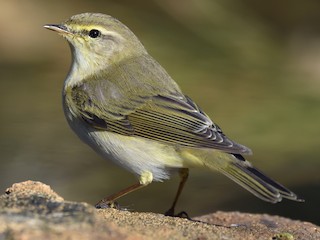
- Upperparts are olive-green to brownish-green, underparts are whitish to pale yellow, often with a yellowish wash on the flanks and breast. It has a distinct yellowish supercilium (eyebrow stripe) and dark eye-stripe. The rump is often slightly brighter green than the back.
- Beak shape
- Small, slender, pointed bill, dark brown to blackish on the upper mandible, paler (often yellowish or orange-brown) on the lower mandible.
- Eye color
- Dark brown.
- Leg color
- Legs are typically pale, ranging from pale brown to yellowish-orange, sometimes pinkish-brown.
- Distinguishing features
- Key features include its overall greenish-brown upperparts, pale underparts, prominent yellowish supercilium, and pale legs. The primary projection (the length of the primary feathers beyond the tertials when the wing is folded) is relatively long compared to the Chiffchaff.
- Juvenile appearance
- Juveniles are generally brighter and more yellowish overall than adults, particularly on the underparts and supercilium, with a fresher plumage.
- Seasonal changes
- Plumage remains largely consistent throughout the year, though fresh autumn plumage may appear slightly brighter and greener than worn summer plumage.
- Sexual dimorphism
- Males and females are outwardly identical in plumage.
How to identify
- 1
Song
Listen for the distinctive, descending, melancholic cascade of notes. This is the most reliable identification feature.
- 2
Leg Color
Observe the leg color. Willow Warblers typically have pale legs (pale brown, yellowish-orange, or pinkish-brown), contrasting with the darker legs of most Chiffchaffs.
- 3
Primary Projection
When the bird is perched, look at the length of the primary feathers extending beyond the tertials. Willow Warblers have a relatively long primary projection, appearing to have 'long wings' compared to the Chiffchaff.
- 4
Plumage Tone
Note the overall greenish-brown upperparts and pale, often yellowish-washed underparts. The supercilium is usually prominent and yellowish.
- 5
Behavior
Willow Warblers tend to be more active and agile in their foraging, often flitting and hovering more than Chiffchaffs, though this can be subtle.
Habitat & range
- Biomes
- Temperate forests, boreal forests, taiga, scrublands, heathlands.
- Geographic range
- Breeds across most of Europe and northern Asia, from Ireland and Great Britain eastwards to eastern Siberia. Winters in sub-Saharan Africa.
- Elevation range
- Typically found from sea level up to 2,000 meters, though generally prefers lower elevations.
- Preferred environments
- Prefers open deciduous or mixed woodlands with a well-developed understory, scrub, young plantations, parks, gardens, and heathland with scattered trees. Avoids dense, mature forests and treeless areas.
Behavior
- Activity time
- Diurnal.
- Feeding habits
- Forages actively in trees and shrubs, gleaning insects from leaves and twigs. It also performs short, agile aerial sallies to catch flying insects. Occasionally feeds on the ground.
- Social behavior
- Solitary or in pairs during the breeding season. During migration, they can form loose flocks, sometimes mixing with other warbler species.
- Flight pattern
- Undulating, bouncy flight when moving between trees. When foraging, it is agile and flitting, often hovering briefly.
- Migration pattern
- Long-distance migratory species. Breeds in Europe and Asia and migrates to sub-Saharan Africa for the non-breeding season. One of the earliest spring migrants to arrive in its breeding grounds and one of the earliest to depart in autumn.
- Territoriality
- Males establish and defend breeding territories through song and displays. They are monogamous, but extra-pair copulations are common.
Song & calls
- Song
- A distinctive, sweet, descending, and slightly melancholic cascade of notes, often described as 'hoo-weet hoo-weet hoo-weet-wit-wit-wit-woo-woo'. It starts strong and fades away towards the end. It is highly diagnostic.
- Call
- A soft, plaintive 'hoo-eet' or 'hweet', often given as a contact call or alarm call. Also a sharper 'chiff' or 'whit' when agitated.
- When they vocalize
- Males sing frequently from arrival on breeding grounds in spring until late summer. Calls are given year-round, particularly when foraging or alarmed.
Breeding & reproduction
- Breeding season
- Typically May to July in Europe, varying with latitude.
- Nesting habits
- Nests are built on or very close to the ground, often concealed in dense vegetation, grass tussocks, or at the base of small shrubs. The nest is dome-shaped or 'oven-shaped' with a side entrance, constructed by the female from grass, moss, leaves, and lined with fine grass, hair, and feathers.
- Clutch size
- 4-8 eggs, usually 5-7.
- Egg description
- 4-8 (typically 5-7) eggs, white with fine reddish-brown or purplish-brown speckles, often concentrated at the broad end. Eggs measure approximately 15 x 12 mm.
- Incubation period
- 11-14 days, primarily by the female.
- Fledging period
- 12-15 days after hatching. Young are fed by both parents.
- Parental care
- Both parents feed the nestlings and fledglings. The female primarily incubates, but both participate in raising the young.
Where to find
Open Woodlands
Look in deciduous or mixed woodlands with a good understory of shrubs and young trees.
Scrub and Heathland
Areas with scattered trees, bushes, and dense scrub are favored, especially during migration.
Parks and Gardens
They can be found in larger parks and gardens with suitable vegetation, particularly during migration.
Young Plantations
Recently planted areas with young trees and developing undergrowth provide ideal breeding habitat.
Field tips
- Listen for the song. The song is the most distinctive and easiest way to identify a Willow Warbler, especially in spring and early summer. Learn to distinguish it from the Chiffchaff's song.
- Observe foraging behavior. Watch for their active gleaning and short aerial sallies in the canopy and understory of trees and shrubs.
- Check leg color and primary projection. If you get a good view, these physical features are crucial for distinguishing them from similar species like the Chiffchaff.
- Visit suitable habitats. Focus your search in open woodlands, scrub, and areas with young trees rather than dense, mature forests.
Similar species
Common Chiffchaff
Phylloscopus collybita
The Chiffchaff is very similar in appearance but generally has darker legs (dark brown to blackish), a shorter primary projection, and a slightly rounder head shape. The most reliable distinction is by song: the Chiffchaff's song is a repetitive 'chiff-chaff, chiff-chaff', while the Willow Warbler's song is a descending, melancholic cascade. Their calls also differ: Chiffchaff's call is a sharp 'hweet' or 'whit', while Willow Warbler's is a softer, more plaintive 'hoo-eet'.
Wood Warbler
Phylloscopus sibilatrix
The Wood Warbler is larger and brighter, with a more vibrant yellow throat and breast, pure white belly, and bright green upperparts. It has a very long primary projection and dark legs. Its song is a distinctive shivering trill followed by a series of accelerating 'pip' notes.
Bonelli's Warbler
Phylloscopus bonelli
Bonelli's Warbler (now split into Western and Eastern Bonelli's Warbler) has a plainer, greyer-green upperparts, whiter underparts, and a less prominent supercilium. Its legs are typically pale, but its primary projection is shorter than Willow Warbler. The song is a rapid, monotonous trill.
Quick facts
- Migration Distance:
- One of the longest migrations for a small passerine, covering thousands of kilometers between Europe/Asia and sub-Saharan Africa.
- Nest Type:
- Dome-shaped or 'oven-shaped' nest built on or near the ground.
- Song Characteristic:
- Descending, melancholic cascade of notes.
- Key ID Feature:
- Pale legs and long primary projection (when seen well).
Fun facts
- Despite their small size, Willow Warblers undertake an epic annual migration, often covering distances of up to 12,000 km (7,500 miles) each way.
- The Willow Warbler's scientific name, 'Phylloscopus trochilus', means 'leaf-gleaner' (Phylloscopus) and 'wren-like' (trochilus), referring to its foraging habits and small size.
- There are three recognized subspecies of Willow Warbler: P. t. trochilus (western Europe), P. t. acredula (northern and eastern Europe to central Siberia), and P. t. yakutensis (eastern Siberia). These subspecies differ subtly in plumage tone and migratory routes.
- Willow Warblers are one of the most abundant breeding birds in many parts of their range, particularly in northern Europe, making their song a quintessential sound of spring and early summer.
Scientific classification
- Kingdom
- Animalia
- Phylum
- Chordata
- Class
- Aves
- Order
- Passeriformes
- Family
- Phylloscopidae
- Genus
- Phylloscopus
- Species
- Phylloscopus trochilus
Explore the Willow Warbler
Identify birds anywhere
Free on iOS, Android, and Web. Photo & sound identification, full species database, and your personal life list.