
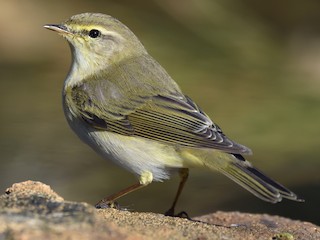
How to identify the Willow Warbler
Phylloscopus trochilus
Spotted a bird? Identify it instantly with the Birdby app
Open the appTo correctly identify the Willow Warbler (Phylloscopus trochilus), check each of these features. Birds can be tricky: habit, habitat, and call often confirm a sighting that a single photo cannot.
Size at a glance
- Length
- 11-12.5 cm
- Wingspan
- 17-22 cm
- Weight
- 6.3-14.6 g
Physical features to check
- 1
Plumage
Overall feather coloration and pattern.
Upperparts are olive-green to brownish-green, underparts are whitish to pale yellow, often with a yellowish wash on the flanks and breast. It has a distinct yellowish supercilium (eyebrow stripe) and dark eye-stripe. The rump is often slightly brighter green than the back.
- 2
Beak shape
Shape and color of the bill: a key field mark.
Small, slender, pointed bill, dark brown to blackish on the upper mandible, paler (often yellowish or orange-brown) on the lower mandible.
- 3
Eye color
Iris color and any distinctive eye markings.
Dark brown.
- 4
Leg color
Leg and foot color.
Legs are typically pale, ranging from pale brown to yellowish-orange, sometimes pinkish-brown.
- 5
Distinguishing features
Standout features that separate this species.
Key features include its overall greenish-brown upperparts, pale underparts, prominent yellowish supercilium, and pale legs. The primary projection (the length of the primary feathers beyond the tertials when the wing is folded) is relatively long compared to the Chiffchaff.
- 6
Juvenile appearance
How young birds differ from adults.
Juveniles are generally brighter and more yellowish overall than adults, particularly on the underparts and supercilium, with a fresher plumage.
- 7
Seasonal changes
Plumage variation between breeding and non-breeding seasons.
Plumage remains largely consistent throughout the year, though fresh autumn plumage may appear slightly brighter and greener than worn summer plumage.
- 8
Sexual dimorphism
How males and females differ.
Males and females are outwardly identical in plumage.
Key field marks
- Song. Listen for the distinctive, descending, melancholic cascade of notes. This is the most reliable identification feature.
- Leg Color. Observe the leg color. Willow Warblers typically have pale legs (pale brown, yellowish-orange, or pinkish-brown), contrasting with the darker legs of most Chiffchaffs.
- Primary Projection. When the bird is perched, look at the length of the primary feathers extending beyond the tertials. Willow Warblers have a relatively long primary projection, appearing to have 'long wings' compared to the Chiffchaff.
- Plumage Tone. Note the overall greenish-brown upperparts and pale, often yellowish-washed underparts. The supercilium is usually prominent and yellowish.
- Behavior. Willow Warblers tend to be more active and agile in their foraging, often flitting and hovering more than Chiffchaffs, though this can be subtle.
Explore the Willow Warbler
Identify birds anywhere
Free on iOS, Android, and Web. Photo & sound identification, full species database, and your personal life list.