
Spotted a bird? Identify it instantly with the Birdby app
Open the appAbout
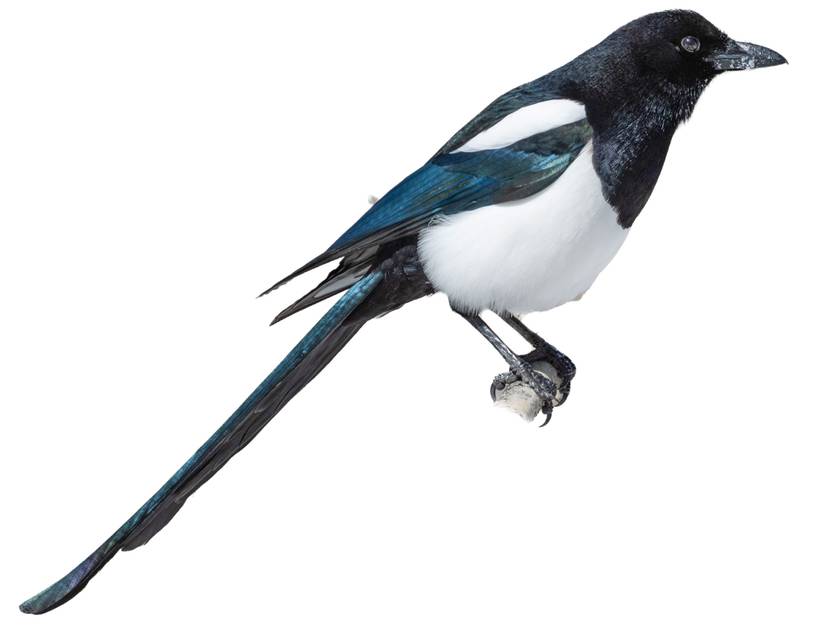
The Black-billed Magpie is a striking, large passerine bird known for its iridescent black and white plumage and long, graduated tail. It is a highly intelligent and social member of the crow family, often seen in open country with scattered trees and shrubs across western North America.
Size & lifespan
- Length
- 45-60 cm (17.7-23.6 in), including a tail that can be 20-30 cm (7.9-11.8 in)
- Wingspan
- 56-61 cm (22-24 in)
- Weight
- 145-210 g (5.1-7.4 oz)
- Lifespan
- Typically 4-6 years in the wild, with records up to 15 years.
- Diet
- Omnivore, with a highly varied diet including insects, carrion, small mammals, nestlings, eggs, fruits, seeds, and human refuse.
Physical characteristics
- Plumage
- Adults have iridescent black plumage on the head, neck, back, and breast, contrasting sharply with pure white scapulars (shoulder patches) and a white belly. The wings are black with iridescent blue-green primaries and secondaries, and a prominent white patch on the inner primaries visible in flight. The long, graduated tail is black with a strong iridescent green, blue, and purple sheen.
- Beak shape
- Stout, conical, and entirely black.
- Eye color
- Dark brown
- Leg color
- Black
- Distinguishing features
- Long, graduated tail (often longer than the body), iridescent black and white plumage, and a distinct white patch on the inner primaries visible during flight.
- Juvenile appearance
- Juveniles resemble adults but have duller, less iridescent black plumage, a shorter tail, and often a slightly brownish tinge to the black areas. The white patches may be less crisp.
- Seasonal changes
- No significant seasonal plumage changes. Plumage may appear duller when worn before molting.
- Sexual dimorphism
- Males are typically slightly larger than females, but plumage is identical. Size difference is often not discernible in the field.
How to identify
- 1
Size and Shape
Look for a large, slender bird with an exceptionally long, graduated tail that often makes up half its total length. The body is robust.
- 2
Plumage Pattern
Observe the stark contrast between iridescent black (head, back, breast, tail, wings) and pure white (belly, scapulars). The white shoulder patches are very distinctive.
- 3
Flight
Note the undulating flight pattern and the prominent white patch on the inner primaries of the wings, visible against the black when in flight.
- 4
Bill Color
Confirm the bill is entirely black. This distinguishes it from the Yellow-billed Magpie.
- 5
Vocalizations
Listen for their characteristic harsh, chattering calls, which are often quite loud and varied.
Habitat & range
- Biomes
- Grasslands, shrublands, open woodlands, riparian areas, agricultural lands, suburban parks, and urban environments.
- Geographic range
- Western North America, from Alaska and western Canada south through the Great Plains to northern Arizona and New Mexico, and west to the Pacific Coast in some areas (e.g., British Columbia).
- Elevation range
- Sea level up to approximately 3,000 meters (10,000 feet), though typically found at lower to mid-elevations.
- Preferred environments
- Open country with scattered trees and shrubs, particularly cottonwood groves along rivers, aspen stands, and areas with human habitation that provide food sources and nesting sites.
Behavior
- Activity time
- Diurnal.
- Feeding habits
- Highly opportunistic and adaptable. Forages on the ground, in trees, and around human settlements. Diet includes insects (grasshoppers, beetles), carrion (roadkill, animal carcasses), small mammals (rodents), eggs and nestlings of other birds, fruits, berries, seeds, and human food scraps. They are known to cache food.
- Social behavior
- Highly social, especially outside the breeding season, forming large communal roosts in winter. During breeding, pairs are territorial but may nest in loose colonies. Known for complex social interactions and intelligence.
- Flight pattern
- Distinctive undulating flight with rapid wing beats followed by short glides. When flying long distances, it can appear somewhat heavy-bodied. Often flies low to the ground.
- Migration pattern
- Primarily a resident species throughout its range. Some northern populations or individuals at higher elevations may undertake short-distance, altitudinal movements or irruptive movements in response to harsh winter conditions or food scarcity.
- Territoriality
- Breeding pairs are territorial around their nest site, defending a small area. Outside the breeding season, they are less territorial and often forage in groups.
Song & calls
- Song
- Magpies do not have a complex song in the traditional sense. Their vocalizations are a series of harsh, chattering, and sometimes musical calls.
- Call
- Most common calls include a rapid, harsh 'mag-mag-mag' or 'chug-chug-chug', a rising 'chek-chek-chek', and various other squawks, whistles, and gurgles. They are known for their varied and often noisy vocalizations.
- When they vocalize
- Vocalize year-round, but particularly active and noisy during the breeding season and when communicating within flocks.
Breeding & reproduction
- Breeding season
- Typically March to July, with peak egg-laying in April-May.
- Nesting habits
- Build large, domed nests made of sticks, mud, and grass, often lined with fine materials like hair or rootlets. Nests are usually placed high in deciduous trees or large shrubs, often thorny ones, providing protection. They frequently build a canopy or roof over the nest cup, with one or more entrance holes.
- Clutch size
- 5-9 eggs, commonly 6-7.
- Egg description
- Typically 5-9 eggs, greenish-blue to olive-buff, heavily spotted and blotched with brown, olive, or purple.
- Incubation period
- 16-18 days, primarily by the female.
- Fledging period
- 24-30 days after hatching. Young remain dependent on parents for several weeks after fledging.
- Parental care
- Both parents participate in feeding the young. The female primarily incubates, while the male brings food to her and later to the nestlings.
Where to find
Open Woodlands and Shrublands
Look in areas with scattered trees, especially cottonwoods along rivers, aspen groves, and dense shrubby thickets.
Agricultural and Rural Areas
Often found near farms, ranches, and pastures, where they can find insects, carrion, and nesting sites.
Suburban and Urban Parks
They adapt well to human presence and can be found in parks, golf courses, and even residential areas with mature trees.
Roadsides
Frequently seen scavenging carrion along roadsides, especially in rural areas.
Field tips
- Look for movement. Their large size and long tail make them conspicuous. They often perch prominently on treetops, utility poles, or fences.
- Listen for calls. Their noisy, chattering calls often give away their presence before they are seen.
- Observe social behavior. Outside the breeding season, look for groups foraging together or congregating at communal roosts, especially at dawn and dusk.
- Check for food sources. Magpies are attracted to carrion, bird feeders (especially those with suet or peanuts), and areas where insects are abundant.
Similar species
Yellow-billed Magpie
Pica nuttalli
The Yellow-billed Magpie is restricted to California's Central Valley and adjacent foothills. Its most obvious difference is its bright yellow bill and a patch of bare yellow skin around the eye, contrasting with the Black-billed Magpie's entirely black bill and dark eye. Their ranges do not overlap.
Eurasian Magpie
Pica pica
Historically, the Black-billed Magpie was considered a subspecies of the Eurasian Magpie. While visually very similar, genetic studies have confirmed them as distinct species. The primary field mark difference is subtle: Eurasian Magpies tend to have a slightly shorter tail and often show more white on the primary feathers, but these are difficult to discern without direct comparison. Their ranges are geographically separated.
Steller's Jay
Cyanocitta stelleri
While also a corvid with some blue and black, Steller's Jays are smaller, lack the extensive white plumage, and have a prominent crest. Their tail is much shorter and not graduated like the magpie's.
Quick facts
- Family:
- Corvidae (Crows, Jays, Magpies)
- Diet:
- Omnivore
- Habitat:
- Open country with scattered trees and shrubs
- Conservation Status:
- Least Concern
- Distinguishing Feature:
- Long, graduated tail and iridescent black and white plumage
Fun facts
- Black-billed Magpies are among the few non-mammalian species known to recognize themselves in a mirror, indicating a high level of self-awareness.
- They are notorious for their intelligence and problem-solving abilities, often observed using tools or engaging in complex social interactions.
- Magpies are known to 'cache' food, burying or hiding excess food items for later consumption, demonstrating foresight.
- Their large, domed nests are among the most elaborate of North American passerines, often taking weeks to build and providing excellent protection from predators and weather.
- Despite their reputation for being 'thieves' of shiny objects, scientific studies have shown this behavior is not as prevalent as commonly believed.
Scientific classification
- Kingdom
- Animalia
- Phylum
- Chordata
- Class
- Aves
- Order
- Passeriformes
- Family
- Corvidae
- Genus
- Pica
- Species
- Pica hudsonia
Explore the Black-billed Magpie
Identify birds anywhere
Free on iOS, Android, and Web. Photo & sound identification, full species database, and your personal life list.