
Spotted a bird? Identify it instantly with the Birdby app
Open the appAbout
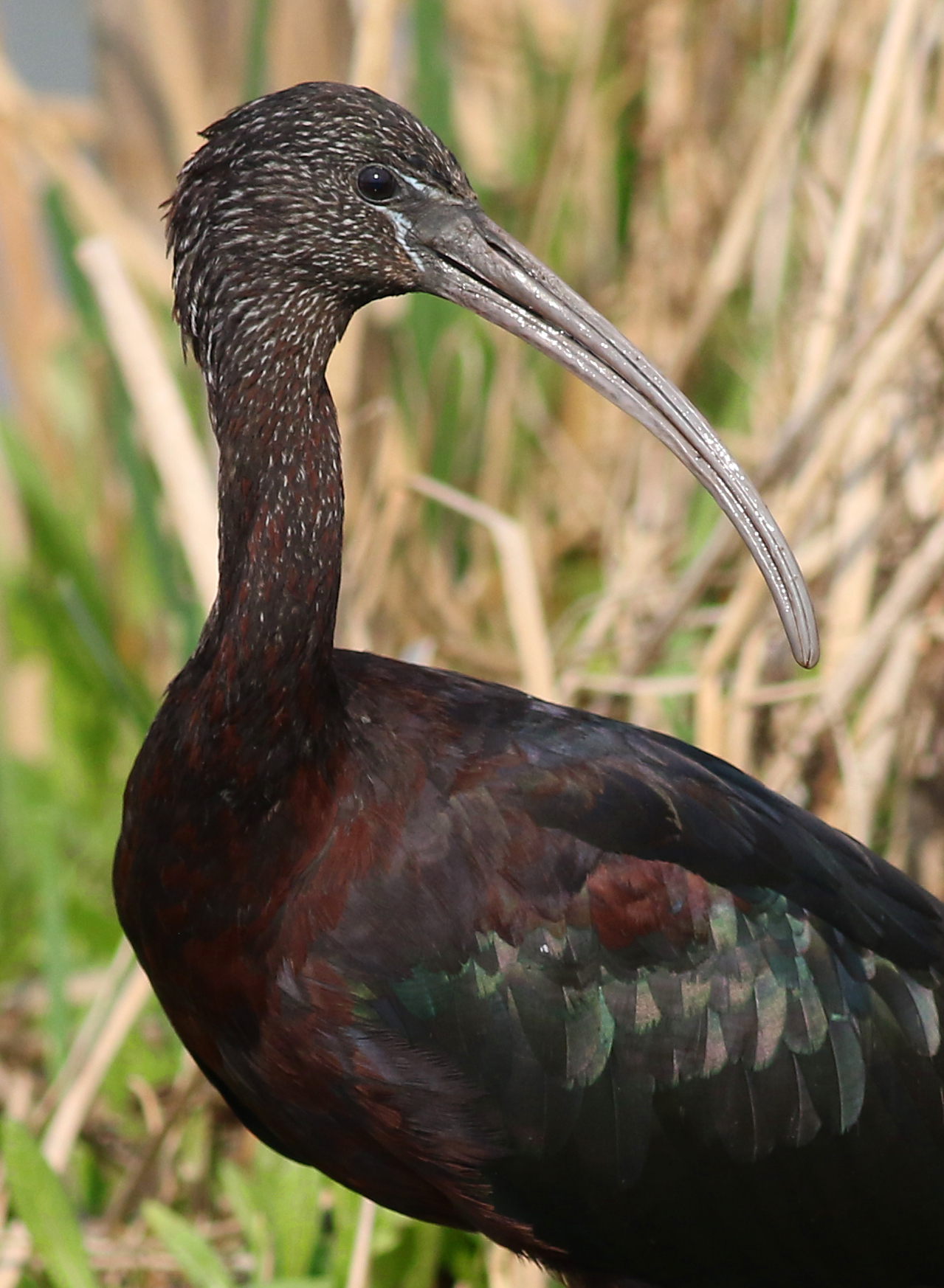
The Glossy Ibis is a medium-sized wading bird characterized by its rich, iridescent dark plumage, long decurved bill, and long legs. It is the most widespread ibis species globally, found in warm regions across Europe, Asia, Africa, Australia, and the Americas. It typically inhabits wetlands, feeding on invertebrates and small vertebrates.
Size & lifespan
- Length
- 48-66 cm (19-26 in)
- Wingspan
- 80-105 cm (31-41 in)
- Weight
- 485-970 g (1.07-2.14 lbs)
- Lifespan
- Up to 20 years in the wild
- Diet
- Carnivore (primarily invertebrates and small vertebrates)
Physical characteristics
- Plumage
- Adult breeding plumage is a striking deep chestnut-maroon on the body, with iridescent bronze-green and purplish gloss on the wings, back, and tail. The head and neck are also chestnut. Non-breeding adults are duller, with a streaky brown head and neck, and less vibrant body plumage. Juveniles are duller still, mostly dark brown with a duller green gloss and a pale, streaky head and neck.
- Beak shape
- Long, slender, strongly decurved (downcurved) bill, dark olive-brown to blackish. In breeding adults, a pale blue-grey line runs from the base of the bill to the eye, bordered by a darker line below.
- Eye color
- Dark brown, surrounded by a narrow, pale blue-grey orbital ring in breeding adults.
- Leg color
- Dark olive-green to blackish, becoming reddish-brown during the breeding season.
- Distinguishing features
- Its unique combination of dark, iridescent plumage, long decurved bill, and dark legs distinguishes it from most other wading birds. The pale facial line in breeding adults is a key field mark.
- Juvenile appearance
- Juveniles are duller than adults, with a dark brown body and a less pronounced iridescent sheen. Their head and neck are streaky brown, lacking the rich chestnut of adults, and the facial skin is duller.
- Seasonal changes
- Breeding adults exhibit richer chestnut plumage and more vibrant iridescent gloss, along with the distinctive pale blue-grey facial line. Non-breeding adults and juveniles are duller, with less distinct facial markings.
- Sexual dimorphism
- Males and females are generally similar in plumage, though males tend to be slightly larger.
How to identify
- 1
Overall Plumage
Look for the dark, iridescent plumage. In good light, the rich chestnut body and bronze-green/purplish wings are striking. In poor light, it may appear uniformly dark.
- 2
Bill Shape
The long, slender, and strongly decurved (downcurved) bill is a primary identification feature, used for probing in mud.
- 3
Facial Markings (Breeding Adults)
Observe the pale blue-grey line running from the base of the bill to the eye, bordered by a darker line below. This is absent in non-breeding adults and juveniles.
- 4
Legs
Long, dark legs, which become reddish-brown during the breeding season. They trail behind the body in flight.
- 5
Flight Pattern
Watch for strong, direct flight with rapid wing beats, often in V-formations or diagonal lines, with neck extended and legs trailing.
Habitat & range
- Biomes
- Wetlands, marshes, swamps, shallow lakes, flooded fields, estuaries, and coastal lagoons.
- Geographic range
- Cosmopolitan distribution, found in scattered populations across Europe, Asia, Africa, Australia, and the Americas (including the Caribbean and parts of the southeastern United States).
- Elevation range
- Primarily lowlands, typically from sea level up to a few hundred meters.
- Preferred environments
- Shallow freshwater or brackish wetlands with emergent vegetation, muddy edges, and open water for foraging. They prefer areas with dense reeds or trees for nesting and roosting.
Behavior
- Activity time
- Diurnal, primarily active during daylight hours for foraging and other activities.
- Feeding habits
- Forages by probing its long, decurved bill into soft mud or shallow water to find invertebrates such as insects, crustaceans, and worms. It also takes small fish, amphibians, and occasionally seeds. Often forages in groups, walking slowly and methodically.
- Social behavior
- Highly gregarious, especially outside the breeding season. They often form large flocks for foraging, roosting, and migration. Breeds colonially, often with other wading bird species.
- Flight pattern
- Strong, direct flight with rapid wing beats, often in V-formations or diagonal lines, especially during migration. Legs trail behind the body, and the neck is extended.
- Migration pattern
- Many populations are migratory, moving from temperate breeding grounds to warmer wintering areas. European and Asian populations migrate to Africa and South Asia. North American populations are largely resident in the southeast but may undertake local movements. Australian populations are nomadic.
- Territoriality
- Generally not territorial outside the immediate nest site within a colony. Foraging areas are typically shared.
Song & calls
- Song
- Not known for a complex song. Vocalizations are generally guttural and croaking.
- Call
- Common calls include a low, guttural 'grrr' or 'krr-krr', often given in flight or when disturbed. Also produces a soft 'hunk-hunk' or 'gug-gug' during social interactions within the colony.
- When they vocalize
- Most vocal during the breeding season within colonies, and when disturbed or in flight.
Breeding & reproduction
- Breeding season
- Varies geographically: March-July in the Northern Hemisphere, August-December in the Southern Hemisphere, and year-round in tropical regions.
- Nesting habits
- Nests colonially, often in mixed-species colonies with other ibises, herons, and spoonbills. Nests are typically platforms of sticks, reeds, or other vegetation, built in dense emergent vegetation (reeds, cattails) or low trees/shrubs over water.
- Clutch size
- 2-5 eggs
- Egg description
- 2-5 (typically 3-4) elliptical eggs, pale turquoise-blue to greenish-blue, unmarked. They become duller and stained during incubation.
- Incubation period
- 20-23 days
- Fledging period
- 28-35 days, though young may leave the nest and clamber in surrounding vegetation before they can fly.
- Parental care
- Both parents share incubation duties and care for the young. Chicks are altricial (helpless at hatching) and are fed by regurgitation.
Where to find
Freshwater Wetlands
Look in marshes, swamps, and shallow edges of lakes and ponds with emergent vegetation.
Brackish and Coastal Areas
Check estuaries, coastal lagoons, and salt marshes, especially where there are muddy flats.
Flooded Agricultural Fields
Often found foraging in recently flooded rice paddies or other agricultural fields.
Field tips
- Look for groups. Glossy Ibises are often found in flocks, sometimes mixed with other wading birds like herons or spoonbills. Scan large areas of wetlands.
- Observe feeding behavior. Watch for their characteristic probing action with their long, decurved bills in shallow water or mud. This behavior is distinctive.
- Check lighting conditions. The iridescent plumage is best seen in good light. In overcast conditions, they may appear uniformly dark, making identification harder without other features.
- Listen for calls. While not highly vocal, their guttural calls can sometimes draw attention, especially in flight or within a colony.
Similar species
White-faced Ibis
Plegadis chihi
The White-faced Ibis is very similar in size and shape. Key differences are the white feathering around the bare facial skin (reddish in breeding plumage) and red eyes in the White-faced Ibis, compared to the Glossy Ibis's dark eyes and pale blue-grey facial line (without white feathering). Leg color is also typically redder in breeding White-faced Ibis.
Puna Ibis
Plegadis ridgwayi
Found only in the Andes. Similar dark plumage but has a distinctive red eye and a patch of bare red skin at the base of the bill, lacking the pale facial line of the Glossy Ibis.
Straw-necked Ibis
Threskiornis spinicollis
Found in Australia. Larger, with a white body, black head and neck, and distinctive straw-like plumes on the neck. Its bill is also decurved but the overall plumage pattern is very different.
Quick facts
- Global Distribution:
- Most widespread ibis species
- Bill Shape:
- Distinctively decurved
- Plumage Iridescence:
- Bronze-green and purplish gloss
- Social Behavior:
- Highly gregarious, colonial breeder
- Diet:
- Invertebrates and small vertebrates
Fun facts
- The Glossy Ibis is one of the most widely distributed wading birds in the world, found on every continent except Antarctica.
- Despite its name, the 'glossy' iridescence is only visible in good light; otherwise, the bird appears dark brown or black.
- They are excellent fliers and can undertake long migratory journeys, often flying in characteristic V-formations.
- Fossil evidence suggests that the Glossy Ibis has existed for millions of years, with fossils found dating back to the Miocene epoch.
Scientific classification
- Kingdom
- Animalia
- Phylum
- Chordata
- Class
- Aves
- Order
- Pelecaniformes
- Family
- Threskiornithidae
- Genus
- Plegadis
- Species
- Plegadis falcinellus
Explore the Glossy Ibis
Identify birds anywhere
Free on iOS, Android, and Web. Photo & sound identification, full species database, and your personal life list.