
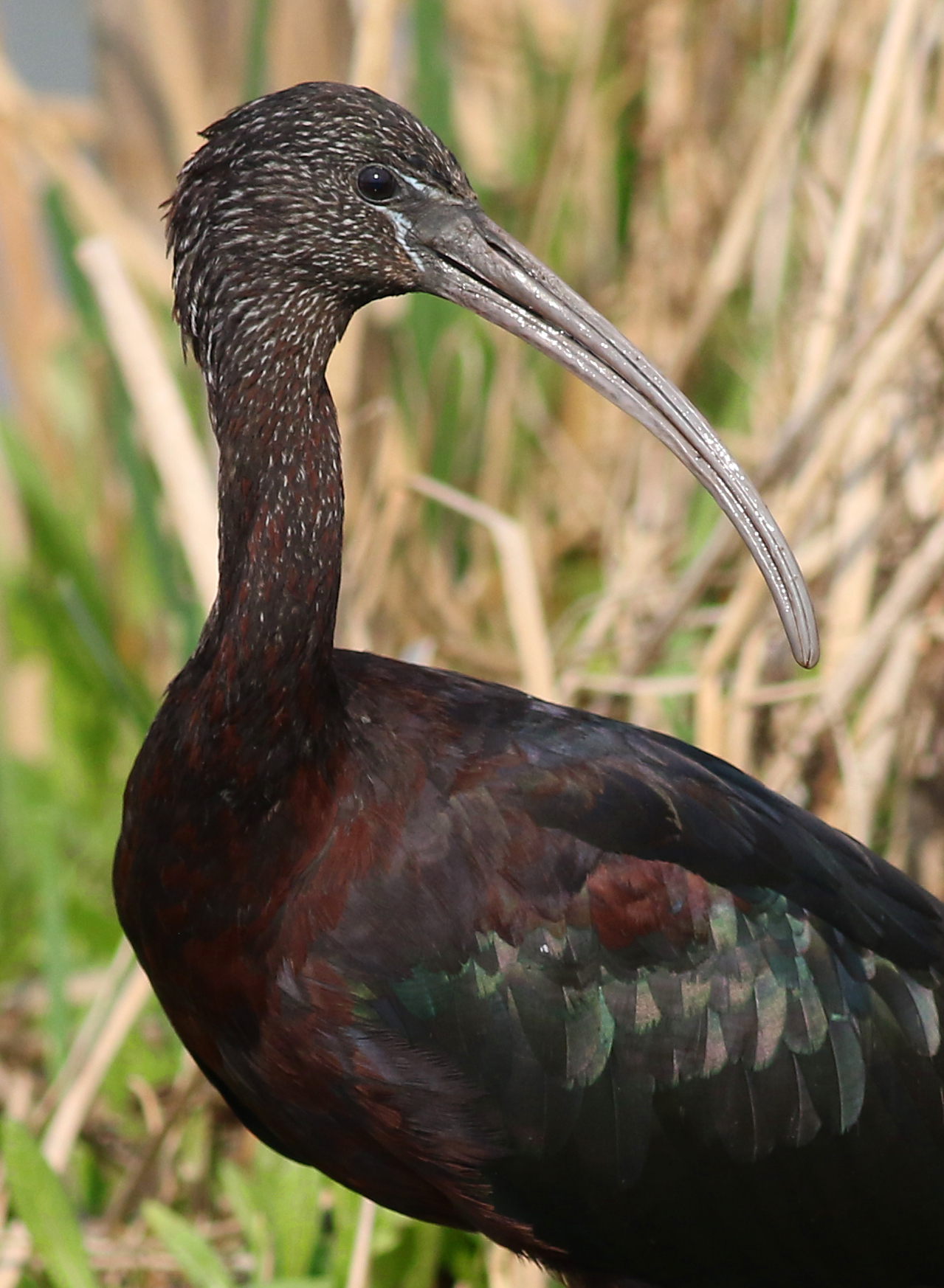
How to identify the Glossy Ibis
Plegadis falcinellus
Spotted a bird? Identify it instantly with the Birdby app
Open the appTo correctly identify the Glossy Ibis (Plegadis falcinellus), check each of these features. Birds can be tricky: habit, habitat, and call often confirm a sighting that a single photo cannot.
Size at a glance
- Length
- 48-66 cm (19-26 in)
- Wingspan
- 80-105 cm (31-41 in)
- Weight
- 485-970 g (1.07-2.14 lbs)
Physical features to check
- 1
Plumage
Overall feather coloration and pattern.
Adult breeding plumage is a striking deep chestnut-maroon on the body, with iridescent bronze-green and purplish gloss on the wings, back, and tail. The head and neck are also chestnut. Non-breeding adults are duller, with a streaky brown head and neck, and less vibrant body plumage. Juveniles are duller still, mostly dark brown with a duller green gloss and a pale, streaky head and neck.
- 2
Beak shape
Shape and color of the bill: a key field mark.
Long, slender, strongly decurved (downcurved) bill, dark olive-brown to blackish. In breeding adults, a pale blue-grey line runs from the base of the bill to the eye, bordered by a darker line below.
- 3
Eye color
Iris color and any distinctive eye markings.
Dark brown, surrounded by a narrow, pale blue-grey orbital ring in breeding adults.
- 4
Leg color
Leg and foot color.
Dark olive-green to blackish, becoming reddish-brown during the breeding season.
- 5
Distinguishing features
Standout features that separate this species.
Its unique combination of dark, iridescent plumage, long decurved bill, and dark legs distinguishes it from most other wading birds. The pale facial line in breeding adults is a key field mark.
- 6
Juvenile appearance
How young birds differ from adults.
Juveniles are duller than adults, with a dark brown body and a less pronounced iridescent sheen. Their head and neck are streaky brown, lacking the rich chestnut of adults, and the facial skin is duller.
- 7
Seasonal changes
Plumage variation between breeding and non-breeding seasons.
Breeding adults exhibit richer chestnut plumage and more vibrant iridescent gloss, along with the distinctive pale blue-grey facial line. Non-breeding adults and juveniles are duller, with less distinct facial markings.
- 8
Sexual dimorphism
How males and females differ.
Males and females are generally similar in plumage, though males tend to be slightly larger.
Key field marks
- Overall Plumage. Look for the dark, iridescent plumage. In good light, the rich chestnut body and bronze-green/purplish wings are striking. In poor light, it may appear uniformly dark.
- Bill Shape. The long, slender, and strongly decurved (downcurved) bill is a primary identification feature, used for probing in mud.
- Facial Markings (Breeding Adults). Observe the pale blue-grey line running from the base of the bill to the eye, bordered by a darker line below. This is absent in non-breeding adults and juveniles.
- Legs. Long, dark legs, which become reddish-brown during the breeding season. They trail behind the body in flight.
- Flight Pattern. Watch for strong, direct flight with rapid wing beats, often in V-formations or diagonal lines, with neck extended and legs trailing.
Explore the Glossy Ibis
Identify birds anywhere
Free on iOS, Android, and Web. Photo & sound identification, full species database, and your personal life list.