
Spotted a bird? Identify it instantly with the Birdby app
Open the appAbout
The Black-capped Chickadee is a small, non-migratory passerine bird found throughout much of North America. Known for its distinctive 'chick-a-dee-dee-dee' call and its curious, acrobatic behavior, it is a common and beloved backyard bird. It is highly adaptable and often seen at bird feeders, especially in winter.
Size & lifespan
- Length
- 12-15 cm (4.7-5.9 in)
- Wingspan
- 16-21 cm (6.3-8.3 in)
- Weight
- 9-14 g (0.32-0.49 oz)
- Lifespan
- Typically 2-3 years in the wild, but can live up to 12 years.
- Diet
- Omnivore (primarily insects and spiders in summer, seeds and berries in winter)
Physical characteristics
- Plumage
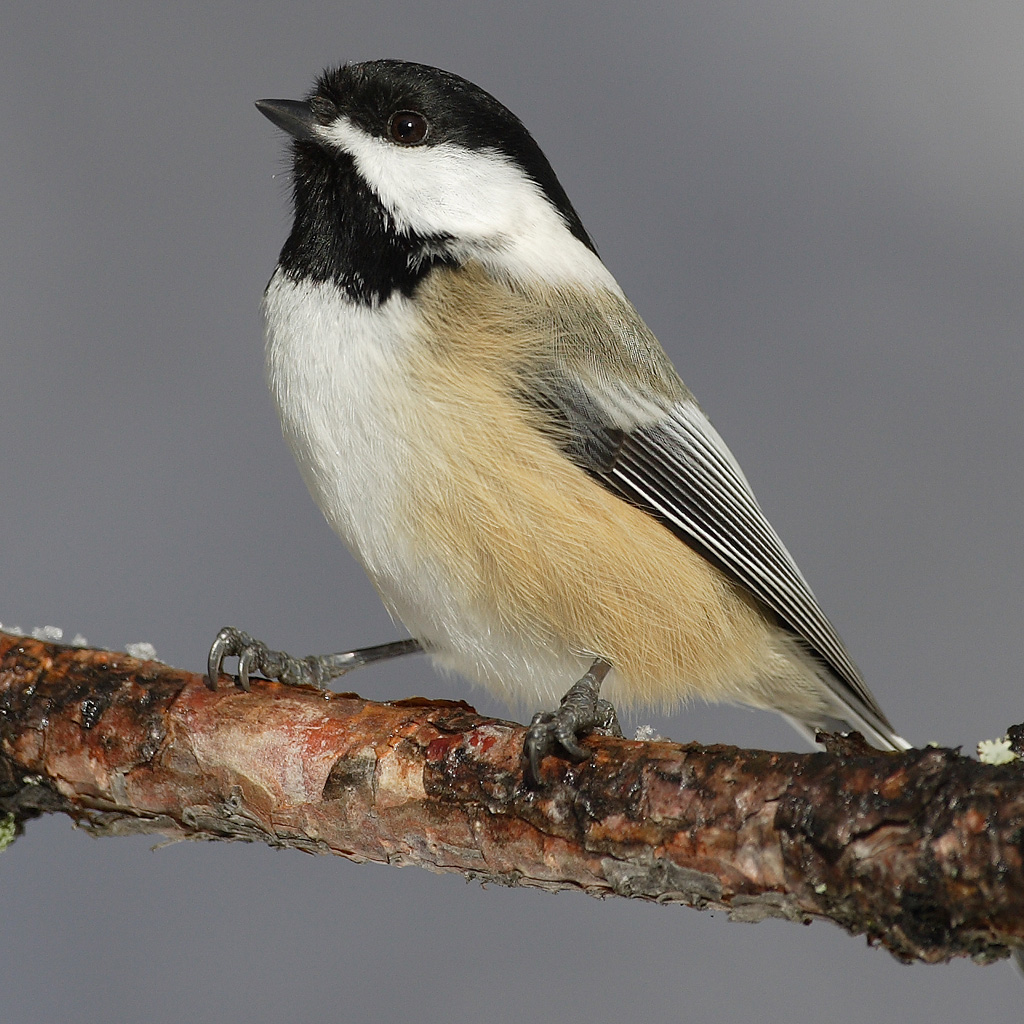
- Distinctive black cap and bib, white cheeks, gray back, wings, and tail, and whitish underparts with buffy flanks. The wing feathers often show white edging, creating a subtle wing bar effect.
- Beak shape
- Small, conical, and sharp; black in color.
- Eye color
- Dark brown.
- Leg color
- Dark gray to black.
- Distinguishing features
- The combination of a black cap, black bib, and clean white cheeks is the most defining feature. Its small size and active, acrobatic movements are also characteristic.
- Juvenile appearance
- Juveniles resemble adults but may have slightly duller plumage, particularly the black cap and bib, and a less crisp demarcation between colors. This difference is subtle and short-lived.
- Seasonal changes
- No significant seasonal plumage changes. They maintain their characteristic black and white pattern year-round.
- Sexual dimorphism
- Males and females are virtually identical in plumage and size, making them indistinguishable in the field.
How to identify
- 1
Head Pattern
Look for the crisp black cap and bib, separated by clean white cheeks. This is the most definitive visual field mark.
- 2
Size and Shape
Small, plump body with a relatively large head and short neck. Active and acrobatic, often hanging upside down.
- 3
Plumage Coloration
Gray back, wings, and tail, with whitish underparts and buffy wash on the flanks. Subtle white edging on wing feathers may be visible.
- 4
Vocalizations
Listen for the diagnostic 'chick-a-dee-dee-dee' call (variable 'dee' notes) and the clear, whistled 'fee-bee' song (two notes, first higher).
- 5
Behavior
Observe its active foraging style, often flitting through branches, and its curious nature, sometimes approaching humans.
Habitat & range
- Biomes
- Deciduous and mixed forests, woodlands, suburban parks, gardens, and riparian areas.
- Geographic range
- Widespread across Canada, Alaska, and the northern two-thirds of the United States, extending south into the Appalachian Mountains.
- Elevation range
- Sea level up to approximately 2,000 meters (6,500 feet), depending on the region and availability of suitable habitat.
- Preferred environments
- Prefers areas with mature trees for foraging and nesting, often near water sources. Highly adaptable to human-modified landscapes, including suburban and urban parks with sufficient tree cover.
Behavior
- Activity time
- Diurnal.
- Feeding habits
- Forages actively on tree branches and trunks, gleaning insects, spiders, and their eggs from bark crevices and foliage. Also consumes seeds, berries, and suet, especially in winter. Known for caching food items for later retrieval.
- Social behavior
- Highly social, especially outside of the breeding season. Forms mixed-species foraging flocks with nuthatches, woodpeckers, and other small passerines. Within their species, they form small, hierarchical flocks.
- Flight pattern
- Undulating flight pattern, characterized by short bursts of wing beats followed by a brief glide, often accompanied by calls.
- Migration pattern
- Primarily a permanent resident throughout its range. Some irruptive movements may occur in winter, especially in northern populations, in response to food scarcity.
- Territoriality
- Pairs defend a breeding territory during the nesting season. Outside of breeding, flocks maintain a winter foraging range, but territorial defense is less pronounced.
Song & calls
- Song
- A clear, whistled, two- or three-note song, typically described as 'fee-bee' or 'fee-bee-ee'. The first note is higher pitched than the second. Males sing this song to attract mates and defend territory.
- Call
- The most iconic call is the 'chick-a-dee-dee-dee', which varies in the number of 'dee' notes depending on the perceived threat level. Other calls include a high-pitched 'tseet' and various scolding notes.
- When they vocalize
- Vocalizes year-round, with increased singing activity during the breeding season (spring and early summer). Calls are frequent during foraging and social interactions.
Breeding & reproduction
- Breeding season
- Typically April to July, with peak activity in May and June.
- Nesting habits
- Primary cavity nesters, excavating their own nests in rotten wood (e.g., dead snags, stumps) or utilizing abandoned woodpecker holes or nest boxes. The female does most of the excavation. The nest cup is lined with soft materials like moss, hair, and plant fibers.
- Clutch size
- 6-8 eggs, occasionally 5-10.
- Egg description
- Small, oval, white eggs, often speckled with fine reddish-brown dots, particularly at the larger end.
- Incubation period
- 12-13 days, primarily by the female.
- Fledging period
- 12-16 days after hatching.
- Parental care
- Both parents feed the nestlings and fledglings. The female incubates, while the male brings her food. After fledging, the young remain with the parents for several weeks, learning foraging skills.
Where to find
Forests and Woodlands
Common in deciduous, mixed, and coniferous forests, especially those with mature trees and some dead snags for nesting.
Suburban Parks and Gardens
Frequently found in residential areas with ample trees and shrubs, often visiting bird feeders.
Riparian Areas
Can be found along rivers and streams where tree cover is present.
Field tips
- Listen for Calls. Their distinctive 'chick-a-dee-dee-dee' call is often the first indication of their presence. Learn to distinguish it from the similar Carolina Chickadee call.
- Check Bird Feeders. They are frequent visitors to feeders, especially in winter, where they prefer black oil sunflower seeds and suet. Look for them taking a seed and flying off to cache it.
- Look for Movement. Chickadees are constantly on the move, flitting from branch to branch, often hanging upside down. Their activity makes them easier to spot.
- Mixed-Species Flocks. In non-breeding seasons, they often join mixed-species foraging flocks. If you find one chickadee, others, and potentially other species, may be nearby.
- Patience and Observation. While active, they can be quick. Find a comfortable spot and observe their movements and foraging patterns.
Similar species
Carolina Chickadee
Poecile carolinensis
The Carolina Chickadee is very similar in appearance but generally smaller and has a shorter tail. The most reliable distinction is their calls: Carolina Chickadees have a four-note 'chick-a-dee-dee-dee-dee' call with a more rapid, slurred quality, and their 'fee-bee' song is typically four notes ('fee-bee-fee-bay') and on a single pitch, unlike the two-note, descending 'fee-bee' of the Black-capped. In terms of plumage, Black-capped Chickadees often show more white edging on their wing feathers, creating a more noticeable white wing bar, and their bib often has a slightly ragged lower edge compared to the cleaner edge of the Carolina.
Mountain Chickadee
Poecile gambeli
Easily distinguished by a prominent white supercilium (eyebrow stripe) above the eye, which the Black-capped Chickadee lacks. Mountain Chickadees also have a slightly duller gray back and less extensive white on the cheeks.
Boreal Chickadee
Poecile hudsonicus
The Boreal Chickadee has a brown cap and bib, contrasting with the black cap and bib of the Black-capped Chickadee. Its flanks are also more rufous, and its call is a slower, more nasal 'chick-a-dee-day-day'.
Quick facts
- Key Call:
- 'chick-a-dee-dee-dee'
- Key Song:
- 'fee-bee' (two notes, first higher)
- Diet:
- Insects, spiders, seeds, berries
- Nesting:
- Cavity nester (excavates own holes)
- Sociality:
- Forms mixed-species flocks outside breeding season
- Status:
- Permanent resident
Fun facts
- Black-capped Chickadees have an exceptional memory, allowing them to remember the locations of hundreds of cached food items, even months later.
- They can lower their body temperature at night (torpor) to conserve energy during cold winter nights, sometimes by as much as 10-12°C (18-22°F).
- The number of 'dee' notes in their 'chick-a-dee-dee-dee' call can indicate the level of threat from a predator; more 'dees' mean a greater threat.
- They are known to be very curious and can sometimes be coaxed to take seeds from a person's hand.
- Black-capped Chickadees are one of the few bird species that can learn new songs and calls throughout their lives, adapting their vocalizations to their local environment.
Scientific classification
- Kingdom
- Animalia
- Phylum
- Chordata
- Class
- Aves
- Order
- Passeriformes
- Family
- Paridae
- Genus
- Poecile
- Species
- Poecile atricapillus
Explore the Black-capped Chickadee
Identify birds anywhere
Free on iOS, Android, and Web. Photo & sound identification, full species database, and your personal life list.