
Spotted a bird? Identify it instantly with the Birdby app
Open the appAbout
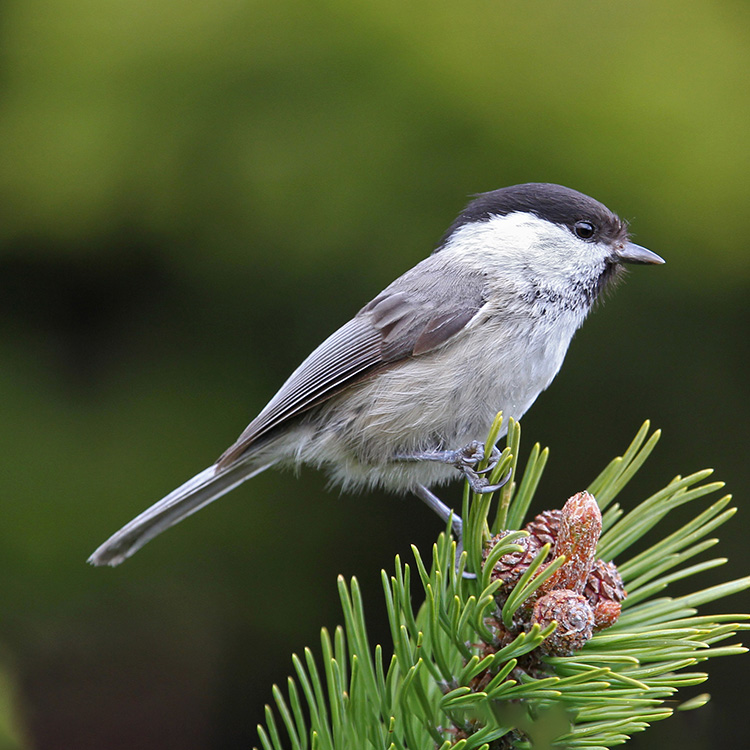
The Willow Tit is a small passerine bird, closely related to the Marsh Tit, from which it was long considered conspecific. It is characterized by its dull plumage, black cap and bib, and pale cheek patches. It is a resident species across much of its range, typically found in damp woodlands, willow thickets, and alder carrs, often near water. Unlike many other tits, it excavates its own nest hole in rotten wood.
Size & lifespan
- Length
- 11.5-13 cm
- Wingspan
- 17-21 cm
- Weight
- 9-12 g
- Lifespan
- 2-5 years (up to 11 years recorded)
- Diet
- Insectivore (primarily insects and spiders, especially caterpillars, supplemented with seeds and berries in winter)
Physical characteristics
- Plumage
- Upperparts are dull grey-brown, underparts are buffish-white, often with a faint buff wash on the flanks. The crown and nape are dull sooty-black, extending to a small, neat black bib under the chin. Cheeks are dull white. Wings and tail are dark grey-brown with paler edges to the flight feathers, but lacking the distinct pale panel seen on Marsh Tits.
- Beak shape
- Small, conical, and sharp; black in color.
- Eye color
- Dark brown.
- Leg color
- Dark grey to blackish.
- Distinguishing features
- Dull sooty-black cap (not glossy like Marsh Tit), duller plumage overall, and a distinctive pale wing panel (formed by pale edges to secondaries) that is less prominent or absent in Marsh Tit. The bib is typically smaller and neater than that of a Marsh Tit. The most reliable distinction is often by call.
- Juvenile appearance
- Similar to adults but generally duller, with a less intense black cap and bib, and often a more yellowish wash to the underparts.
- Seasonal changes
- No significant seasonal plumage changes. Plumage may appear slightly fresher after the autumn moult and more worn by late spring.
- Sexual dimorphism
- None; sexes are outwardly identical in plumage and size.
How to identify
- 1
Cap Color
Look for a dull, sooty-black cap that appears matte, not glossy. This contrasts with the glossy cap of the Marsh Tit.
- 2
Bib Size
Observe the black bib under the chin; it is typically smaller and neater than that of a Marsh Tit.
- 3
Wing Panel
Check for a subtle, pale panel on the folded wing, formed by pale edges to the secondary feathers. This is often absent or much less distinct on the Marsh Tit.
- 4
Vocalizations
Listen carefully to its calls. The harsh, buzzing 'chay-chay-chay' call is the most reliable field mark to distinguish it from the Marsh Tit. Its song is a mournful, descending 'tsee-tsee-tsee'.
- 5
Habitat Preference
Consider the habitat. Willow Tits prefer damper, more open woodlands with decaying wood, while Marsh Tits often favor drier, more mature deciduous forests.
Habitat & range
- Biomes
- Temperate forests, boreal forests, taiga, wetlands.
- Geographic range
- Widespread across northern and central Eurasia, from Western Europe (excluding Ireland and parts of the Mediterranean) through Scandinavia, Russia, and Siberia to the Pacific coast, and south to parts of China and Japan.
- Elevation range
- Sea level up to 2,000 meters, occasionally higher in mountainous regions.
- Preferred environments
- Damp deciduous or mixed woodlands, willow and alder thickets, riverine forests, bogs, and areas with decaying wood suitable for nest excavation. Less common in dry, mature forests than Marsh Tit.
Behavior
- Activity time
- Diurnal.
- Feeding habits
- Forages actively among branches and foliage, gleaning insects and spiders from bark, leaves, and buds. Also takes seeds and berries, especially in winter. Known to cache food items, particularly seeds, for later consumption. Often hangs upside down while foraging.
- Social behavior
- Typically seen singly or in pairs during the breeding season. In winter, they may join mixed-species foraging flocks, often with other tit species, but are generally less gregarious than many other tits.
- Flight pattern
- Undulating flight, typical of small passerines, with rapid wing beats interspersed with short glides.
- Migration pattern
- Mostly resident throughout its range, though some northern populations may undertake short-distance altitudinal or irruptive movements in harsh winters or during food shortages.
- Territoriality
- Territorial during the breeding season, defending their nesting and foraging areas. Pairs remain together on their territory year-round.
Song & calls
- Song
- The song is a distinctive, melancholic, descending series of notes, often described as 'tsee-tsee-tsee-tsee' or 'pee-pee-pee-pee', becoming slower and more drawn out towards the end. It has a mournful quality.
- Call
- The most characteristic call is a harsh, buzzing 'chay-chay-chay' or 'zee-zee-chay-chay', often given in alarm or contact. This call is crucial for distinguishing it from the Marsh Tit. Other calls include a soft 'tchip' or 'tsee'.
- When they vocalize
- Most vocal during the breeding season (spring and early summer), but calls can be heard year-round, especially the contact and alarm calls.
Breeding & reproduction
- Breeding season
- April to July, with peak activity in May and June.
- Nesting habits
- Unique among European tits for excavating its own nest hole, usually in soft, decaying wood (e.g., willow, birch, alder stumps or dead trees). The nest chamber is lined with moss, hair, and feathers. Occasionally uses old woodpecker holes or natural cavities.
- Clutch size
- 5-9 eggs (average 6-8).
- Egg description
- 5-9 eggs, typically 6-8. White with fine reddish-brown spots, often concentrated at the broader end. Smooth and slightly glossy.
- Incubation period
- 13-15 days, primarily by the female.
- Fledging period
- 17-20 days after hatching. Young are fed by both parents.
- Parental care
- Both parents participate in feeding the nestlings and fledglings. The female incubates, while the male brings food to her and later to the young.
Where to find
Damp Woodlands
Look in areas with high humidity, often near rivers, lakes, or bogs.
Willow and Alder Thickets
These dense, often wet, shrubby areas are prime habitat for Willow Tits.
Riverine Forests
Forests along watercourses provide the soft, decaying wood they need for nesting.
Bogs and Marshes
Areas with standing water and suitable vegetation can host Willow Tits.
Field tips
- Listen for Calls. Their distinctive 'chay-chay-chay' call is often the first indication of their presence, especially when they are hidden in dense foliage.
- Observe Foraging Behavior. Watch for them actively gleaning insects from branches and bark, often hanging acrobatically.
- Check Decaying Wood. In the breeding season, look for signs of excavation in soft, dead wood, as they create their own nest holes.
- Patience and Stealth. Willow Tits can be shy and blend well into their environment. Moving slowly and quietly increases your chances of observation.
Similar species
Marsh Tit
Poecile palustris
The Marsh Tit has a glossy black cap (vs. dull sooty-black in Willow Tit), a larger, more extensive black bib, and lacks the pale wing panel of the Willow Tit. Its call is a sharp, explosive 'pitchoo' or 'pit-choo', distinctly different from the Willow Tit's harsh 'chay-chay-chay'.
Coal Tit
Periparus ater
The Coal Tit has a glossy black cap and bib, but also a prominent white patch on the nape and two white wing-bars. Its overall plumage is darker and more contrasting than the Willow Tit.
Great Tit
Parus major
The Great Tit is larger, with a glossy black head, white cheeks, a prominent black stripe down its yellow underparts, and blue-grey upperparts. It is easily distinguished by its size and striking coloration.
Quick facts
- Scientific Name:
- Poecile montanus
- Family:
- Paridae
- Diet:
- Insectivore (insects, spiders, seeds, berries)
- Conservation Status:
- Least Concern
- Distinguishing Feature:
- Dull sooty-black cap, pale wing panel, and 'chay-chay-chay' call
- Nesting Habit:
- Excavates own nest hole in decaying wood
Fun facts
- The Willow Tit was once considered the same species as the Marsh Tit, and their separation as distinct species was largely based on differences in their vocalizations and subtle plumage details.
- Unlike most other tits that use pre-existing cavities, the Willow Tit is a primary cavity excavator, digging its own nest hole in soft, rotten wood.
- They are known to cache food, particularly seeds, in various crevices and under bark, remembering the locations for later retrieval, a crucial survival strategy in winter.
- There are numerous subspecies of Willow Tit recognized across its vast Eurasian range, showing slight variations in plumage tone and size.
Scientific classification
- Kingdom
- Animalia
- Phylum
- Chordata
- Class
- Aves
- Order
- Passeriformes
- Family
- Paridae
- Genus
- Poecile
- Species
- montanus
Explore the Willow Tit
Identify birds anywhere
Free on iOS, Android, and Web. Photo & sound identification, full species database, and your personal life list.