
How to identify the Willow Tit
Poecile montanus
Spotted a bird? Identify it instantly with the Birdby app
Open the appTo correctly identify the Willow Tit (Poecile montanus), check each of these features. Birds can be tricky: habit, habitat, and call often confirm a sighting that a single photo cannot.
Size at a glance
- Length
- 11.5-13 cm
- Wingspan
- 17-21 cm
- Weight
- 9-12 g
Physical features to check
- 1
Plumage
Overall feather coloration and pattern.
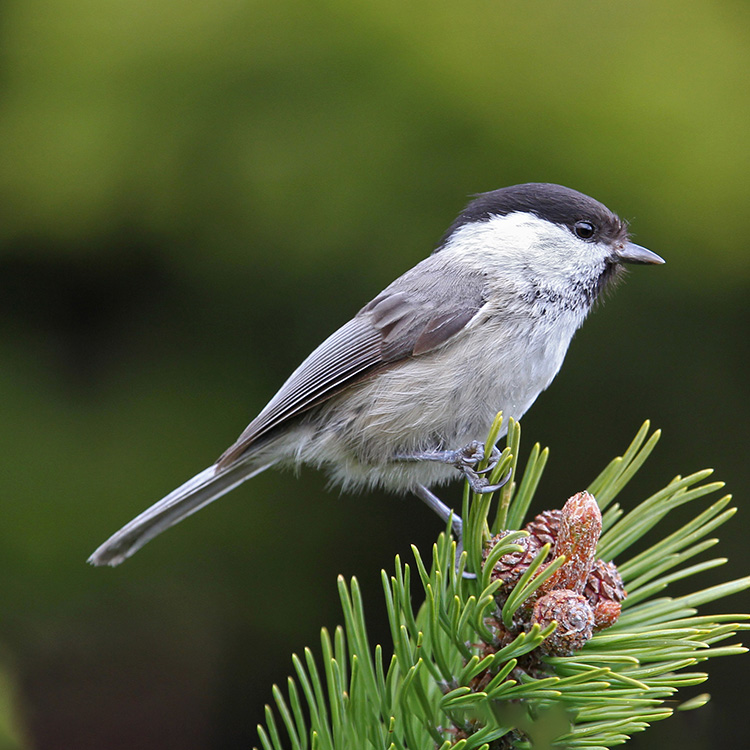
Upperparts are dull grey-brown, underparts are buffish-white, often with a faint buff wash on the flanks. The crown and nape are dull sooty-black, extending to a small, neat black bib under the chin. Cheeks are dull white. Wings and tail are dark grey-brown with paler edges to the flight feathers, but lacking the distinct pale panel seen on Marsh Tits.
- 2
Beak shape
Shape and color of the bill: a key field mark.
Small, conical, and sharp; black in color.
- 3
Eye color
Iris color and any distinctive eye markings.
Dark brown.
- 4
Leg color
Leg and foot color.
Dark grey to blackish.
- 5
Distinguishing features
Standout features that separate this species.
Dull sooty-black cap (not glossy like Marsh Tit), duller plumage overall, and a distinctive pale wing panel (formed by pale edges to secondaries) that is less prominent or absent in Marsh Tit. The bib is typically smaller and neater than that of a Marsh Tit. The most reliable distinction is often by call.
- 6
Juvenile appearance
How young birds differ from adults.
Similar to adults but generally duller, with a less intense black cap and bib, and often a more yellowish wash to the underparts.
- 7
Seasonal changes
Plumage variation between breeding and non-breeding seasons.
No significant seasonal plumage changes. Plumage may appear slightly fresher after the autumn moult and more worn by late spring.
- 8
Sexual dimorphism
How males and females differ.
None; sexes are outwardly identical in plumage and size.
Key field marks
- Cap Color. Look for a dull, sooty-black cap that appears matte, not glossy. This contrasts with the glossy cap of the Marsh Tit.
- Bib Size. Observe the black bib under the chin; it is typically smaller and neater than that of a Marsh Tit.
- Wing Panel. Check for a subtle, pale panel on the folded wing, formed by pale edges to the secondary feathers. This is often absent or much less distinct on the Marsh Tit.
- Vocalizations. Listen carefully to its calls. The harsh, buzzing 'chay-chay-chay' call is the most reliable field mark to distinguish it from the Marsh Tit. Its song is a mournful, descending 'tsee-tsee-tsee'.
- Habitat Preference. Consider the habitat. Willow Tits prefer damper, more open woodlands with decaying wood, while Marsh Tits often favor drier, more mature deciduous forests.
Explore the Willow Tit
Identify birds anywhere
Free on iOS, Android, and Web. Photo & sound identification, full species database, and your personal life list.