
Spotted a bird? Identify it instantly with the Birdby app
Open the appAbout
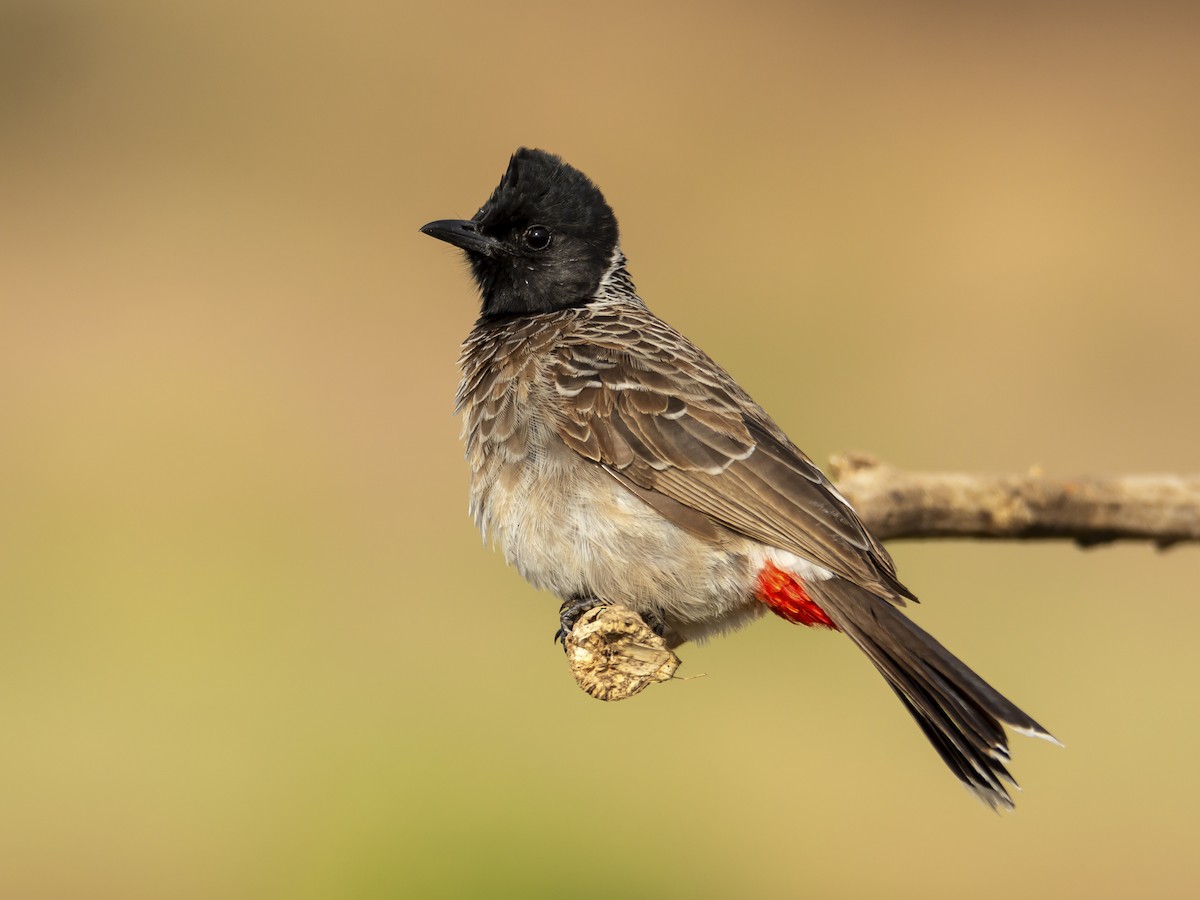
The Red-vented Bulbul is a medium-sized passerine bird characterized by its dark plumage, an erectile crest, and a distinctive crimson-red patch under its tail. It is a highly adaptable and opportunistic species, commonly found in a variety of habitats, from urban gardens to scrublands. Known for its cheerful and varied vocalizations, this bulbul is often seen foraging for fruits, insects, and nectar.
Size & lifespan
- Length
- 19-21 cm (7.5-8.3 in)
- Wingspan
- 25-28 cm (9.8-11 in)
- Weight
- 30-45 g (1.1-1.6 oz)
- Lifespan
- 3-7 years in the wild, up to 11 years in captivity.
- Diet
- Omnivorous, primarily frugivorous and insectivorous. Eats a wide variety of fruits (berries, figs, grapes), nectar, petals, and invertebrates such as spiders, caterpillars, ants, and beetles. It is also known to consume young shoots and buds.
Physical characteristics
- Plumage
- The adult Red-vented Bulbul has a dark brown to blackish head, a pointed black crest, and a dark brown upper body. The underparts are paler, often whitish or greyish-brown, with streaky flanks. The most prominent feature is the bright crimson-red patch of feathers under the tail (vent). The rump is white or pale grey, contrasting with the darker back and tail. The tail is dark brown to blackish with white tips on the outer tail feathers. Sexes are outwardly similar.
- Beak shape
- Slender, slightly decurved bill, dark brown to black.
- Eye color
- Dark brown.
- Leg color
- Dark grey to black.
- Distinguishing features
- Erectile black crest, dark plumage, and the bright crimson-red vent. The white rump is also a key field mark, especially in flight.
- Juvenile appearance
- Juveniles are duller than adults, with a less prominent crest and a paler, duller reddish-orange vent that may sometimes appear orange-yellow. Their plumage is generally browner and less defined.
- Seasonal changes
- No significant seasonal plumage changes. The plumage remains consistent year-round.
- Sexual dimorphism
- Males and females are visually identical in plumage and size.
How to identify
- 1
Crimson-red vent
The most definitive field mark is the bright crimson-red patch of feathers beneath the tail. This is visible from almost any angle when the bird moves.
- 2
Dark crest
Look for the short, spiky, dark crest on its head, which can be raised or lowered depending on its activity and mood.
- 3
White rump
Observe for a distinct white or pale grey rump, which typically contrasts with the darker back and tail, especially noticeable in flight.
- 4
General plumage
Overall dark brown to blackish head and upperparts, with paler, sometimes streaked, underparts. Absence of any prominent white or red facial patches.
- 5
Vocalizations
Listen for its distinctive, cheerful, and often abrupt song, characterized by a series of hurried and varied notes, often sounding conversational or scolding.
- 6
Behavior
Often active and conspicuous, foraging in open areas, gardens, and along roadsides. Its bold and somewhat aggressive demeanor, especially towards other birds, can also be an identifier.
Habitat & range
- Biomes
- Tropical and subtropical dry forests, moist lowland forests, mangroves, savanna, shrubland, grasslands, gardens, rural gardens, urban areas, plantations, cultivated land, coastal areas.
- Geographic range
- Native to the Indian subcontinent and parts of Southeast Asia, including India, Nepal, Bangladesh, Bhutan, Pakistan, Afghanistan, Myanmar, Thailand, and parts of China. Introduced populations are widespread globally, including in Fiji, Hawaii, New Zealand, New Caledonia, Mauritius, Seychelles, Samoa, Tonga, and various parts of the Arabian Peninsula.
- Elevation range
- Sea level up to approximately 2000 meters (6500 feet) in its native range, occasionally higher.
- Preferred environments
- Highly adaptable, prefers open woodlands, scrub, gardens, orchards, agricultural areas, and urban parks. It thrives in human-modified landscapes and is a common sight in towns and cities.
Behavior
- Activity time
- Diurnal, most active during the morning and late afternoon.
- Feeding habits
- Forages actively in trees, shrubs, and on the ground. Primarily feeds on fruits, berries, and nectar, using its bill to pluck items. It also gleans insects from foliage and bark and occasionally catches flying insects. Often seen feeding in small groups.
- Social behavior
- Usually seen in pairs or small family groups, though larger flocks can form around abundant food sources or during roosting. They can be quite bold and gregarious.
- Flight pattern
- Undulating flight pattern, often short and quick between perches. Generally agile in flight, especially when navigating dense vegetation.
- Migration pattern
- Generally resident throughout its native and introduced range, exhibiting only local movements or dispersal rather than long-distance migration.
- Territoriality
- Pairs defend a nesting territory during the breeding season. Can be aggressive towards other birds, especially when defending food sources or nesting sites.
Song & calls
- Song
- A varied and cheerful song, often described as a series of loud, rapid, and bubbly notes, sometimes musical and sometimes grating. Phrases are often repeated. It lacks a clear, structured song but rather a continuous medley of calls.
- Call
- Common calls include a sharp 'pleased to meet you' or 'pretty-du-wit' sound, a harsh 'kish-e-kew', a scolding 'pwik-pwik-pwik', or a rapid, chattering 'whit-it-it'. Also utters alarm calls when disturbed.
- When they vocalize
- Vocalizes year-round, but most frequently and loudly during the breeding season before and during nesting. Calls are often heard in the early morning and late afternoon.
Breeding & reproduction
- Breeding season
- Highly variable depending on geographic location, usually during spring and summer (March to October in many parts of India), often coinciding with the monsoon or post-monsoon periods. Can breed multiple times a year.
- Nesting habits
- Nests are typically cup-shaped, constructed from twigs, rootlets, grasses, leaves, and sometimes lined with softer materials like hair or fine fibers. Nests are usually placed in a fork of a tree or shrub, 2-15 meters off the ground, often well-concealed within dense foliage. Both parents participate in nest building.
- Clutch size
- Usually 2-4 eggs, most commonly 3.
- Egg description
- Eggs are typically oval, pale pinkish-white to reddish-white, heavily streaked and spotted with darker reddish-brown, purplish-brown, or black markings. The markings are often denser at the broad end.
- Incubation period
- 11-14 days, primarily by the female, though the male may assist.
- Fledging period
- 12-14 days after hatching. Young are altricial.
- Parental care
- Both parents share duties in feeding and caring for the chicks. Parents are highly protective of the nest and young.
Where to find
Urban Gardens and Parks
One of the easiest places to find them, as they are very comfortable around human habitation and readily visit feeders or fruit-bearing trees.
Orchards and Agricultural Areas
Abundant food sources make these ideal locations. Look among fruit trees and flowering shrubs.
Open Woodlands and Scrubland
Native habitats where they forage among trees and bushes. Listen for their calls to locate them.
Roadsides and Edges of Forests
Often seen perched on wires, fences, or low branches along roadsides, especially in areas with shrubs and trees.
Introduced Ranges
In areas where they are introduced (e.g., Hawaii, Fiji), they have adapted to similar urban, suburban, and agricultural environments.
Field tips
- Listen for calls. Their noisy and varied vocalizations are often the first sign of their presence. They are quite vocal, especially during the breeding season.
- Look for movement in fruiting trees. They are highly attracted to ripe fruits and berries. Observe any fruit-bearing trees or shrubs; you're likely to spot them foraging.
- Check for foraging in dense bushes. While often in the open, they also spend considerable time gleaning insects and berries from dense undergrowth. Patience may be required.
- Observe near human settlements. They have successfully adapted to human-altered landscapes, so gardens, parks, and even bustling city areas can be prime viewing spots.
Similar species
Red-whiskered Bulbul
Pycnonotus jocosus
The Red-whiskered Bulbul has a prominent red patch behind the eye ('whiskers') and a white belly with fine streaking, distinct from the Red-vented Bulbul's lack of red facial markings and more uniformly pale underparts with a fully red vent.
White-eared Bulbul
Pycnonotus leucotis
The White-eared Bulbul has a distinctive white patch on its cheeks and lacks the prominent red vent, which is present and a key identifier for the Red-vented Bulbul.
Himalayan Bulbul
Pycnonotus leucogenys
Similar in general appearance, but the Himalayan Bulbul has a large white cheek patch, a longer crest, and a prominent yellow vent, contrasting with the Red-vented Bulbul's dark cheeks and crimson-red vent.
Quick facts
- Call Signature:
- Cheerful, varied, 'pretty-du-wit' calls
- Diet Specialty:
- Fruits, nectar, insects
- Habitat Preference:
- Open woodlands, gardens, urban areas
- Introduced Status:
- Widespread invasive species in many parts of the world
- Unique Feature:
- Crimson-red patch under the tail
Fun facts
- The Red-vented Bulbul is considered an invasive species in many parts of the world where it has been introduced, due to its adaptability and potential impact on native ecosystems and agriculture.
- It is intelligent and can learn to adapt quickly to new food sources and environments, contributing to its success as an invasive species.
- In some cultures, its cheerful song is considered a good omen, while in others, its presence is viewed negatively due to agricultural damage.
- The name 'bulbul' is derived from a Persian word meaning 'nightingale', though bulbuls are not closely related to true nightingales.
Scientific classification
- Kingdom
- Animalia
- Phylum
- Chordata
- Class
- Aves
- Order
- Passeriformes
- Family
- Pycnonotidae
- Genus
- Pycnonotus
- Species
- Pycnonotus cafer
Explore the Red-vented Bulbul
Identify birds anywhere
Free on iOS, Android, and Web. Photo & sound identification, full species database, and your personal life list.