
Spotted a bird? Identify it instantly with the Birdby app
Open the appAbout
The Eurasian Bullfinch is a medium-sized passerine bird known for its striking plumage, particularly the male's vibrant rosy-red underparts. It is a shy and often elusive bird, typically found in well-vegetated areas. Its diet primarily consists of buds, seeds, and berries, making it a potential pest in orchards.
Size & lifespan
- Length
- 14.5-16.5 cm
- Wingspan
- 22-29 cm
- Weight
- 21-27 g
- Lifespan
- 2-5 years (up to 8 years recorded in the wild)
- Diet
- Herbivore (primarily granivorous and frugivorous)
Physical characteristics
- Plumage
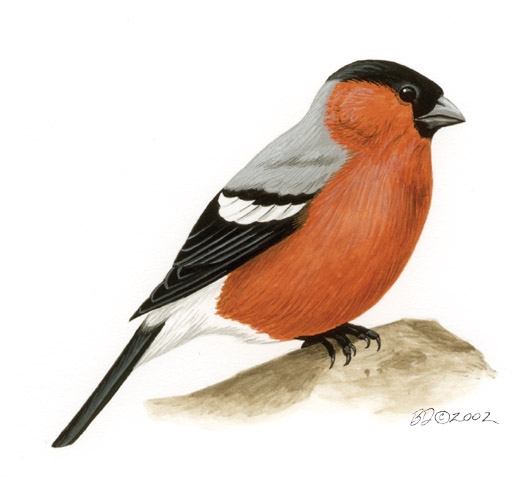
- Adult males have a black cap, grey back, white rump, and black wings with a prominent white wing-bar. Their underparts are a striking rosy-red. Adult females are similar but have duller, pinkish-grey underparts and a browner back. Both sexes have a short, stout, conical black bill and a black tail. Juveniles are duller overall, lacking the black cap, with a brownish head and streaky underparts, and a less defined wing-bar.
- Beak shape
- Short, stout, conical, and black, adapted for crushing seeds and buds.
- Eye color
- Dark brown.
- Leg color
- Dark brown to blackish-brown.
- Distinguishing features
- The combination of a black cap, white rump, and white wing-bar is distinctive. The male's bright red breast is unmistakable. The short, thick bill is also a key feature.
- Juvenile appearance
- Juveniles lack the black cap of adults, having a brownish head. Their plumage is generally duller and more streaky, with less vibrant colors. The white wing-bar is present but often less distinct.
- Seasonal changes
- No significant seasonal plumage changes. Plumage remains consistent throughout the year, though wear and tear can make colors appear slightly duller before molting.
- Sexual dimorphism
- Pronounced. Males have vibrant rosy-red underparts, while females have duller pinkish-grey underparts and a browner back. Both share the black cap, white rump, and white wing-bar.
How to identify
- 1
Size and Shape
A plump, medium-sized finch with a short neck and a distinctive short, stout, conical bill.
- 2
Male Plumage
Look for the unmistakable combination of a black cap, grey back, white rump, black wings with a single prominent white wing-bar, and vibrant rosy-red underparts.
- 3
Female Plumage
Similar to the male but with duller pinkish-grey underparts and a browner back, retaining the black cap, white rump, and white wing-bar.
- 4
Juvenile Plumage
Brownish head (no black cap), duller and streaky body plumage, but still shows a white wing-bar.
- 5
Call
Listen for the soft, plaintive, and often repeated 'peu' or 'dew' whistle, which is highly characteristic and often heard before the bird is seen.
- 6
Behavior
Often shy and elusive, preferring dense cover. May be seen feeding on buds in trees or shrubs, often in pairs or small groups.
Habitat & range
- Biomes
- Temperate forests, mixed woodlands, coniferous forests, orchards, parks, gardens, hedgerows.
- Geographic range
- Widespread across Europe and temperate Asia, from the British Isles and Iberia eastwards to Japan and Kamchatka. Absent from Iceland and parts of southern Europe.
- Elevation range
- Sea level up to 2,000 meters, occasionally higher in mountainous regions.
- Preferred environments
- Dense undergrowth, thickets, young plantations, and areas with abundant berry-bearing shrubs and trees. They prefer areas with good cover and a mix of deciduous and coniferous trees.
Behavior
- Activity time
- Diurnal.
- Feeding habits
- Primarily feeds on buds of various trees (e.g., fruit trees, hawthorn, oak), seeds (especially from ash, birch, nettle, dock), and berries (e.g., hawthorn, elder, rowan). They use their strong bill to snip off buds and extract seeds. They can be quite destructive in orchards during late winter and early spring.
- Social behavior
- Typically seen in pairs or small family groups during the breeding season. In winter, they may form larger, loose flocks, sometimes mixing with other finch species, especially when foraging for food.
- Flight pattern
- Undulating flight, typical of finches, with rapid wing beats followed by a short glide. Often flies low between cover.
- Migration pattern
- Mostly resident or short-distance migrant. Northern populations may move south in winter, and some altitudinal migration occurs. Irruptive movements can happen in years of poor food supply.
- Territoriality
- Males defend a breeding territory during the nesting season, primarily through song and displays. Outside the breeding season, they are less territorial.
Song & calls
- Song
- The song is a soft, melancholic, and often subdued series of piping whistles, sometimes described as a 'flute-like' or 'whispered' song. It's not loud or elaborate, often delivered from dense cover.
- Call
- The most characteristic call is a soft, plaintive, and often repeated 'peu' or 'dew' whistle. It's a distinctive, almost mournful sound that carries well. They also have a short, sharp 'chip' alarm call.
- When they vocalize
- Calls are heard year-round, but the song is most frequently heard during the breeding season (spring and early summer).
Breeding & reproduction
- Breeding season
- April to July, typically raising 1-2 broods.
- Nesting habits
- Nests are usually built in dense bushes, hedges, or small trees, often 1.5-4 meters above the ground. The nest is a neat, cup-shaped structure made of twigs, moss, and lichens, lined with fine roots, hair, and feathers. The female primarily builds the nest.
- Clutch size
- 4-6 eggs.
- Egg description
- 4-6 eggs, pale blue with purplish-brown spots and streaks, particularly at the broader end. Approximately 19 x 14 mm.
- Incubation period
- 12-14 days, primarily by the female.
- Fledging period
- 12-18 days after hatching. Young are fed by both parents.
- Parental care
- Both parents feed the nestlings and fledglings. The male often feeds the female during incubation.
Where to find
Woodlands and Forests
Look in the undergrowth and edges of deciduous, coniferous, and mixed woodlands.
Parks and Gardens
Well-vegetated parks and large gardens with dense shrubs and berry-bearing plants.
Orchards
Can be found in orchards, especially in late winter and early spring when feeding on fruit tree buds.
Hedgerows and Thickets
Dense hedgerows and thickets provide ideal cover and food sources.
Field tips
- Listen for the call. The distinctive 'peu' call is often the first indication of a Bullfinch's presence. They are often heard before they are seen.
- Look for movement in dense cover. Bullfinches are shy and prefer to stay hidden. Scan dense bushes, hedges, and the lower branches of trees for subtle movements.
- Observe feeding behavior. In late winter and early spring, watch for them feeding on buds in fruit trees or other deciduous trees. In autumn and winter, they will be feeding on berries and seeds.
- Be patient and quiet. Their elusive nature requires patience. Remain still and quiet, and they may eventually emerge from cover.
Similar species
Pine Grosbeak
Pinicola enucleator
Larger size, longer tail, and a less contrasting plumage pattern. Males are rosy-red but lack the black cap and white rump of the Bullfinch. Pine Grosbeaks have two white wing-bars, not one prominent one.
Trumpeter Finch
Bucanetes githagineus
Found in arid regions, not typically overlapping in habitat. Smaller, with a pale, conical bill and a more sandy-pinkish plumage. Lacks the black cap and white rump.
Common Rosefinch
Carpodacus erythrinus
Males are brighter crimson-red, but lack the black cap, grey back, and white rump. They have a less stout bill and a more streaky appearance on the flanks. Females are streaky brown and lack the distinct white wing-bar.
Quick facts
- Diet:
- Mainly buds, seeds, and berries
- Habitat:
- Woodlands, gardens, orchards, hedgerows
- Call:
- Soft, plaintive 'peu' whistle
- Male Plumage:
- Rosy-red underparts, black cap, grey back, white rump, white wing-bar
- Female Plumage:
- Pinkish-grey underparts, black cap, browner back, white rump, white wing-bar
Fun facts
- The Bullfinch's scientific name, Pyrrhula pyrrhula, is derived from the Greek word 'pyrrhos' meaning 'flame-colored' or 'reddish', referring to the male's plumage.
- Historically, Bullfinches were sometimes kept as cage birds and taught to mimic tunes, a practice now largely illegal in many regions due to conservation efforts.
- Despite their beauty, Bullfinches can be considered a pest by fruit growers due to their habit of eating fruit tree buds in late winter, which can significantly reduce crop yields.
- There are several recognized subspecies of Eurasian Bullfinch across its vast range, showing variations in size and plumage intensity, particularly in the red coloration of males.
Scientific classification
- Kingdom
- Animalia
- Phylum
- Chordata
- Class
- Aves
- Order
- Passeriformes
- Family
- Fringillidae
- Genus
- Pyrrhula
- Species
- Pyrrhula pyrrhula
Explore the Eurasian Bullfinch
Identify birds anywhere
Free on iOS, Android, and Web. Photo & sound identification, full species database, and your personal life list.