
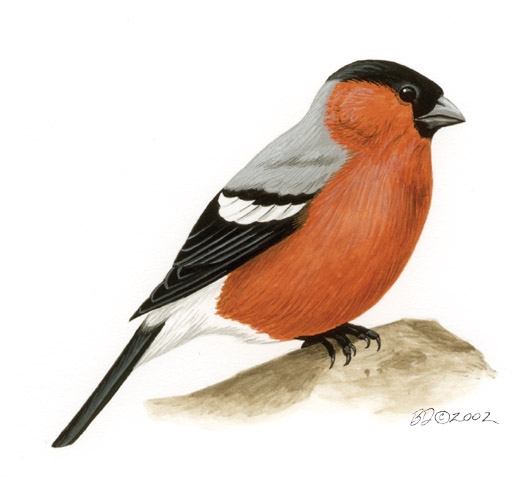
Where does the Eurasian Bullfinch live?
Pyrrhula pyrrhula
Spotted a bird? Identify it instantly with the Birdby app
Open the appThe Eurasian Bullfinch lives in specific habitats and regions. Knowing where, and when, to look improves your chances of a successful sighting.
Biomes
Temperate forests, mixed woodlands, coniferous forests, orchards, parks, gardens, hedgerows.
Geographic range
Widespread across Europe and temperate Asia, from the British Isles and Iberia eastwards to Japan and Kamchatka. Absent from Iceland and parts of southern Europe.
Preferred environments
Dense undergrowth, thickets, young plantations, and areas with abundant berry-bearing shrubs and trees. They prefer areas with good cover and a mix of deciduous and coniferous trees.
Elevation range
Sea level up to 2,000 meters, occasionally higher in mountainous regions.
Where to look
Woodlands and Forests
Look in the undergrowth and edges of deciduous, coniferous, and mixed woodlands.
Parks and Gardens
Well-vegetated parks and large gardens with dense shrubs and berry-bearing plants.
Orchards
Can be found in orchards, especially in late winter and early spring when feeding on fruit tree buds.
Hedgerows and Thickets
Dense hedgerows and thickets provide ideal cover and food sources.
Field tips
- Listen for the call. The distinctive 'peu' call is often the first indication of a Bullfinch's presence. They are often heard before they are seen.
- Look for movement in dense cover. Bullfinches are shy and prefer to stay hidden. Scan dense bushes, hedges, and the lower branches of trees for subtle movements.
- Observe feeding behavior. In late winter and early spring, watch for them feeding on buds in fruit trees or other deciduous trees. In autumn and winter, they will be feeding on berries and seeds.
- Be patient and quiet. Their elusive nature requires patience. Remain still and quiet, and they may eventually emerge from cover.
Migration
Mostly resident or short-distance migrant. Northern populations may move south in winter, and some altitudinal migration occurs. Irruptive movements can happen in years of poor food supply.
Explore the Eurasian Bullfinch
Identify birds anywhere
Free on iOS, Android, and Web. Photo & sound identification, full species database, and your personal life list.