
Spotted a bird? Identify it instantly with the Birdby app
Open the appAbout
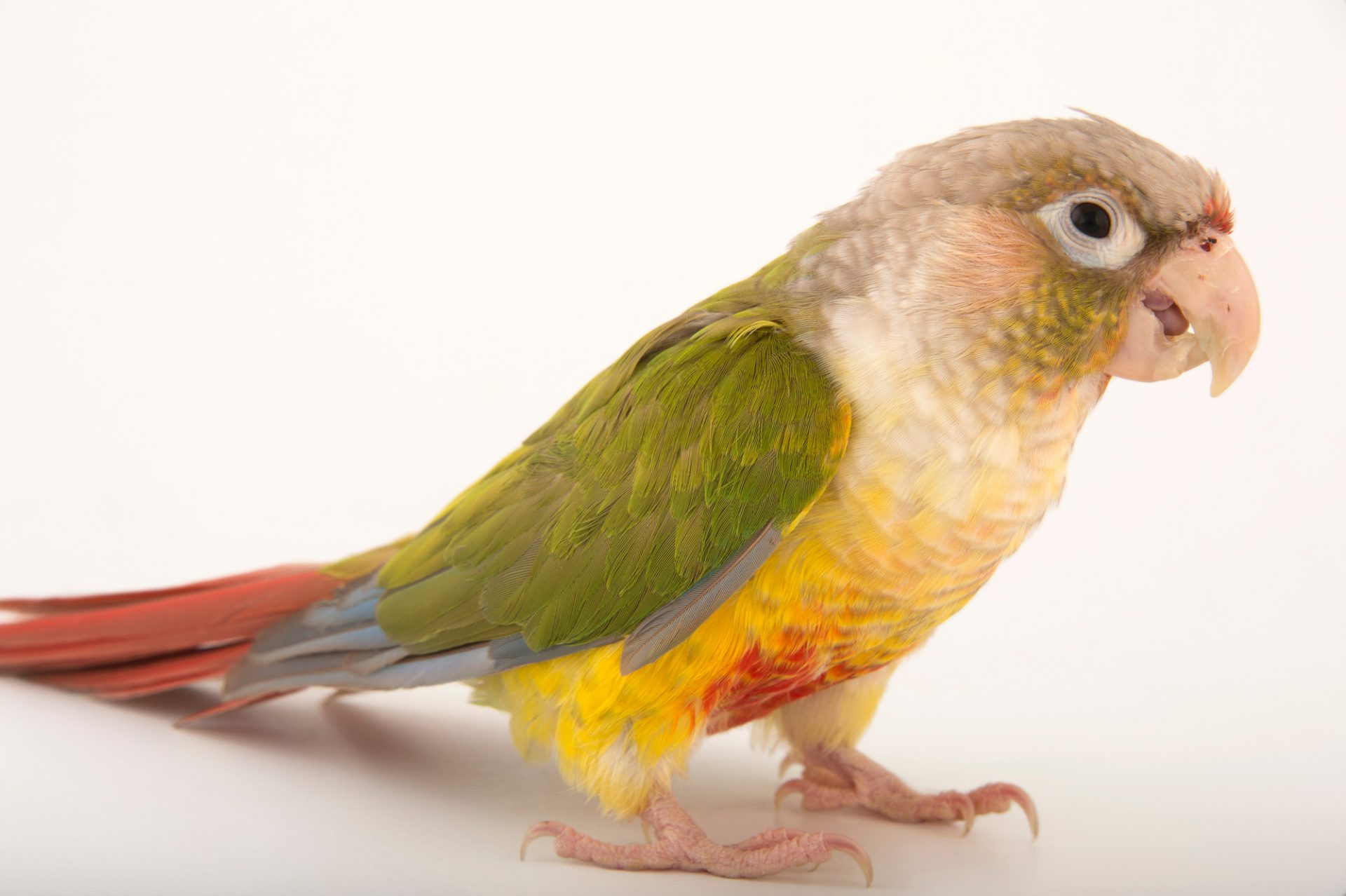
The Green-cheeked Parakeet, also known as the Green-cheeked Conure, is a small parrot native to South America. It is a popular pet bird due to its intelligence, playful nature, and relatively quiet vocalizations compared to some other parrot species. In the wild, they are social birds, typically found in flocks, and are known for their acrobatic flight and ability to blend into their arboreal habitats.
Size & lifespan
- Length
- 24-26 cm (9.4-10.2 in)
- Wingspan
- 30-35 cm (11.8-13.8 in)
- Weight
- 60-80 g (2.1-2.8 oz)
- Lifespan
- 10-15 years in the wild; up to 20-30 years in captivity
- Diet
- Omnivore (primarily herbivorous)
Physical characteristics
- Plumage
- Predominantly green plumage. The crown is brownish-black, transitioning to a dull green on the nape. Cheeks are green, giving the bird its common name. The breast is barred with brown and white, becoming reddish-brown on the belly and lower back. Primary flight feathers are blue, and the tail is maroon, especially visible from below. A distinctive red patch is often present on the bend of the wing (carpal joint), though this can vary in prominence among individuals and subspecies.
- Beak shape
- Small, hooked, and dark grey to black.
- Eye color
- Dark brown with a white periophthalmic ring (bare eye-ring).
- Leg color
- Dark grey.
- Distinguishing features
- Green cheeks, brownish-black crown, barred breast, reddish-brown belly/lower back, blue primary flight feathers, and maroon tail. The white eye-ring is also a good field mark.
- Juvenile appearance
- Juveniles resemble adults but may have duller plumage, particularly less prominent reddish-brown on the belly and a less distinct barred pattern on the breast. Their eye-ring may also be less defined.
- Seasonal changes
- No significant seasonal plumage changes.
- Sexual dimorphism
- None. Males and females are visually identical.
How to identify
- 1
Green Cheeks
Look for the distinct green coloration on the sides of the head, which contrasts with the brownish-black crown.
- 2
Barred Breast
Observe the fine brown and whitish barring pattern on the breast, which transitions to a reddish-brown on the lower belly.
- 3
Maroon Tail
Note the maroon coloration of the tail, especially visible when the bird is in flight or perched with its tail fanned.
- 4
White Eye-ring
A thin, bare white ring around the dark eye is a consistent and helpful field mark.
- 5
Vocalizations
Listen for their characteristic high-pitched, chattering, and squeaky calls, often given in rapid succession.
Habitat & range
- Biomes
- Subtropical or tropical dry forests, subtropical or tropical moist lowland forests, and heavily degraded former forest.
- Geographic range
- Central-southern South America, including southwestern Brazil, northern Argentina, Bolivia, and Paraguay.
- Elevation range
- Typically found from sea level up to 2,900 meters (9,500 feet), but most commonly below 1,500 meters.
- Preferred environments
- Forest edges, secondary growth, gallery forests along rivers, and sometimes agricultural areas with scattered trees. They prefer areas with dense canopy cover for roosting and nesting, but forage in more open areas.
Behavior
- Activity time
- Diurnal, most active during early morning and late afternoon.
- Feeding habits
- Primarily feeds on seeds, fruits, nuts, berries, and flowers. They will also consume insects and their larvae, especially during breeding season to supplement protein intake. They forage in the canopy and mid-story of trees.
- Social behavior
- Highly social birds, typically found in flocks of 10 to 20 individuals, sometimes forming larger aggregations at communal roosts or abundant food sources. They maintain strong pair bonds within the flock.
- Flight pattern
- Fast, direct, and agile flight, often accompanied by rapid wing beats. They are highly acrobatic, especially when navigating dense forest canopies.
- Migration pattern
- Resident throughout their range; they do not undertake long-distance migrations. Local movements may occur in response to food availability.
- Territoriality
- While generally social, breeding pairs may exhibit some territoriality around their nest site during the breeding season.
Song & calls
- Song
- Not known for a distinct 'song' in the traditional sense. Their vocalizations are a series of chattering, squeaky, and sometimes harsh calls.
- Call
- Common calls include high-pitched, rapid 'scree-scree-scree' or 'kree-kree-kree' notes, often given in flight or when alarmed. They also produce softer chattering and twittering sounds when feeding or interacting within the flock. Calls are generally less piercing than many other conure species.
- When they vocalize
- Most vocal during flight, when foraging, and during social interactions within the flock, particularly in the morning and evening.
Breeding & reproduction
- Breeding season
- Varies geographically, but generally between October and March in the southern parts of their range. In Bolivia, it can be from December to May.
- Nesting habits
- Nests are typically made in tree cavities, often old woodpecker holes, or sometimes in rock crevices. They do not add nesting material, relying on the natural substrate of the cavity.
- Clutch size
- 3-7 eggs, typically 4-6.
- Egg description
- White, oval-shaped eggs.
- Incubation period
- Approximately 22-25 days.
- Fledging period
- Chicks fledge (leave the nest) around 6-8 weeks after hatching.
- Parental care
- Both parents participate in incubation and feeding of the young. The male often feeds the female during incubation, and both bring food to the nestlings.
Where to find
Forest Edges
Often found at the interface between dense forest and more open areas, where they can forage and quickly retreat to cover.
Gallery Forests
Look along riverbanks and watercourses where strips of forest provide suitable habitat.
Secondary Growth
Areas of regenerating forest or disturbed woodlands are frequently utilized.
Agricultural Areas
Occasionally seen in cultivated lands with scattered large trees, especially if adjacent to natural forest.
Field tips
- Listen for Calls. Their distinctive chattering calls are often the first indication of their presence, especially when they are in flight or foraging in the canopy.
- Look for Flocks. Green-cheeked Parakeets are social and usually found in small to medium-sized flocks. Scan the canopy for groups of birds moving together.
- Observe Feeding Behavior. Watch for birds actively feeding on fruits, seeds, or flowers in trees. They can be quite acrobatic while foraging.
- Early Morning/Late Afternoon. These are their most active periods for foraging and social interaction, making them easier to spot.
Similar species
Maroon-bellied Parakeet
Pyrrhura frontalis
The Maroon-bellied Parakeet has a more extensive maroon-red patch on its belly, extending further up the breast, and lacks the distinct barred pattern on the breast seen in the Green-cheeked Parakeet. Its crown is typically greener, less brownish-black.
Black-capped Parakeet
Pyrrhura rupicola
The Black-capped Parakeet has a solid black cap and lacks the barred breast. It also has a prominent white patch on the ear coverts, which is absent in the Green-cheeked Parakeet.
Crimson-bellied Parakeet
Pyrrhura perlata
The Crimson-bellied Parakeet has a much more extensive and vibrant crimson-red belly and undertail coverts, and a blue primary coverts patch. Its breast is also scaled rather than barred.
Quick facts
- Common Name:
- Green-cheeked Parakeet
- Scientific Name:
- Pyrrhura molinae
- Family:
- Psittacidae
- Size:
- 24-26 cm
- Weight:
- 60-80 g
- Diet:
- Seeds, fruits, nuts, insects
- Habitat:
- Forests, forest edges, secondary growth
- Conservation Status:
- Least Concern
- Social Behavior:
- Highly social, found in flocks
Fun facts
- Green-cheeked Parakeets are one of the most popular pet parrot species due to their small size, intelligence, and affectionate nature.
- They are known for their playful antics and can be taught to mimic sounds and words, though they are not as proficient as some larger parrot species.
- In the wild, they play an ecological role as seed dispersers, helping to regenerate forest ecosystems.
- Their ability to blend into the forest canopy makes them surprisingly difficult to spot despite their bright green plumage, until they call or move.
Scientific classification
- Kingdom
- Animalia
- Phylum
- Chordata
- Class
- Aves
- Order
- Psittaciformes
- Family
- Psittacidae
- Genus
- Pyrrhura
- Species
- Pyrrhura molinae
Explore the Green-cheeked Parakeet
Identify birds anywhere
Free on iOS, Android, and Web. Photo & sound identification, full species database, and your personal life list.