
Spotted a bird? Identify it instantly with the Birdby app
Open the appAbout
The Great-tailed Grackle is a large, conspicuous passerine bird native to North and Central America. Known for its iridescent black plumage, long tail, and distinctive calls, it has successfully adapted to human-modified landscapes and is often found in urban and suburban areas.
Size & lifespan
- Length
- 33-46 cm (13-18 in)
- Wingspan
- 40-52 cm (16-20.5 in)
- Weight
- 88-265 g (3.1-9.3 oz)
- Lifespan
- Up to 12 years in the wild
- Diet
- Omnivore
Physical characteristics
- Plumage
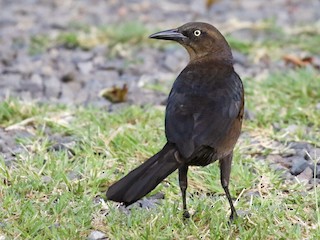
- Adult males are entirely iridescent black, appearing purple-blue to green in strong light. Adult females are smaller, duller, and typically dark brown on the upperparts with lighter brown underparts, sometimes with a darker cap and streaking on the throat. Juveniles resemble females but are often paler and more streaky.
- Beak shape
- Long, stout, conical, and sharply pointed; black in color.
- Eye color
- Bright yellow (adults), dark brown (juveniles)
- Leg color
- Black
- Distinguishing features
- Males possess an exceptionally long, keel-shaped tail, often longer than their body. Females have a noticeably shorter tail. Both sexes have striking yellow eyes.
- Juvenile appearance
- Juveniles are similar to adult females but are generally paler brown, often with more noticeable streaking on the breast and throat. Their eyes are dark brown, gradually changing to yellow as they mature.
- Seasonal changes
- No significant seasonal plumage changes. Plumage remains consistent year-round, though wear and tear can make iridescence appear less vibrant over time.
- Sexual dimorphism
- Pronounced sexual dimorphism. Males are significantly larger (up to 50% heavier) and have a much longer, iridescent black tail and body. Females are smaller, duller brown, and have a shorter, less prominent tail.
How to identify
- 1
Size and Shape
Look for a large, slender black bird with a very long tail, especially in males. The tail is often held in a distinctive V-shape during flight.
- 2
Plumage Color
Males are iridescent black, appearing purple, blue, or green in good light. Females are dark brown with a paler breast and a shorter tail.
- 3
Eye Color
Adults have striking bright yellow eyes, a key field mark.
- 4
Vocalizations
Listen for their distinctive, often harsh and varied calls, including raspy notes, whistles, and gurgles. They are very noisy birds.
- 5
Behavior
Observe their confident, often bold behavior, foraging on the ground, and their tendency to gather in large, noisy flocks, especially at roosts.
Habitat & range
- Biomes
- Grasslands, shrublands, wetlands, urban, suburban, agricultural areas
- Geographic range
- Southwestern United States (from California, Nevada, Utah, Arizona, New Mexico, Texas, Oklahoma, Kansas, Missouri, Arkansas, Louisiana, Mississippi, Alabama, Florida, Georgia, South Carolina, North Carolina, Virginia, Maryland, Delaware, New Jersey, Pennsylvania, New York, Ohio, Indiana, Illinois, Iowa, Nebraska, South Dakota, North Dakota, Montana, Wyoming, Colorado) through Mexico and Central America to northern South America (Colombia, Venezuela, Ecuador, Peru).
- Elevation range
- Sea level up to 2,500 meters (8,200 feet), occasionally higher.
- Preferred environments
- Highly adaptable, preferring open or semi-open habitats with scattered trees, shrubs, and access to water. Commonly found in parks, golf courses, agricultural fields, suburban neighborhoods, shopping centers, and city centers.
Behavior
- Activity time
- Diurnal
- Feeding habits
- Highly opportunistic omnivores. Forage on the ground, in trees, and in shallow water. Diet includes insects (grasshoppers, beetles, grubs), spiders, small vertebrates (lizards, frogs, nestlings, eggs), fruits, seeds, grains, and human refuse. They often 'dip' food in water before eating, a behavior known as 'dunking'.
- Social behavior
- Highly social, especially outside the breeding season, forming large communal roosts that can number in the thousands. During breeding, they often nest in loose colonies. They can be aggressive towards other birds, especially around food sources.
- Flight pattern
- Strong, direct flight with steady wingbeats. The long tail of the male is often held in a V-shape during flight, especially when displaying.
- Migration pattern
- Primarily resident throughout much of its range, particularly in the southern parts. Northern populations may undertake short-distance migrations, moving south for the winter, but many are expanding their year-round range northward.
- Territoriality
- Males defend small territories around nesting sites during the breeding season. Outside of breeding, they are less territorial, often foraging in groups.
Song & calls
- Song
- A complex repertoire of harsh, raspy calls, whistles, clicks, and gurgles. Males often perform a 'song-spread' display, puffing up feathers and fanning their tail while vocalizing. Their 'song' is not melodious but a series of varied, often grating, sounds.
- Call
- Common calls include a sharp 'check' or 'chack', a harsh 'kssshhh', and various squeaks and whistles. They are known for their noisy communal roosts, where a cacophony of calls can be heard.
- When they vocalize
- Most vocal during the breeding season (spring and early summer) and at communal roosts, particularly at dawn and dusk. They can be heard year-round, especially in urban environments.
Breeding & reproduction
- Breeding season
- Typically March to July, varying by latitude. Can have multiple broods per year.
- Nesting habits
- Nests are typically bulky, cup-shaped structures made of twigs, grasses, mud, and sometimes artificial materials. They are usually placed in trees or tall shrubs, often near water, and frequently in loose colonies.
- Clutch size
- 3-5 eggs
- Egg description
- 3-5 eggs, pale blue to greenish-blue, heavily marked with dark brown, black, or purple spots, streaks, and blotches, particularly at the larger end.
- Incubation period
- 13-14 days
- Fledging period
- 12-17 days after hatching
- Parental care
- Primarily the female incubates the eggs and broods the young. Both parents feed the nestlings, though the female does the majority of the work. Males may guard the nest and help feed fledglings.
Where to find
Urban and Suburban Areas
Parks, shopping centers, parking lots, residential areas, and city centers with scattered trees and open ground.
Agricultural Lands
Crop fields, pastures, and areas around farm buildings.
Wetlands and Riparian Zones
Edges of ponds, lakes, rivers, and marshes, especially where there are reeds or trees for roosting.
Field tips
- Listen for their calls. Great-tailed Grackles are very vocal and often announce their presence with their distinctive, varied calls. Listen for their noisy chatter, especially in groups.
- Look in open areas. They prefer open or semi-open habitats. Scan lawns, fields, and paved areas where they often forage for food.
- Observe communal roosts. At dawn and dusk, look for large numbers of grackles gathering in trees or on power lines, particularly in urban settings. These roosts can be massive and very noisy.
- Check for 'dunking' behavior. If near water, watch for them dipping food items into the water before consuming them, a characteristic feeding behavior.
Similar species
Boat-tailed Grackle
Quiscalus major
The Great-tailed Grackle's range overlaps with the Boat-tailed Grackle primarily along the Gulf Coast and southeastern US. Great-tailed Grackles generally have brighter yellow eyes (Boat-tailed can have dark eyes in some populations), and males have a more pronounced 'keel-shaped' tail in flight, whereas the Boat-tailed's tail is more uniformly broad. Female Great-tailed Grackles are typically dark brown with a paler throat/breast, while female Boat-tailed Grackles are more uniformly brown and often larger than female Great-taileds.
Common Grackle
Quiscalus quiscula
Common Grackles are generally smaller with a shorter tail, especially noticeable in males. Their iridescence is typically more purple-bronze on the body and green on the head, compared to the Great-tailed's more uniform purple-blue to green. Common Grackles have a less robust bill and often a less prominent yellow eye. Their calls are also distinct, with Common Grackles having a more 'rusty gate' sound.
Brewer's Blackbird
Euphagus cyanocephalus
Brewer's Blackbirds are significantly smaller than Great-tailed Grackles and have a much shorter tail. Males are glossy black with purple iridescence on the head and green on the body, and bright yellow eyes. Females are duller gray-brown with dark eyes. The overall body shape and tail length are the primary distinguishing features.
Quick facts
- Tail Length (Male):
- Can be as long as the body
- Eye Color:
- Bright yellow (adults)
- Diet:
- Highly opportunistic omnivore
- Sociality:
- Highly social, forms large roosts
- Habitat Adaptability:
- Thrives in human-modified landscapes
Fun facts
- The Great-tailed Grackle has significantly expanded its range northward over the last century, largely due to its adaptability to human-altered environments and agricultural expansion.
- Males perform an elaborate 'song-spread' display, puffing up their body feathers and fanning their long tail while vocalizing to attract mates.
- They are known for their intelligence and problem-solving abilities, including using tools and observing human behavior to find food.
- Despite their commonality, their complex vocalizations are a subject of scientific study, revealing a wide array of sounds used for communication.
Scientific classification
- Kingdom
- Animalia
- Phylum
- Chordata
- Class
- Aves
- Order
- Passeriformes
- Family
- Icteridae
- Genus
- Quiscalus
- Species
- Quiscalus mexicanus
Explore the Great-tailed Grackle
Identify birds anywhere
Free on iOS, Android, and Web. Photo & sound identification, full species database, and your personal life list.