
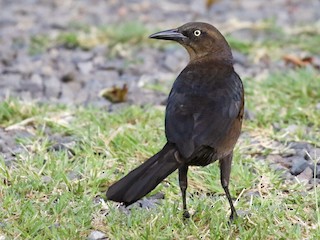
Where does the Great-tailed Grackle live?
Quiscalus mexicanus
Spotted a bird? Identify it instantly with the Birdby app
Open the appThe Great-tailed Grackle lives in specific habitats and regions. Knowing where, and when, to look improves your chances of a successful sighting.
Biomes
Grasslands, shrublands, wetlands, urban, suburban, agricultural areas
Geographic range
Southwestern United States (from California, Nevada, Utah, Arizona, New Mexico, Texas, Oklahoma, Kansas, Missouri, Arkansas, Louisiana, Mississippi, Alabama, Florida, Georgia, South Carolina, North Carolina, Virginia, Maryland, Delaware, New Jersey, Pennsylvania, New York, Ohio, Indiana, Illinois, Iowa, Nebraska, South Dakota, North Dakota, Montana, Wyoming, Colorado) through Mexico and Central America to northern South America (Colombia, Venezuela, Ecuador, Peru).
Preferred environments
Highly adaptable, preferring open or semi-open habitats with scattered trees, shrubs, and access to water. Commonly found in parks, golf courses, agricultural fields, suburban neighborhoods, shopping centers, and city centers.
Elevation range
Sea level up to 2,500 meters (8,200 feet), occasionally higher.
Where to look
Urban and Suburban Areas
Parks, shopping centers, parking lots, residential areas, and city centers with scattered trees and open ground.
Agricultural Lands
Crop fields, pastures, and areas around farm buildings.
Wetlands and Riparian Zones
Edges of ponds, lakes, rivers, and marshes, especially where there are reeds or trees for roosting.
Field tips
- Listen for their calls. Great-tailed Grackles are very vocal and often announce their presence with their distinctive, varied calls. Listen for their noisy chatter, especially in groups.
- Look in open areas. They prefer open or semi-open habitats. Scan lawns, fields, and paved areas where they often forage for food.
- Observe communal roosts. At dawn and dusk, look for large numbers of grackles gathering in trees or on power lines, particularly in urban settings. These roosts can be massive and very noisy.
- Check for 'dunking' behavior. If near water, watch for them dipping food items into the water before consuming them, a characteristic feeding behavior.
Migration
Primarily resident throughout much of its range, particularly in the southern parts. Northern populations may undertake short-distance migrations, moving south for the winter, but many are expanding their year-round range northward.
Explore the Great-tailed Grackle
Identify birds anywhere
Free on iOS, Android, and Web. Photo & sound identification, full species database, and your personal life list.