
Spotted a bird? Identify it instantly with the Birdby app
Open the appAbout
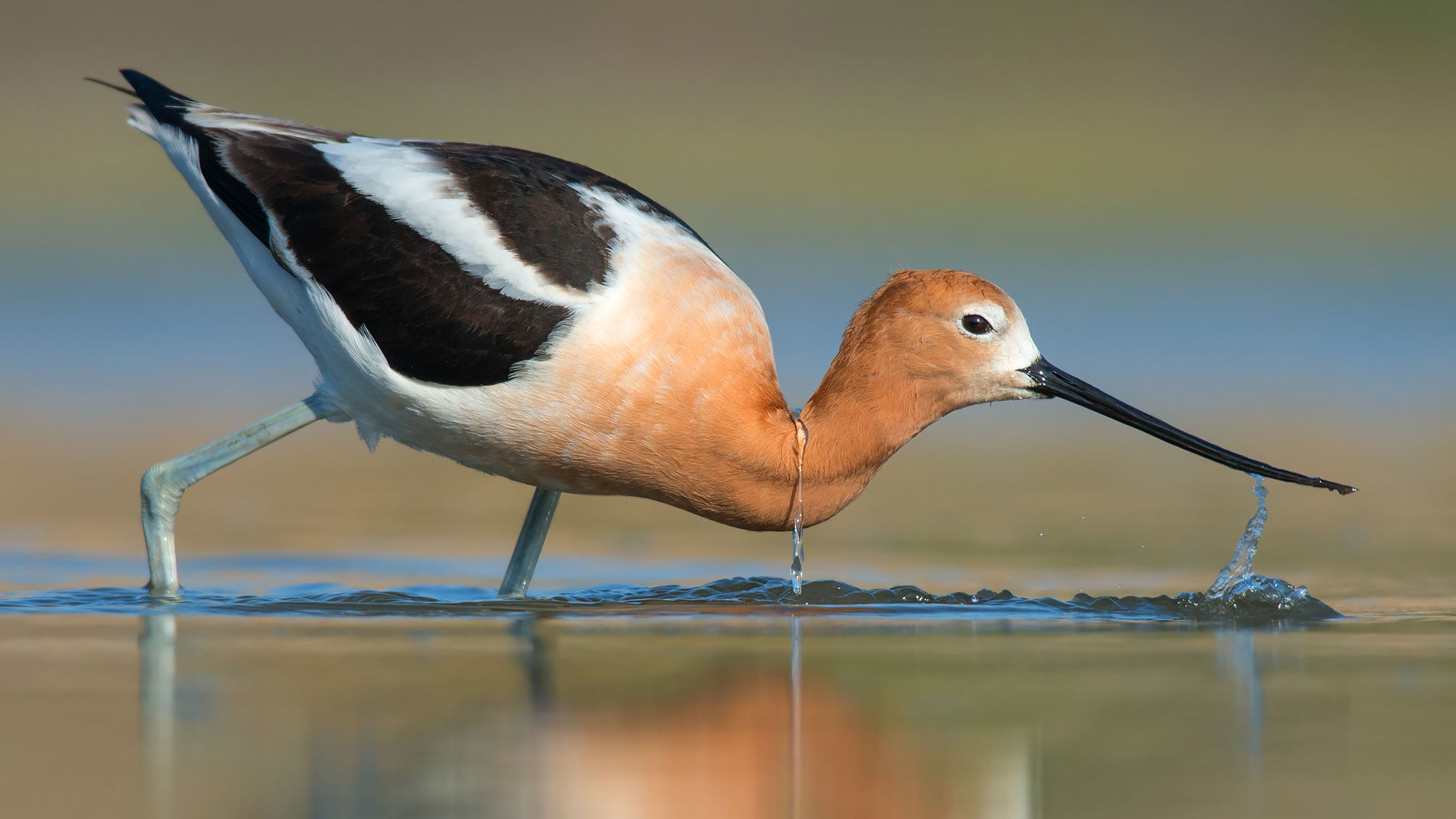
The American Avocet is a striking, long-legged shorebird known for its distinctive upturned bill, which it uses to sweep through shallow water in search of food. Its elegant black and white plumage, complemented by a rusty head and neck during breeding season, makes it easily recognizable. These birds are highly social, often foraging and nesting in groups, and are strong migrants, traveling long distances between breeding and wintering grounds.
Size & lifespan
- Length
- 40-51 cm (16-20 in)
- Wingspan
- 68-76 cm (27-30 in)
- Weight
- 275-370 g (9.7-13.1 oz)
- Lifespan
- Up to 15 years in the wild
- Diet
- Carnivore (primarily aquatic invertebrates)
Physical characteristics
- Plumage
- Adult breeding plumage features a striking pattern of black and white. The back and wings are largely black, contrasting sharply with a white belly and flanks. The head, neck, and upper breast are a rich cinnamon-rufous color. A prominent white stripe runs along the inner wing (secondary coverts) and is visible in flight. Non-breeding adults have a gray head and neck, replacing the rufous. Juveniles resemble non-breeding adults but often have a duller, more brownish-gray head and neck, and some brownish mottling on the back.
- Beak shape
- Long, slender, and distinctly upturned (recurved) bill, black in color.
- Eye color
- Dark brown.
- Leg color
- Long, slender, bluish-gray legs and feet.
- Distinguishing features
- The most distinctive feature is the long, thin, upturned black bill. Other key features include long bluish-gray legs, and a bold black-and-white body pattern, especially noticeable in flight with the white wing stripe.
- Juvenile appearance
- Juveniles resemble non-breeding adults but have a duller, more brownish-gray head and neck. Their back feathers may have buffy or brownish fringes, giving a slightly mottled appearance. The bill is also upturned, similar to adults.
- Seasonal changes
- Breeding adults display a cinnamon-rufous head, neck, and upper breast. Non-breeding adults (and first-winter birds) have a pale gray head and neck, replacing the rufous coloration. The black and white body pattern remains consistent year-round.
- Sexual dimorphism
- Males and females are generally similar in plumage. Females tend to have a slightly more pronounced upturn to their bill and may have a slightly duller rufous coloration on the head and neck during breeding season, but these differences are subtle and not reliable for field identification.
How to identify
- 1
Bill Shape
Look for the long, slender, distinctly upturned black bill. This is the most defining characteristic.
- 2
Legs
Observe the long, thin, bluish-gray legs, which trail behind the body in flight.
- 3
Plumage (Breeding)
Note the striking black and white body with a rich cinnamon-rufous head, neck, and upper breast. A prominent white stripe on the inner wing is visible in flight.
- 4
Plumage (Non-breeding)
In non-breeding plumage, the head and neck are pale gray, replacing the rufous, while the black and white body pattern remains.
- 5
Behavior
Watch for its characteristic feeding behavior: sweeping its bill from side to side through shallow water.
- 6
Vocalization
Listen for its clear, sharp 'wheet' or 'pleet' calls, especially when disturbed or in flight.
Habitat & range
- Biomes
- Wetlands, grasslands, deserts, coastal areas.
- Geographic range
- Breeds across western and central North America, from southern Canada south through the western United States. Winters along the Pacific and Atlantic coasts of the United States, and south into Mexico and Central America.
- Elevation range
- Primarily found in low-lying areas, from sea level up to approximately 2,000 meters (6,500 feet) in some interior basins.
- Preferred environments
- Shallow, brackish or saline wetlands, alkaline lakes, mudflats, salt ponds, flooded fields, and estuaries. They prefer open areas with sparse vegetation for foraging and nesting.
Behavior
- Activity time
- Diurnal, primarily active during daylight hours for foraging and other activities.
- Feeding habits
- Primarily feeds by sweeping its upturned bill from side to side through shallow water, often with its head submerged, to detect and capture small aquatic invertebrates (crustaceans, insect larvae, worms). They also pick prey from the surface of the water or mud. Occasionally, they will dabble like ducks or probe in soft mud.
- Social behavior
- Highly social birds, often found in flocks, especially during migration and winter. They breed in loose colonies and forage in groups. They are known for their aggressive defense of nests and young, often performing distraction displays.
- Flight pattern
- Strong, direct flight with rapid wingbeats. In flight, the long legs trail behind the body, and the bold black-and-white wing pattern (especially the white secondary stripe) is very conspicuous.
- Migration pattern
- Long-distance migrant. Most populations breed in the interior West and Great Plains of North America and migrate to coastal areas of the southern U.S. and Mexico for winter. Some populations along the Pacific coast may be resident or undertake shorter migrations.
- Territoriality
- While they nest in colonies, individual pairs defend a small territory around their nest. They are known to be quite aggressive towards intruders, including other birds and potential predators, often performing elaborate distraction displays.
Song & calls
- Song
- American Avocets do not have a complex song. Their vocalizations are primarily calls.
- Call
- The most common call is a sharp, clear, often repeated 'wheet' or 'pleet', sometimes given in a series. When alarmed or defending territory, they may give a more insistent, rapid 'kleet-kleet-kleet' or 'kweek-kweek-kweek' call. They also produce a soft 'whoop' call during courtship.
- When they vocalize
- Most vocal during the breeding season, especially when establishing territories, during courtship, and when defending nests or young. They also call during migration and when disturbed in wintering areas.
Breeding & reproduction
- Breeding season
- Typically April to July, varying with latitude and local conditions.
- Nesting habits
- Nests are usually shallow scrapes on the ground, often lined with pebbles, grass, or other debris. They are typically located on small islands, dikes, or elevated areas near water, often in loose colonies. Both parents participate in nest construction.
- Clutch size
- Usually 3-4 eggs, occasionally 2 or 5.
- Egg description
- Typically 3-4 eggs, olive-buff to brownish-olive, heavily spotted and blotched with dark brown or black. The eggs are pyriform (pear-shaped).
- Incubation period
- 22-25 days, shared by both parents.
- Fledging period
- Young are precocial and leave the nest shortly after hatching (within 24 hours). They are able to feed themselves but are guarded by both parents for approximately 4-5 weeks until they can fly.
- Parental care
- Both male and female share incubation duties and care for the young. Parents are highly protective and will aggressively defend their chicks from predators, often performing elaborate broken-wing displays or mobbing intruders.
Where to find
Shallow Wetlands
Look in shallow, open water bodies, especially those with brackish or saline conditions, such as salt ponds, alkaline lakes, and estuaries.
Mudflats and Flooded Fields
They often forage on exposed mudflats or in temporarily flooded agricultural fields.
Coastal Lagoons
During migration and winter, they can be found in coastal lagoons and sheltered bays along the Pacific and Atlantic coasts.
Interior Basins
In the western U.S., they are common breeders in the Great Basin and other interior wetland complexes.
Field tips
- Scan Open Water. Avocets prefer open, shallow water. Use binoculars or a scope to scan large expanses of water and mudflats.
- Observe Feeding Behavior. Their unique sweeping feeding motion is a strong identification clue. Look for birds with their heads partially submerged, moving their bills side to side.
- Look for Flocks. They are often found in groups, so if you see one, there are likely more nearby. Their black and white plumage makes them stand out against water or mud.
- Listen for Calls. Their distinctive 'wheet' calls can often alert you to their presence before you see them.
- Check Seasonal Presence. Be aware of their migratory patterns. They are most widespread in their breeding grounds during spring and summer, and in wintering grounds during fall and winter.
Similar species
Black-necked Stilt
Himantopus mexicanus
The Black-necked Stilt has extremely long, thin, bright pink legs and a straight, needle-like black bill. Its plumage is also black and white, but the black extends further down the back and neck, and it lacks the rufous head/neck of breeding avocets or the gray head/neck of non-breeding avocets. The bill shape is the most obvious distinction.
Pied Avocet
Recurvirostra avosetta
The Pied Avocet (found in Eurasia and Africa) is very similar in shape and bill structure. However, its plumage lacks the rufous or gray head/neck of the American Avocet. Instead, it has a white head and neck with a distinctive black cap and two black stripes running from the cap down the back of the neck and along the wings. The American Avocet has a solid black back and wings (except for the white secondary stripe).
Quick facts
- Distinctive Feature:
- Upturned bill
- Feeding Method:
- Bill-sweeping
- Sociality:
- Highly colonial and gregarious
- Migration:
- Long-distance migrant
- Conservation Status:
- Least Concern
Fun facts
- The American Avocet's upturned bill is perfectly adapted for its unique feeding strategy of sweeping through shallow water to catch small invertebrates.
- They are known for their elaborate and aggressive distraction displays, such as the 'broken-wing act,' to lure predators away from their nests and young.
- Avocets can swim, and young chicks are capable swimmers shortly after hatching.
- The species name 'americana' refers to its distribution in the Americas, distinguishing it from other avocet species found elsewhere in the world.
- During courtship, males and females engage in a 'bill-crossing' display, where they stand side-by-side and cross their bills over each other's backs.
Scientific classification
- Kingdom
- Animalia
- Phylum
- Chordata
- Class
- Aves
- Order
- Charadriiformes
- Family
- Recurvirostridae
- Genus
- Recurvirostra
- Species
- Recurvirostra americana
Explore the American Avocet
Identify birds anywhere
Free on iOS, Android, and Web. Photo & sound identification, full species database, and your personal life list.