
Spotted a bird? Identify it instantly with the Birdby app
Open the appAbout
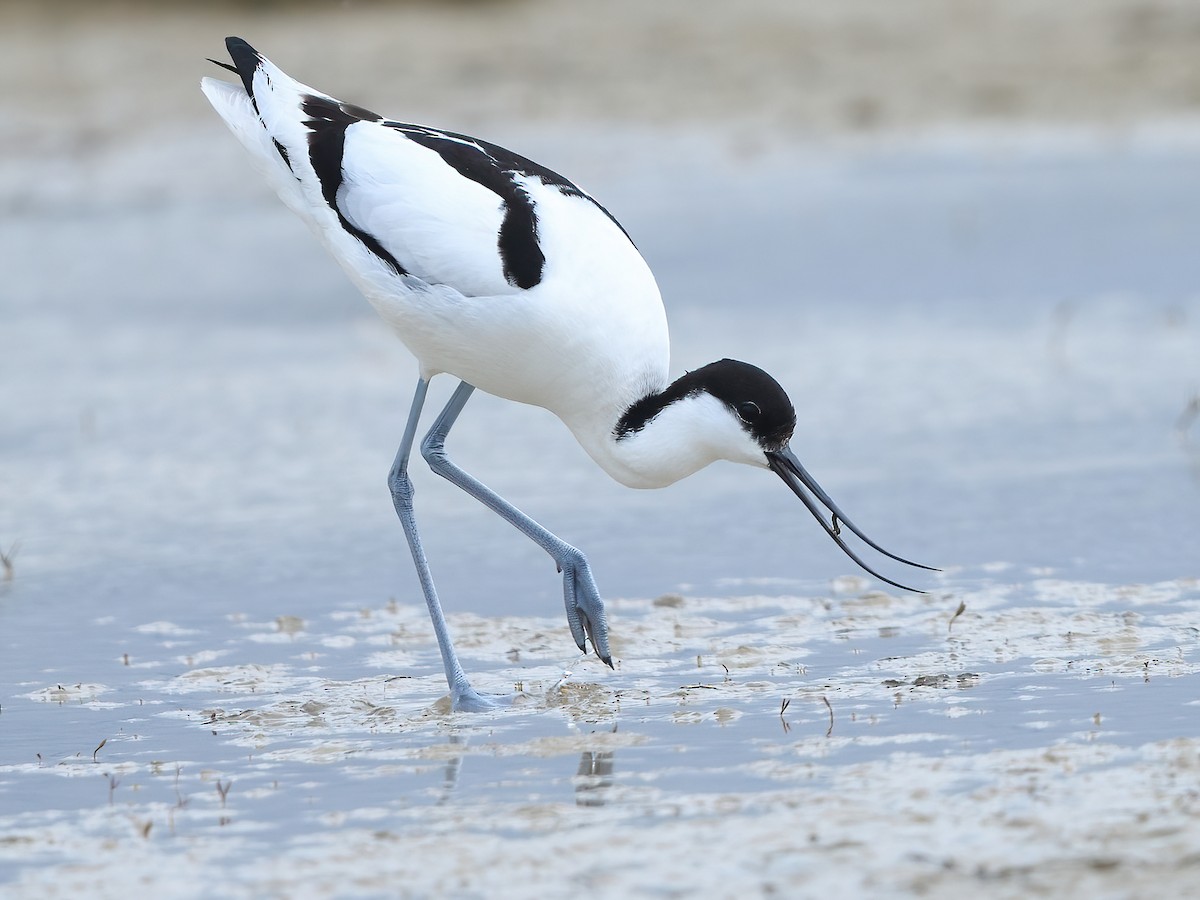
The Pied Avocet is a striking, medium-sized wading bird characterized by its elegant black and white plumage and a distinctive, strongly upcurved bill. It is a highly social species, often found in flocks, and is renowned for its unique feeding technique of sweeping its bill through shallow water.
Size & lifespan
- Length
- 42-45 cm (16.5-17.7 in)
- Wingspan
- 67-77 cm (26.4-30.3 in)
- Weight
- 225-400 g (7.9-14.1 oz)
- Lifespan
- Up to 20 years in the wild, typically 8-10 years.
- Diet
- Carnivore (primarily aquatic invertebrates)
Physical characteristics
- Plumage
- Adults have a pristine white body with bold black markings. These include a black cap extending from the bill to the nape, two broad black stripes on the back, and black primary and secondary flight feathers. The underparts are pure white.
- Beak shape
- Long, slender, and distinctly upcurved, black in color. This unique shape is adapted for its specialized feeding method.
- Eye color
- Dark brown, almost black.
- Leg color
- Long, slender, bluish-grey legs and feet.
- Distinguishing features
- The combination of its pied black and white plumage, long bluish-grey legs, and especially its unique upcurved bill makes it unmistakable. In flight, the long legs trail behind the tail, and the black and white wing pattern is prominent.
- Juvenile appearance
- Juveniles resemble adults but have a duller, browner tinge to the black markings, particularly on the head and back. The black areas may appear more greyish-brown, and the white plumage might be less pristine.
- Seasonal changes
- There are no significant seasonal plumage changes in adults. Breeding and non-breeding plumages are essentially identical.
- Sexual dimorphism
- Males and females are generally monomorphic in plumage, though females may appear slightly smaller and have a slightly less pronounced bill curvature. These differences are subtle and not reliable for field identification.
How to identify
- 1
Plumage
Look for the striking black and white pattern: pure white body, black cap, and two prominent black stripes on the back. Black primary and secondary flight feathers are visible in flight.
- 2
Bill Shape
The long, slender, and distinctly upcurved black bill is the most unique and defining feature, used in its characteristic sweeping feeding motion.
- 3
Legs
Observe the long, slender, bluish-grey legs, which extend well beyond the tail in flight.
- 4
Behavior
Watch for its distinctive feeding behavior: wading in shallow water and sweeping its bill from side to side. Often seen in flocks.
- 5
Call
Listen for its clear, repeated 'kluit' or 'klooit' call, especially when disturbed or in flight.
Habitat & range
- Biomes
- Wetlands, coastal areas, estuaries, saltmarshes, lagoons, shallow lakes, and saline or brackish pools.
- Geographic range
- Widespread across temperate Europe and Asia, and parts of Africa. Breeding occurs primarily in Europe and Central Asia, with wintering grounds extending to Africa, the Middle East, and South Asia.
- Elevation range
- Typically found at sea level up to low elevations, rarely above 500 meters.
- Preferred environments
- Shallow, open water bodies with muddy or sandy substrates, often with sparse vegetation. They favor areas with fluctuating water levels that expose rich feeding grounds.
Behavior
- Activity time
- Diurnal, though they may feed at night during high tides or in areas with nocturnal invertebrate activity.
- Feeding habits
- Feeds by wading in shallow water, sweeping its upcurved bill from side to side through the water or mud surface. It detects small aquatic invertebrates (crustaceans, insects, worms) and small fish by touch. It can also dabble and pick items from the surface.
- Social behavior
- Highly gregarious, often forming large flocks, especially outside the breeding season. Breeds in loose colonies. They are known to be quite vocal and can be aggressive in defending their nests.
- Flight pattern
- Strong, direct flight with rapid wingbeats. In flight, the long legs extend beyond the tail, and the black and white wing pattern is conspicuous. Often flies in V-formations or lines when migrating.
- Migration pattern
- Partially migratory. Northern and eastern populations are migratory, moving south to warmer climates for winter. Southern and western populations may be resident or undertake shorter movements. Migrates in flocks.
- Territoriality
- During the breeding season, pairs defend a small territory around their nest, often within a larger colony. They can be quite vocal and aggressive towards intruders, including other birds and potential predators.
Song & calls
- Song
- The Pied Avocet does not have a complex song. Its vocalizations are primarily calls.
- Call
- A distinctive, clear, far-carrying 'kluit' or 'klooit' call, often repeated rapidly, especially when alarmed or in flight. Also produces a softer 'plew-plew' or 'kleep' sound. Calls are often given in chorus by flocks.
- When they vocalize
- Most vocal during the breeding season and when disturbed. Calls are frequently heard in flight and from feeding or roosting flocks.
Breeding & reproduction
- Breeding season
- Typically April to July in Europe, varying with geographic location.
- Nesting habits
- Nests in shallow scrapes on open ground, often on small islands, spits, or raised areas near water. Nests are usually lined with a small amount of vegetation, pebbles, or shell fragments. They often nest in loose colonies.
- Clutch size
- Typically 3-4 eggs.
- Egg description
- Usually 3-4 eggs, pear-shaped, olive-buff to greenish-brown, heavily blotched and spotted with dark brown or black. The cryptic coloration helps them blend into the substrate.
- Incubation period
- 23-25 days, incubated by both parents.
- Fledging period
- Chicks are precocial and leave the nest shortly after hatching. They are able to feed themselves but are guarded by parents. They become fully independent and capable of flight at around 35-42 days.
- Parental care
- Both parents share incubation duties and care for the young. Chicks are precocial and feed themselves, but parents lead them to feeding grounds and protect them from predators.
Where to find
Coastal Lagoons and Estuaries
These brackish water bodies provide ideal shallow feeding grounds and nesting sites.
Saltmarshes and Saline Lakes
Often found in inland saline wetlands, particularly during migration and breeding.
Mudflats
Exposed mudflats at low tide are prime feeding areas for avocets.
Shallow Freshwater Pools
Can also be found in shallow freshwater habitats, especially those with muddy edges.
Field tips
- Scan shallow water bodies. Focus your binoculars or scope on the edges of shallow lakes, lagoons, and estuaries where they wade and feed.
- Look for characteristic feeding. Their unique side-to-side bill-sweeping motion is a strong indicator of their presence.
- Listen for calls. Their distinctive 'kluit' call can often be heard before the birds are seen, especially in flocks.
- Visit during migration. Spring and autumn migrations can bring large numbers of avocets to suitable stopover sites.
- Check nature reserves. Many wetland nature reserves and bird sanctuaries actively manage habitats for avocets and other waders.
Similar species
American Avocet
Recurvirostra americana
The American Avocet has a similar body shape and upcurved bill, but its breeding plumage includes rusty-orange coloration on the head, neck, and breast, which the Pied Avocet lacks. Non-breeding American Avocets are grey where Pied Avocets are black on the head and back.
Red-necked Avocet
Recurvirostra novaehollandiae
Found in Australia, this species has a distinctive chestnut-red head and neck, clearly differentiating it from the Pied Avocet's black and white head.
Andean Avocet
Recurvirostra andina
Found in the Andes, this species has a black head and neck, but its back and wings are entirely black, lacking the white body and distinct black stripes of the Pied Avocet.
Quick facts
- Distinctive Feature:
- Upcurved bill
- Plumage:
- Black and white
- Feeding Method:
- Bill-sweeping
- Sociality:
- Highly gregarious
- Conservation Status:
- Least Concern
Fun facts
- The Pied Avocet is the emblem of the Royal Society for the Protection of Birds (RSPB) in the UK, symbolizing its successful return to Britain after near extinction in the mid-20th century.
- Their unique bill shape allows them to feed on tiny invertebrates that other waders might miss, reducing competition for food.
- Avocet chicks are precocial, meaning they are born relatively mature and can walk and feed themselves shortly after hatching, though parents still provide protection.
- They often engage in 'false brooding' displays to distract predators from their nests, pretending to incubate eggs in an empty scrape.
- The scientific name 'Recurvirostra' literally means 'bent-back bill', referring to its distinctive upcurved beak.
Scientific classification
- Kingdom
- Animalia
- Phylum
- Chordata
- Class
- Aves
- Order
- Charadriiformes
- Family
- Recurvirostridae
- Genus
- Recurvirostra
- Species
- Recurvirostra avosetta
Explore the Pied Avocet
Identify birds anywhere
Free on iOS, Android, and Web. Photo & sound identification, full species database, and your personal life list.