
Spotted a bird? Identify it instantly with the Birdby app
Open the appAbout
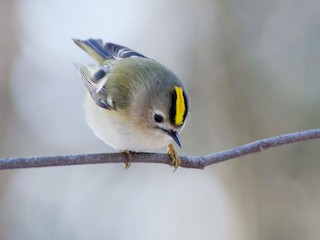
The Goldcrest is Europe's smallest bird, a tiny, restless passerine known for its distinctive golden-orange or yellow crown stripe. It is an insectivorous bird, constantly flitting through foliage in search of small invertebrates. Despite its diminutive size, it is remarkably hardy and widespread across much of Eurasia.
Size & lifespan
- Length
- 8.5-9.5 cm
- Wingspan
- 13-16 cm
- Weight
- 4-7 g
- Lifespan
- 2-3 years (up to 5 years recorded)
- Diet
- Insectivore
Physical characteristics
- Plumage
- Overall dull olive-green upperparts, paler greyish-white underparts. The most striking feature is the crown: males have a bright orange stripe bordered by black, while females have a yellow stripe bordered by black. Both sexes have a small white supercilium (eyebrow stripe) and a dark eye. The wings have two faint white wing-bars.
- Beak shape
- Tiny, needle-like, dark grey to black bill, perfectly adapted for picking small insects from crevices.
- Eye color
- Dark brown.
- Leg color
- Dark grey to blackish-brown.
- Distinguishing features
- Its extremely small size, olive-green plumage, and the distinctive black-bordered golden-orange (male) or yellow (female) crown stripe are key. The white supercilium is also a good field mark.
- Juvenile appearance
- Juveniles are similar to adults but lack the distinctive colored crown stripe, which is replaced by a duller, uniform olive-green crown. They may also have slightly duller plumage overall.
- Seasonal changes
- No significant seasonal plumage changes. The plumage remains consistent throughout the year.
- Sexual dimorphism
- Present in the crown stripe color: males have a brighter orange crown, while females have a yellow crown. Otherwise, plumages are very similar.
How to identify
- 1
Size
Look for Europe's smallest bird, barely larger than a thumb. Its tiny size is often the first clue.
- 2
Crown Stripe
Observe the top of the head. Males have a bright orange crown bordered by black, females a yellow crown bordered by black. This is the most definitive field mark.
- 3
Plumage Color
Note the dull olive-green upperparts and pale greyish-white underparts. Look for two faint white wing-bars.
- 4
Facial Markings
A small, indistinct white supercilium (eyebrow stripe) and a dark eye are present, but less prominent than in a Firecrest.
- 5
Behavior
Watch its constant, restless movement, flitting and hovering among conifer needles. It rarely stays still for long.
- 6
Vocalization
Listen for its extremely high-pitched 'see-see-see' call or its thin, rising 'sisi-sisi-sisi-sissisui' song. Often easier to hear than to see.
Habitat & range
- Biomes
- Temperate forests, boreal forests, mixed woodlands, parks, and gardens.
- Geographic range
- Widespread across much of Europe and temperate Asia, from the British Isles and Scandinavia east to Japan, and south to the Mediterranean and Himalayas. Absent from Iceland and parts of southern Europe.
- Elevation range
- Sea level up to 2,000 meters, occasionally higher in mountainous regions.
- Preferred environments
- Coniferous woodlands are preferred, especially spruce, fir, and pine forests, due to the abundance of insects and sheltered nesting sites. Also found in mixed woodlands, parks, and large gardens with mature trees.
Behavior
- Activity time
- Diurnal.
- Feeding habits
- Highly active and acrobatic, constantly flitting and hovering among branches and needles to glean small insects, spiders, and their eggs/larvae. Often hangs upside down to access prey. Will occasionally take small seeds, especially in winter.
- Social behavior
- Generally solitary or in pairs during the breeding season. Outside of breeding, they often join mixed-species flocks, particularly with tits (Paridae), to forage, especially in winter.
- Flight pattern
- Weak, fluttering, and undulating flight over short distances. Rarely flies high or for extended periods, preferring to move between trees with short, jerky bursts.
- Migration pattern
- Partially migratory. Northern and eastern populations are migratory, moving south and west for the winter. Western and southern populations are largely resident. Migrants can undertake significant sea crossings.
- Territoriality
- Males establish and defend small breeding territories with song. During winter, territoriality is reduced, especially when foraging in mixed flocks.
Song & calls
- Song
- A high-pitched, thin, and rather weak series of 'sree-sree-sree' notes, often accelerating and rising in pitch towards the end, sometimes ending with a short trill. It's often described as 'sisi-sisi-sisi-sissisui'.
- Call
- A very high-pitched, thin 'see-see-see' or 'tsee-tsee-tsee' call, often given repeatedly. Can be difficult to hear for some people due to its high frequency.
- When they vocalize
- Most vocal during the breeding season (spring and early summer). Calls can be heard year-round, especially when foraging or in contact with other birds.
Breeding & reproduction
- Breeding season
- April to July, often raising two broods.
- Nesting habits
- Builds a small, deep, cup-shaped nest, often suspended from the drooping branches of conifers, typically spruce. The nest is intricately woven from moss, lichen, spider silk, and fine twigs, lined with feathers and hair. It's often well-camouflaged and difficult to spot.
- Clutch size
- 6-12 eggs, with 7-11 being most common.
- Egg description
- 6-12 (typically 7-11) tiny, smooth, glossy eggs. They are whitish or pale buff, sometimes with fine reddish-brown speckles, particularly at the broader end.
- Incubation period
- 14-17 days, primarily by the female.
- Fledging period
- 17-22 days after hatching. Both parents feed the young.
- Parental care
- Both parents participate in feeding the nestlings. The female incubates, while the male brings food to her and later to the chicks. They are highly attentive parents.
Where to find
Coniferous Forests
Especially spruce, fir, and pine forests are prime habitats. Look in the dense canopy and lower branches.
Mixed Woodlands
Areas with a good mix of conifers and broadleaf trees can also host Goldcrests.
Parks and Gardens
Large parks and gardens with mature conifers, particularly during winter when they may be more visible.
Field tips
- Listen for calls. Their high-pitched calls are often the first indication of their presence. Train your ear to pick out these subtle sounds.
- Look up. They spend most of their time high in the canopy, so scan the upper branches of conifers carefully.
- Be patient and still. Their constant movement makes them hard to track. Find a good spot near conifers and wait for them to move into view.
- Check mixed flocks. In winter, they often join flocks of tits. If you find a tit flock, look closely for the tiny Goldcrest among them.
- Use binoculars. Essential for observing their small size and subtle markings, especially the crown stripe.
Similar species
Firecrest
Regulus ignicapilla
The Firecrest is slightly larger and has a more striking facial pattern: a prominent white supercilium, a black eye-stripe, and a bronze-orange patch on the sides of the neck. Its crown stripe is also brighter orange (male) or yellow (female) but is bordered by a more distinct black stripe. The Firecrest also has a bronze patch on its shoulders, which the Goldcrest lacks. Its call is typically a slightly lower-pitched 'zit-zit-zit' compared to the Goldcrest's 'see-see-see'.
Pallas's Warbler
Phylloscopus proregulus
While also small and yellowish-green, Pallas's Warbler has a much more prominent yellow supercilium, a dark eye-stripe, and a distinct yellow rump patch. It also has two strong yellow wing-bars and a yellow median crown stripe, but this is not bordered by black like the Goldcrest's. Its overall shape is more warbler-like, and its calls are different.
Quick facts
- Smallest European Bird:
- Yes
- Crown Color (Male):
- Orange with black borders
- Crown Color (Female):
- Yellow with black borders
- Primary Diet:
- Insects and spiders
- Preferred Habitat:
- Coniferous forests
- Migration Status:
- Partially migratory
Fun facts
- The Goldcrest is named for the 'golden crown' on its head, which in folklore was sometimes associated with royalty or a tiny king.
- Despite its tiny size, it can survive harsh winters, often by shivering to generate heat and foraging almost continuously.
- Goldcrests are known to undertake impressive migratory journeys across the North Sea, a remarkable feat for such a small bird.
- Their nests are among the most intricate and elastic of all bird nests, often stretching to accommodate the growing brood.
- A Goldcrest can eat its own body weight in insects every day to fuel its high metabolism.
Scientific classification
- Kingdom
- Animalia
- Phylum
- Chordata
- Class
- Aves
- Order
- Passeriformes
- Family
- Regulidae
- Genus
- Regulus
- Species
- Regulus regulus
Explore the Goldcrest
Identify birds anywhere
Free on iOS, Android, and Web. Photo & sound identification, full species database, and your personal life list.