
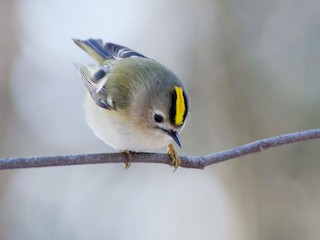
Where does the Goldcrest live?
Regulus regulus
Spotted a bird? Identify it instantly with the Birdby app
Open the appThe Goldcrest lives in specific habitats and regions. Knowing where, and when, to look improves your chances of a successful sighting.
Biomes
Temperate forests, boreal forests, mixed woodlands, parks, and gardens.
Geographic range
Widespread across much of Europe and temperate Asia, from the British Isles and Scandinavia east to Japan, and south to the Mediterranean and Himalayas. Absent from Iceland and parts of southern Europe.
Preferred environments
Coniferous woodlands are preferred, especially spruce, fir, and pine forests, due to the abundance of insects and sheltered nesting sites. Also found in mixed woodlands, parks, and large gardens with mature trees.
Elevation range
Sea level up to 2,000 meters, occasionally higher in mountainous regions.
Where to look
Coniferous Forests
Especially spruce, fir, and pine forests are prime habitats. Look in the dense canopy and lower branches.
Mixed Woodlands
Areas with a good mix of conifers and broadleaf trees can also host Goldcrests.
Parks and Gardens
Large parks and gardens with mature conifers, particularly during winter when they may be more visible.
Field tips
- Listen for calls. Their high-pitched calls are often the first indication of their presence. Train your ear to pick out these subtle sounds.
- Look up. They spend most of their time high in the canopy, so scan the upper branches of conifers carefully.
- Be patient and still. Their constant movement makes them hard to track. Find a good spot near conifers and wait for them to move into view.
- Check mixed flocks. In winter, they often join flocks of tits. If you find a tit flock, look closely for the tiny Goldcrest among them.
- Use binoculars. Essential for observing their small size and subtle markings, especially the crown stripe.
Migration
Partially migratory. Northern and eastern populations are migratory, moving south and west for the winter. Western and southern populations are largely resident. Migrants can undertake significant sea crossings.
Explore the Goldcrest
Identify birds anywhere
Free on iOS, Android, and Web. Photo & sound identification, full species database, and your personal life list.