
Spotted a bird? Identify it instantly with the Birdby app
Open the appAbout
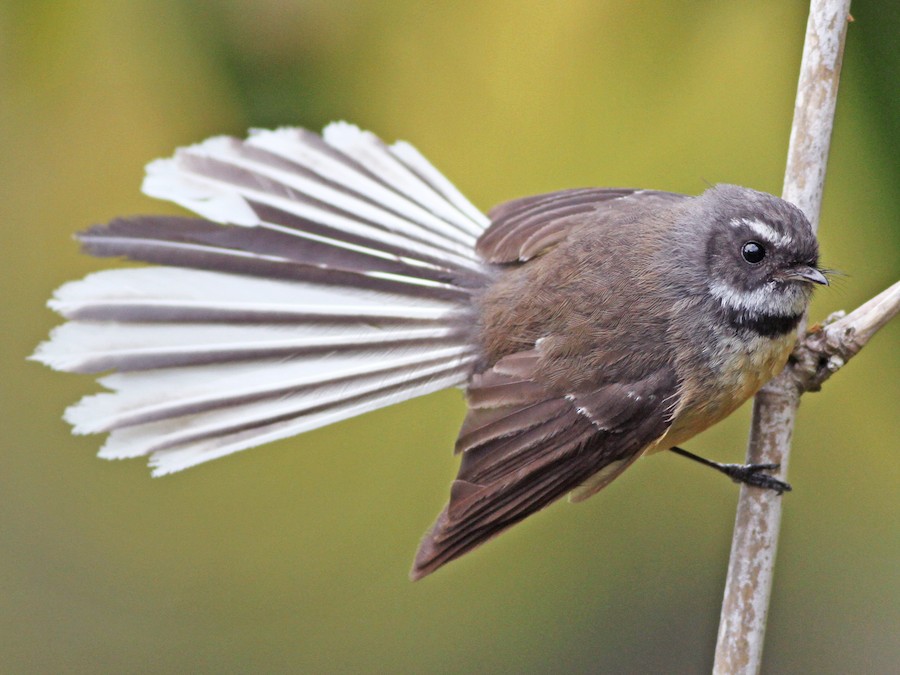
The Grey Fantail is a small, highly active, and acrobatic insectivorous bird known for its distinctive fanned tail and undulating flight. It is a common and widespread species across Australia, New Zealand, and surrounding islands.
Size & lifespan
- Length
- 14.5-17.5 cm (including tail)
- Wingspan
- 19-23 cm
- Weight
- 6-10 g
- Lifespan
- 3-5 years in the wild, up to 10 years recorded in captivity
- Diet
- Strictly insectivorous, feeding on small flying insects such as flies, moths, beetles, and mosquitos.
Physical characteristics
- Plumage
- Adults have sooty grey upperparts, a whitish throat, and a short white supercilium (eyebrow stripe). The underparts are rufous-brown, fading to buffy-white on the belly. The tail is long and dark grey with white outer edges, often fanned open. Some subspecies may have a more rufous chest band or darker plumage overall.
- Beak shape
- Small, fine, and black, adapted for catching insects in flight.
- Eye color
- Dark brown.
- Leg color
- Dark grey to black.
- Distinguishing features
- Constantly fanning and wagging its tail side-to-side and up-and-down, making it appear larger than it is. Agile and acrobatic flight.
- Juvenile appearance
- Juveniles are similar to adults but often have a duller, more washed-out plumage, sometimes with a less defined white throat and supercilium. They may also have some rufous or buffy tones on the wing coverts.
- Seasonal changes
- No significant seasonal plumage changes. Subspecies variation exists across its range.
- Sexual dimorphism
- Males and females are generally indistinguishable in plumage.
How to identify
- 1
Tail Action
Constantly fanning and wagging its tail side-to-side and up-and-down. This is its most characteristic and unmistakable field mark.
- 2
Flight Style
Highly erratic, acrobatic, and undulating flight as it chases insects, almost never perching still for long.
- 3
Plumage
Sooty grey upperparts, distinctive white throat, short white supercilium, and rufous-buff underparts (often appearing rusty brown). Dark tail with white outer edges.
- 4
Voice
High-pitched, chattering, and squeaky song, often likened to a 'machine gun' trill.
Habitat & range
- Biomes
- Forests, woodlands, scrublands, open country with scattered trees, parks, and gardens.
- Geographic range
- Australia (widespread), New Zealand (widespread), New Caledonia, Vanuatu, Solomon Islands, Lord Howe Island, Norfolk Island, and New Guinea.
- Elevation range
- Sea level up to 1,500 meters, occasionally higher in some parts of its range.
- Preferred environments
- Prefers areas with dense undergrowth, open woodlands, and forest edges where it can actively pursue insects. Commonly found in gardens and urban parks with sufficient tree cover.
Behavior
- Activity time
- Diurnal, most active during the cooler parts of the day, particularly early morning and late afternoon.
- Feeding habits
- Aerial hawker, catching insects in flight with remarkable agility. It flits rapidly from perch to perch, constantly fanning its tail and making sudden turns and dives to pursue prey. Occasionally gleans insects from foliage.
- Social behavior
- Usually solitary or in pairs, but can join mixed-species foraging flocks, especially during non-breeding seasons.
- Flight pattern
- Highly erratic, undulating, and acrobatic, characterized by rapid wing beats, frequent directional changes, and extensive tail fanning. Almost never still.
- Migration pattern
- Largely resident in many areas, but some populations, particularly in southern Australia and New Zealand, undertake altitudinal or local migration, moving to lower elevations or warmer coastal areas during winter.
- Territoriality
- Territorial during the breeding season, defending nesting sites and foraging areas. Will actively chase away other birds, sometimes much larger, from its perceived territory.
Song & calls
- Song
- A distinctive, musical, high-pitched, chattering or squeaky song, often described as a 'cheet cheet chweet chwee-chwee' or 'machine-gun' trill. Varies geographically.
- Call
- Sharp 'chitzik' or 'chip' calls, often given when agitated or interacting with other birds.
- When they vocalize
- Most vocal during the breeding season, but can be heard year-round, especially when foraging actively.
Breeding & reproduction
- Breeding season
- August to January in Australia and New Zealand, varying slightly with local conditions. Can raise multiple broods per season.
- Nesting habits
- Builds a distinctive, tiny, cup-shaped nest, often with a 'tail' or 'stem' at the base, giving it a wine-glass appearance. Made of fine grass, rootlets, and spiderweb, typically placed on a thin, horizontal branch, usually 1-5 meters above the ground.
- Clutch size
- 2-4 eggs.
- Egg description
- 2-4 eggs, white to off-white, speckled with grey or brown spots, particularly at the larger end.
- Incubation period
- 14-16 days.
- Fledging period
- 14-17 days after hatching.
- Parental care
- Both parents incubate the eggs and feed the young. Fledglings are fed extensively by parents for several weeks after leaving the nest.
Where to find
Woodlands
Search in natural woodlands, particularly those with an open understory and shrubbery. Often found along forest edges.
Gardens and Parks
Check urban and suburban gardens, parks, and tree-lined streets, especially those with mature trees and native vegetation. They are quite tolerant of human presence.
Riparian Zones
Look along watercourses, rivers, and streams where insect activity is typically high.
Bushland Reserves
Fantails are common inhabitants of many protected bushland and nature reserves across their range.
Field tips
- Listen for its call. Its distinctive chattering song is often the first indication of its presence, even before you see the bird.
- Look for movement. Fantails are rarely still. Scan the mid-story and understory for constant, rapid movement – a flitting, fanning tail is a dead giveaway.
- Observe foraging behavior. Watch for small birds making quick, darting flights to catch insects in the air. Their acrobatic aerial displays are a key identifier.
- Be patient and still. While active, they can also be quite habituated to people. If you remain still, they may approach quite closely as they forage.
Similar species
Rufous Fantail
Rhipidura rufifrons
The Rufous Fantail has richer rufous underparts, particularly on the breast, a prominent rufous rump, and a darker throat with a small white spot (not a broad white throat). It also has a more prominent white forehead. The Grey Fantail is overall greyer with a white throat and rufous-buff belly.
Willie Wagtail
Rhipidura leucophrys
The Willie Wagtail is larger and entirely black and white, lacking any grey or rufous. It has a prominent white supercilium and a black breast band. Its tail wagging is side-to-side and up-and-down, but its overall structure and plumage are distinctly different.
Black-faced Fantail
Rhipidura tenebrosa
Found only in the Solomon Islands. It is much darker, almost entirely sooty brown to black, with less prominent white on the tail and no white throat or supercilium. Its habitat is typically dense forest.
Quick facts
- Flight Style:
- Erratic and acrobatic
- Tail Movement:
- Constantly fanning and wagging
- Diet:
- Small flying insects
- Voice:
- High-pitched chattering trill
- Nest Type:
- Cup-shaped with a 'stem'
Fun facts
- The Grey Fantail is sometimes called the 'Mad Fan' due to its incredibly erratic and energetic flight and tail fanning.
- It often follows large mammals, including humans, to catch insects disturbed by their movement.
- Its unique 'wine-glass' or 'stemmed cup' nest is a marvel of avian architecture, often incorporating spider silk for strength and elasticity.
- Despite its small size, it is quite fearless, often confronting much larger birds or perceived threats.
Scientific classification
- Kingdom
- Animalia
- Phylum
- Chordata
- Class
- Aves
- Order
- Passeriformes
- Family
- Rhipiduridae
- Genus
- Rhipidura
- Species
- fuliginosa
Explore the Grey Fantail
Identify birds anywhere
Free on iOS, Android, and Web. Photo & sound identification, full species database, and your personal life list.